
Curfew in Azzun, new building in Nabi Iliyas and a big new road being built
The occupation routine – curfew in Azzun, new building at Nabi Iliyas
We begin at the barrier, the soldiers arrive late, at 13:30 (they are supposed to arrive at 13:15). Today everybody is registered on the computer and all the certificates are checked for those entering Habla as well as for those leaving it.
A driver in a car arrives and is not allowed to pass, he has no authorization. There is a debate and phone calls and he waits on the side. It turns out that he has arrived in order to repair a water pump, this is his expertise. At the DCO he was told that he has an authorization to pass, but at the barrier they have not heard about it. After many phone calls and a long wait of half an hour, the longed-for authorization arrives and he passes. Many cars pass, mainly from Habla, on the way to the plant nurseries, carrying plants. Again the cars are stopped and there is a debate, a long queue is formed but at least one polite soldier goes to the cars entering Habla and lets them pass. The car which has been stopped and not allowed to pass unloads work utensils and loads them on another car, while it itself stands to the side. Again telephone conversations and checks, according to the driver he has an authorization to pass – but at the barrier they don’t know about it. In the meantime a woman carrying a heavy cardboard box on her head is stopped in order to check the box. A soldier helps her to transfer the box to the other side – I am full of admiration.
The soldiers decide to close the barrier and our friend is still waiting at the center of the barrier with his car. After many phone calls he is released and allowed to enter the plant nurseries. The gate begins to be closed, a bit before its time, but other persons arrive and the soldiers again open it and let the people pass. At 14:15 all is closed and we drive first through Nabi Iliyas. Shops are open and there is activity but further on, at the ascent there suddenly is an enormous wall and on the side of the road there is a signboard: Welcome to upper Nabi Iliyas – see photo.

So we entered, there is a new well paved road and a number of new and well kept houses, plots planted with fruit trees as well as cucumbers, pumpkins and other vegetables. The plots are meticulously fenced in. It seems to be a new neighborhood for well-off residents. It turned out that this was probably the B area, where it is allowed to build.
We continued to Azzun to see whether there is a curfew there, and indeed in the streets of Azzun all is closed except for the tire repairman’s shop and food shops. The curfew there is strictly kept.
'Azzun
See all reports for this place-
Azoun (updated February 2019)
A Palestinian town situated in Area B (under civil Palestinian control and Israeli security control),
on road 5 between Nablus and Qalqiliya, east of Nabi Elias village. The inhabitants are allowed to construct and improve infrastructures. The Separation Fence has confiscated lands belonging to the town's people. In 2018 olive tree groves owned by one of its inhabitants were confiscated for the sake of paving a road to bypass Nabi Elias. Azoun population numbers 13,000, its economic state dire. Its infrastructures are poor, neglect and poverty rampant. In the meantime, the town council has completed paving an internal road for the inhabitants' welfare.
Because of its proximity to the Jewish settler-colony of Karnei Shomron and its outposts, the town suffers the intense presence of the Israeli army, especially at nighttime: soldiers enter homes, arrest suspects, trash the house and sometimes ruin it, as they do in numerous places in the West Bank. At times a checkpoint closes the entrance to the town, so no one can come in or get out.
-
A-Nabi Elias
See all reports for this place-
A-Nabi Elias this is a Palestinian village in the northern West Bank, east of Qalqilia on Road 55, north-east of Alfei Menashe colony and west of Karnei Shomron colony and the Palestinian city of Nablus. As of 2016, the village was populated by 1,458 inhabitants.
Near the village is a maqam (holy site memorializing a sanctified person) - the prophet Elisha. Until 2021 Road 55 crossed the village. Then a bypass road was paved through olive groves that were sequestered from the villagers. Consequently, the farmers were left with small olive groves that they could not access nor cultivate. Inhabitants protested against the road for weeks, supported by peace activists, but nothing helped and the road is now a given fact.
The village's main street had been a shopping center for all residents, including colonists. We even saw a Kashrut (kosher food) inspector in a butcher shop close to the falafel stand… The bypass road, according to tradesmen, has impacted their businesses and clients, while others claim that there are customers now for parking has become easier.
Alfei Menashe and Tzofim colonies nibble at the village lands from the north and south and get closer to it all the time. Colonists of Alfei Menashe have outdone themselves, sending their surplus sewage from the oxygenation pools toward a-Nabi Elias land, even reaching the houses.
The villagers are known as seekers of peace. For years there was no hostility towards Israelis. On the contrary, we were always welcomed warmly and stopped there to enjoy their delicious, inexpensive falafel.
-
Habla CP (1393)
See all reports for this place-
Habla CP (1393)
The Habla checkpoint (1393) was established on the lands of the residents of Qalqilya, on the short road that
connected it for centuries to the nearby town of Habla. The separation barrier intersects this road twice and cut off the residents of Qalqilya from their lands in the seam zone.(between the fence and the green line).
There is a passage under Road 55 that connects Qalqilya to the sabotage This agricultural barrier is used by the farmers and nursery owners established along Road 55 from the Green Line and on both sides of the kurkar road leading to the checkpoint.
This agricultural checkpoint serves the residents of Arab a-Ramadin al-Janoubi (detached from the West Bank), who pass through it to the West Bank and back to their homes. The opening hours (3 times a day) of this agricultural checkpoint are longer than usual, about an hour (recently shortened to 45 minutes), and are coordinated with the transportation hours of a-Ramadin children studying in the occupied in the West Bank.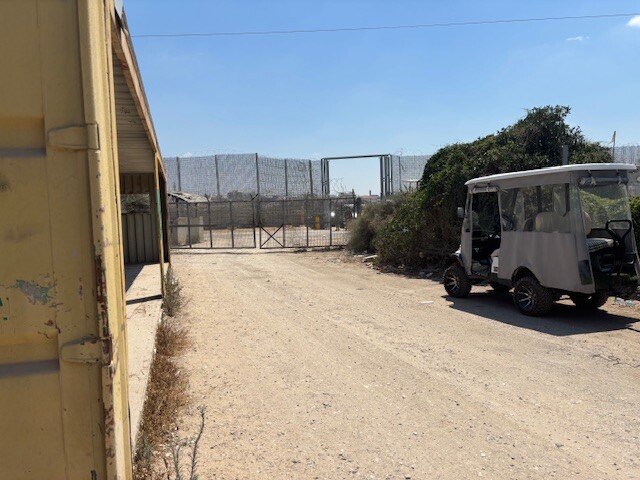 Nina SebaAug-18-2025Habla: The gate is in the process of closing
-