
Deir Sharaf, Eliyahu Crossing, Habla, Irtah (Sha’ar Efrayim), Jubara (Kafriat), Mon 27.12.10, Afternoon
Summary
Any shift or tour reports to the OPT today cannot avoid using a certain terminology: “prevention,” “separation,” “fabric of life,” and “law enforcement.” Those are concepts we, as Israelis, are made aware of by the authorities — words used to describe various aspects of Israeli policy in the Occupied Palestinian Territories. Only through our reports can we translate and illustrate the reality of what we monitor, of what goes on in the OPT. The words themselves have a defensive connotation. Instead of maintaining a so called status quo in the OPT, awaiting a “peace” that does not progress and providing for the security interests of those who live within the Green Line, we can only present to those who join us on shifts or tours of the OPT that Israel is working to change that status quo. More and more Palestinians are dispossessed of their land, more and more of Israel’s military superiority, cunningly disguised through the bureaucratic impositions of “permits” through the Civil Administration serves to control more and more aspects of everyday Palestinian life.
There are 2.4 million Palestinians in the West Bank, barred from entering Jerusalem or Israel proper unless they have special permits, which they can receive only in exceptional cases from the military authority known as the Civil Administration. The freedom of movement of almost all Palestinians in the West Bank is limited — to inside the West Bank only.
And then there’s the question of Palestinians getting from their homes to or from school or work in the Seam Zone, that area of enclaves caught between the Wall/Separation Barrier/ Fence – whatever euphemism is given — on the East, and Israel and the Green Line on the West. In reality, 80% of the Wall is built on West Bank land: Palestinian owners were not compensated for the destruction/confiscation of their lands, and further severe restrictions were placed on freedom of Palestinian movement after 2002 when the Israeli government decided to build a Separation Barrier/Wall with the stated goal of “providing security” to Israeli citizens. The barrier created successfully encircles and/or isolates numerous Palestinian population centers. The Wall itself is a combination of an eight meter high concrete wall (mainly around Palestinian population centers like Jerusalem or Qalqiliya), trenches, fences, razor wire and military-only roads. There is also a 30-100 m. wide “buffer zone” east of the Wall with electrified fences, trenches, sensors and military patrol roads and some sections have armed sniper towers. Approximately 50,000 Palestinians now live in the Seam Zone, and since 2003, all Palestinians living there or wanting to enter are required to obtain a permit from the Israeli authorities, in effect requiring permits for people to live and work on their own land.
And now…..
Gate 1393: Habla
14:00-15:00 is the official opening time of the gate, or gates. They are opened, a few minutes late, by five reservist soldiers all of whom, except one, seem relaxed about their task. The usual donkey and horse carts, and the usual people, wait on our side of the Separation Barrier, including the one woman, with permit, who works on the other side of the Green Line, lives in Ras Atiya and who is somebody we know from the “good old days” maybe 18 months ago when the Separation Barrier still went by her village, and she could cross there. Today, she is far from that village, has to cross here, at Gate 1393, twice a day, and take a taxi from the other side to her own home, now inaccessible to us – a ten minute ride, which, again she must do twice daily.
The Bedouin youngsters must also do this trip twice daily, to and from school, and the two buses, one with boys, the other with girls, now wait for at least ten minutes that we saw on the far side of the Barrier. As usual, two soldiers get into the bus and, as usual in the morning too, they go right through it when the children return from school.
Eliahu Gate is manned by police who relax and refresh themselves on this abnormally hot December afternoon.
Route 55: nothing much to report, except that the settlement of Zufim seems to be expanding at a very rapid rate, the newly built houses getting larger and larger.
We drive to Deir Sharaf via the now non existent and notorious checkpoint of Beit Iba and so admire, one again, the beauty of the countryside as well as the newly built road sloping down to it, a “gift of the American People to the Palestinian People.”
At Deir Sharaf, there is much activity and a lot of vehicular traffic, to Jenin as well as to Nablus.
16:15 — at Jubara, the soldiers don’t bother to examine the trunk of the car unlike at Eliahu Gate, through which we had returned to Habla after an excellent lunch at Nabi Elias.
16:30 — on to the terminal at Irtah where hundreds of workers are returning to their homes at this hour. A huge, ugly altercation ensues as one of the visitors has taken a photo of two of the other visitors engaged in conversation with an armed guard – civilian — of course at this terminal, but outside the terminal gates. All’s well that ends well, but, once again, a lesson, as if we needed it, in terms of control, complete control.
At the turnstiles, there is no line, the men pass quickly, again complaining that we, MachsomWatchers, should be there at 4:00 in the morning. One man stops to tell us that although he lives in Tulkarm, quite near the terminal, he was there, today, at 4:30, but it was 6:45 before he got out. And, he laments, “Even if you were to come, would you be able to change things? I fear not.”
To complete this shift/tour, another man tells the visitors, “Who does not see the facts, (meaning the reality on the ground) does not understand.” Indeed!
Deir Sharaf checkpoint
See all reports for this place-
Deir Sharaf checkpoint is located west of Nablus and south of the settlement of Shavei Shomron, at the entrance to the village of Deir Sharaf on the road leading to Nablus. The checkpoint was activated in early March 2009 after the Beit Iba checkpoint was closed. Palestinians are allowed through the checkpoint , but not for Israelis. Unlike the checkpoints leading to Qalqilya and Tulkarm, crossing of Israeli Palestinians is only allowed on Saturdays.
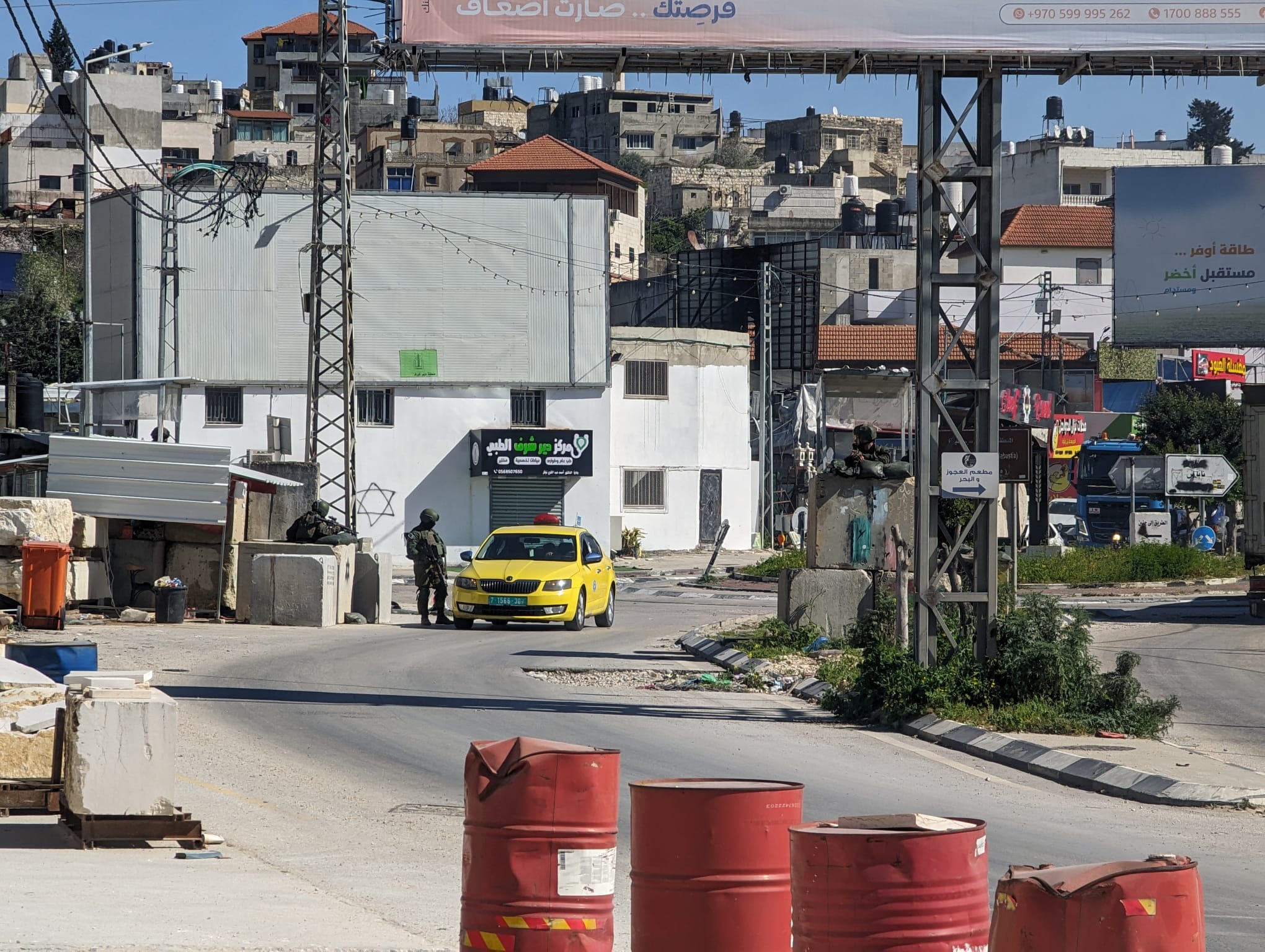 Nina SebaFeb-28-2024Deir Sharaf - the entrance to the village
-
Eliyahu CP (109) / Crossing
See all reports for this place-
Eliyahu CP (109) / Crossing This checkpoint, also known as the Fruit Crossing, is one of the main checkpoints between Israel and the West Bank. It is located on Route 55 between Alfei Menashe and the turn to Qalqilya and Zufin, more than 4 km east of the Green Line, in the separation fence, which separates Qalqilya from its lands to the south, thus leaving Alfei Menashe West of the fence - the Seam Zone. This checkpoint, a few kilometers across the Green Line, is intended for "Israeli settlement in the West Bank and the population of the Seam Zone." It is managed by a civil company. Palestinians with a special permit for their lands in the seam area are also allowed to pass through it, on foot, and sometimes by car.
-
Habla
See all reports for this place-
Habla CP (1393)
The Habla checkpoint (1393) was established on the lands of the residents of Qalqilya, on the short road that
connected it for centuries to the nearby town of Habla. The separation barrier intersects this road twice and cut off the residents of Qalqilya from their lands in the seam zone.(between the fence and the green line).
There is a passage under Road 55 that connects Qalqilya to the sabotage This agricultural barrier is used by the farmers and nursery owners established along Road 55 from the Green Line and on both sides of the kurkar road leading to the checkpoint.
This agricultural checkpoint serves the residents of Arab a-Ramadin al-Janoubi (detached from the West Bank), who pass through it to the West Bank and back to their homes. The opening hours (3 times a day) of this agricultural checkpoint are longer than usual, about an hour (recently shortened to 45 minutes), and are coordinated with the transportation hours of a-Ramadin children studying in the occupied in the West Bank.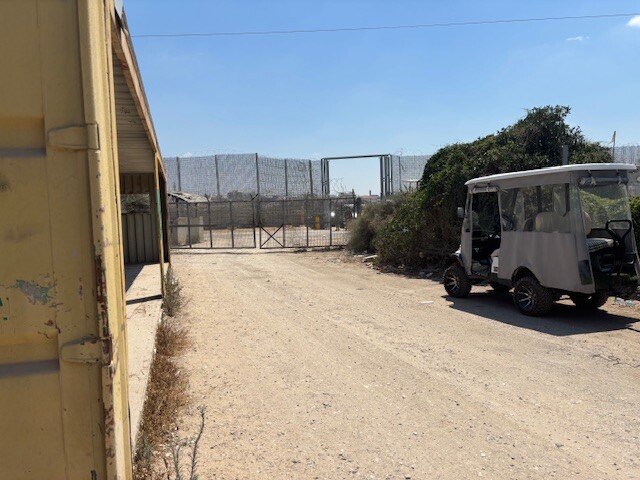 Nina SebaAug-18-2025Habla: The gate is in the process of closing
-
Irtah (Sha'ar Efrayim)
See all reports for this place-
The checkpoint is for Palestinians only. It is the main barrier to the passage of workers from the northern West Bank to Israel. Workers with a permit to work in Israel and also for trade (with appropriate permissions), medicine, and visiting prisoners. One can cross the checkpoint only on foot. The checkpoint is located north of Road 557 and south of Tulkarm. Operated by a civil security company, opening hours: between 4:00 and 19:00 on weekdays. As members of Machsom Watch, we began our shifts to this location in 2007. We arrived before it opened at 4 in the morning and report since, on the harsh conditions and the long and crowded queues of workers. The workers who pass by continue their journey by transportation to work throughout Israel. In the first period of its activity, about 3,000 and then 5,000 people passed through this checkpoint every day. Due to the small number of checking points and arbitrary delays for long periods of time in the "rooms", workers feared losing their transportation. Hence workers leave their homes at 2:30 at night to be among the first. Today, 15,000 pass and the transition is faster. Workers are still leaving their homes very early to get past the checkpoint at 7 p.m. In an adjacent compound, there is a terminal for the transfer of goods on a commercial scale, using the back-to-back method.
-
Jubara (Kafriat)
See all reports for this place-
The Jabra checkpoint was on Road 557, south of Tulkarm, on the side of the Figs Pass, which is located within the Palestinian Authority (a few kilometers east of the Green Line), and serves as an entry barrier from the territories to Israel. The checkpoint to the village of Jubara, which until 2013 was in the seam area, blocked and surrounded by a fence, was intended for the passage of the family members of the house next to the checkpoint, and also for the MachsomWatch volunteers (with special permission only), on their way to checkpoint 753. on the other side of the village. The soldiers supervising the "fig crossing" also supervised the crossing at this checkpoint, in our shifts we often waited a long time until the key was found and the gate opened. The checkpoint was abolished and became part of the separation fence that was moved west following the High Court.
-