
Deir Sharaf, Eliyahu Crossing, Habla, Irtah (Sha’ar Efrayim), Jubara (Kafriat), Sun 4.9.11, Afternoon
Summary
The social protest movement here began on July 14, “le quatorze juillet,” the date that symbolizes the uprising of France as a modern nation. Whether Israel is headed in the direction of social justice, equality, and democracy is not yet obvious, since the “revolutionaries” or “protesters” have to triumph over a government that cannot or will not face up to the ongoing social demonstrations. Unresolved conflicts, to an Israeli government, can and must remain unresolved. So, the government continues to take comfort in showing that it can act with determination to protect Israel’s security, and that it prefers, well ahead of the September vote about Palestinian statehood, to resort to crises and banging the drumbeats of trouble in the OPT. Already military materiel is all over the place, and one can feel in the air that security checkpoints, plus the usual roadblocks, are bound to become part of the landscape again, while the Seam Zone becomes ever more a “no man’s land” where people’s lives are hard whether Palestine is an independent state or not.
Habla
12:55-13:20 A Hummer arrives early, in time to open the gates for waiting Palestinians but the two lone soldiers check them outside the concrete hut, and it’s slower than usual. The reason is soon obvious. A jeep carrying the military policewoman – late on the job – arrives at 13:20!
Nothing unusual about the trucks, pedestrians, bicycles and pony carts, crossing from either side of the Separation Barrier, but it’s the first time we’ve seen a group of about 20 little boys with one older boy and an older woman walk across the Separation Barrier. The latter two’s IDs are checked. These are indeed the Bedouin kids we’re used to seeing coming across with a school bus. A new school year and no bus? Shortage of funds?
13:15 – a pickup truck arrives and carries off the woman and a number of the kids in the cab of the truck while others run after it and hop on to the back.
13:25 – now we spy a large, green bus, “the” school bus, arriving from Habla. In it are both boys and girls, and we can’t help noting that the girls are at the back of the bus….
Gate 1360 on the Security Barrier near Alfei Menashe
This gate has been closed for a long time and forms part of the enclave of surrounded Palestinian villages near Alfei Menashe. This is the second time that the gate leading on to the Security Barrier has been open. It is labeled 1359 and 1360, since it seems that each section of an opening in the fence has to have a gate number! The open section is, of course, on the north side of the Barrier, on the side we are parked. The other, southern side consists of three gates as is usual in these parts. Why is one section open? It’s clear since “they” are “improving” a road leading to the Separation Barrier from Ras Atiya, perhaps to create a new security checkpoint?
14:00 Sh’aar Eliahu or Gate 109
So called improvements are also being instituted here. Added to which a blue policeman plus a Border policeman check cars, no, correct that, checking cars entering the OPT whose drivers bear Israeli IDs but who are racially profiled as Arabs even though they are Israelis. Two such cars are accorded this treatment in front of us.
We note, too, that the grandiose compound on the south side of the checkpoint with its ominous grey concrete walls, probably the height of the Jerusalem Wall, is being whitewashed, literally, we should add. Two painters are jazzing up the drab gray with pristine white paint – no, whitewash. Stay tuned for more whitewash in the coming weeks.
Along Routes 55 and 57 many jeeps and Hummers, as well as white Matak jeeps.
We hear, for the first time, that Palestinians, as we know from the summer, are being issued permits, of up to one week, to visit Israel. We hear, too, that more and more Palestinian Israelis, “48ers” are bringing their Israeli Jewish friends to visit the OPT, in particular Nablus for eating and shopping. Interesting tourism taking place despite politics!
Jubara
14:45 – a large contingent of Military Policewomen here, a whole unit. As has been common in the past weeks, they have something to say about checkpoints: wishing them away, not for reasons of human rights but for reasons of their own convenience and their lack of desire to serve at these institutions.
15:00 Irtah (Sha’ar Efraim)
Here the issue is less one of human rights but one of civil rights. The Palestinian workers pass through easily on their way home now. But one of the Palestinian Israeli midi bus drivers complains of the wait and checking he has to endure at places like Jubara where, indeed, the waiting line for Palestinian Israelis is longer than ever. Even our trunk and back of the car as well as IDs are checked, but the Palestinian Israelis, in their special line for checking, bearers of blue Israeli IDs, have something much more onerous to deal with.
In addition, and this needs to be double checked, Palestinians, particularly those who come into Israel from Palestine at this odd time of day, seem to be systematically checked, on schedule, one every fifteen minutes, having to wait in a windowless room, waiting to be called (and this is before any hospital appointment, if that is what they have a permit to enter Israel for).
Deir Sharaf checkpoint
See all reports for this place-
Deir Sharaf checkpoint is located west of Nablus and south of the settlement of Shavei Shomron, at the entrance to the village of Deir Sharaf on the road leading to Nablus. The checkpoint was activated in early March 2009 after the Beit Iba checkpoint was closed. Palestinians are allowed through the checkpoint , but not for Israelis. Unlike the checkpoints leading to Qalqilya and Tulkarm, crossing of Israeli Palestinians is only allowed on Saturdays.
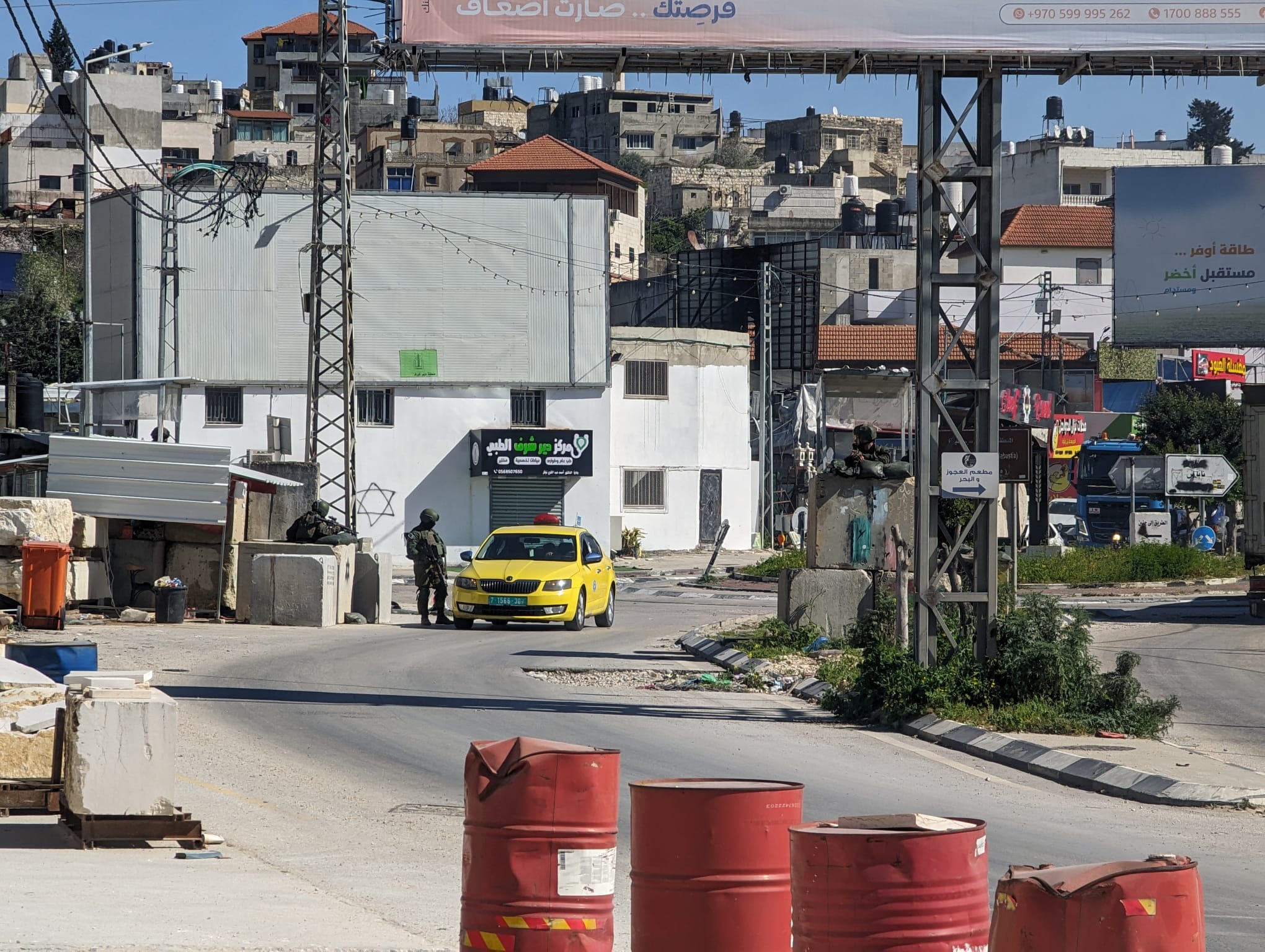 Nina SebaFeb-28-2024Deir Sharaf - the entrance to the village
-
Eliyahu CP (109) / Crossing
See all reports for this place-
Eliyahu CP (109) / Crossing This checkpoint, also known as the Fruit Crossing, is one of the main checkpoints between Israel and the West Bank. It is located on Route 55 between Alfei Menashe and the turn to Qalqilya and Zufin, more than 4 km east of the Green Line, in the separation fence, which separates Qalqilya from its lands to the south, thus leaving Alfei Menashe West of the fence - the Seam Zone. This checkpoint, a few kilometers across the Green Line, is intended for "Israeli settlement in the West Bank and the population of the Seam Zone." It is managed by a civil company. Palestinians with a special permit for their lands in the seam area are also allowed to pass through it, on foot, and sometimes by car.
-
Habla
See all reports for this place-
Habla CP (1393)
The Habla checkpoint (1393) was established on the lands of the residents of Qalqilya, on the short road that
connected it for centuries to the nearby town of Habla. The separation barrier intersects this road twice and cut off the residents of Qalqilya from their lands in the seam zone.(between the fence and the green line).
There is a passage under Road 55 that connects Qalqilya to the sabotage This agricultural barrier is used by the farmers and nursery owners established along Road 55 from the Green Line and on both sides of the kurkar road leading to the checkpoint.
This agricultural checkpoint serves the residents of Arab a-Ramadin al-Janoubi (detached from the West Bank), who pass through it to the West Bank and back to their homes. The opening hours (3 times a day) of this agricultural checkpoint are longer than usual, about an hour (recently shortened to 45 minutes), and are coordinated with the transportation hours of a-Ramadin children studying in the occupied in the West Bank.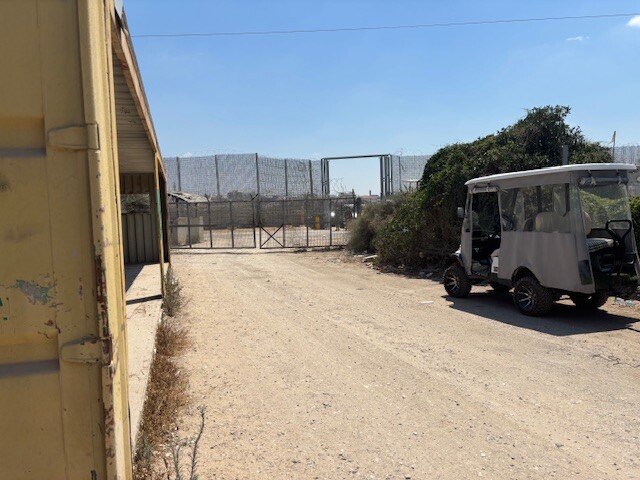 Nina SebaAug-18-2025Habla: The gate is in the process of closing
-
Irtah (Sha'ar Efrayim)
See all reports for this place-
The checkpoint is for Palestinians only. It is the main barrier to the passage of workers from the northern West Bank to Israel. Workers with a permit to work in Israel and also for trade (with appropriate permissions), medicine, and visiting prisoners. One can cross the checkpoint only on foot. The checkpoint is located north of Road 557 and south of Tulkarm. Operated by a civil security company, opening hours: between 4:00 and 19:00 on weekdays. As members of Machsom Watch, we began our shifts to this location in 2007. We arrived before it opened at 4 in the morning and report since, on the harsh conditions and the long and crowded queues of workers. The workers who pass by continue their journey by transportation to work throughout Israel. In the first period of its activity, about 3,000 and then 5,000 people passed through this checkpoint every day. Due to the small number of checking points and arbitrary delays for long periods of time in the "rooms", workers feared losing their transportation. Hence workers leave their homes at 2:30 at night to be among the first. Today, 15,000 pass and the transition is faster. Workers are still leaving their homes very early to get past the checkpoint at 7 p.m. In an adjacent compound, there is a terminal for the transfer of goods on a commercial scale, using the back-to-back method.
-
Jubara (Kafriat)
See all reports for this place-
The Jabra checkpoint was on Road 557, south of Tulkarm, on the side of the Figs Pass, which is located within the Palestinian Authority (a few kilometers east of the Green Line), and serves as an entry barrier from the territories to Israel. The checkpoint to the village of Jubara, which until 2013 was in the seam area, blocked and surrounded by a fence, was intended for the passage of the family members of the house next to the checkpoint, and also for the MachsomWatch volunteers (with special permission only), on their way to checkpoint 753. on the other side of the village. The soldiers supervising the "fig crossing" also supervised the crossing at this checkpoint, in our shifts we often waited a long time until the key was found and the gate opened. The checkpoint was abolished and became part of the separation fence that was moved west following the High Court.
-