
Deir Sharaf, Habla, Huwwara, Za’tara (Tapuah), Sun 8.5.11, Afternoon
Summary
Despite what’s going on at the international level, and the likely creation of a Palestinian state in the near future, Israel’s security-first narrative has been so persuasive on the world stage, particularly in European and American policy, that those of us who continue to monitor what goes on in the OPT, are more than a little concerned. What we see are the actions on the ground which point to no legal or administrative sovereignty at all and, instead, little more than continued occupation and/or colonization.
11:15 Route 5 to Zaa’tra
The road appears just as it should to the unknowing (the majority of our fellow citizens): a highway, the Trans Samaria that is still, nearly two decades after its creation, a marvelous piece of engineering – over Palestinian lands.
The Zaa’tra junction is busy, but vehicles are not often held up by the police and the army, both of whom see fit to man this checkpoint.
Huwwara
The former checkpoint basks in the summery sunshine midst tall grasses, and only one of the two military lookout towers is manned. None of the military positions at ground level are manned, and one seems to be falling over…
Deir Sharaf
As usual, all is not as it seems, since further on, we learn that checkpoints were lately taken down, but that at 7:00 am each morning vehicles are stopped on Route 60 at the foot of the old road leading up to the colony of Shavei Shomron.
A huge 14 wheel trailer truck., blows one tire very, very noisily, and everyone looks and sounds extremely worried until it’s clear what occurred.
Of further interest in the area around Qedumim, the huge amount of building going on at this already vast colony. Rocks have been gouged out of the hillside and a number of flat roofed buildings (what? no red tiled roofs?) are in the process of being built south of Route 60.
At the junction of Route 60 and 55, a blue police car, manned by Border Police, has stopped two young men in a car with Israeli license plates – yellow). Another surprise, a Hummer, not an army Hummer but instead painted the colors of the Israeli blue police, complete with wire mesh windows, etc.
13:20-13:50 Habla
As usual, the now familiar complement of five soldiers mans the gates, meaning each time a vehicle — donkey or pony cart, bicycle, tractor, car or truck — wants to pass, the four gates, two on each side require four soldiers, two on each side to open and close them. A ridiculous effort. The pedestrian lane has to be used by those on foot.
Alongside the ever more elaborate checkpoint, a stop sign of the variety seen at every crossroads, has been thrown into the ditch; next to it, bales of cast off razor wire, replaced by new razor wire (and one has to assume, another contractor making a fast buck off the Occupation).
Other than that, the passage across the Separation Barrier is as ever. One of the usuals has to tie his pony cart to the Zim container as he goes over to have his ID checked. A woman brings her large load of grasses (not melokia – mallow), which was refused passage by one of the soldiers at this agricultural gate just a few days ago), props it against one of the posts, and goes to have her ID checked in the concrete booth. A tractor waits on the far side. The second school bus of the Bedouin kids (we’ve missed the first one earlier in the hour) also waits on the far side. The soldiers spend their time talking, to each other, drinking, smoking or shooting the breeze. And the Palestinians wait and wait.
Deir Sharaf checkpoint
See all reports for this place-
Deir Sharaf checkpoint is located west of Nablus and south of the settlement of Shavei Shomron, at the entrance to the village of Deir Sharaf on the road leading to Nablus. The checkpoint was activated in early March 2009 after the Beit Iba checkpoint was closed. Palestinians are allowed through the checkpoint , but not for Israelis. Unlike the checkpoints leading to Qalqilya and Tulkarm, crossing of Israeli Palestinians is only allowed on Saturdays.
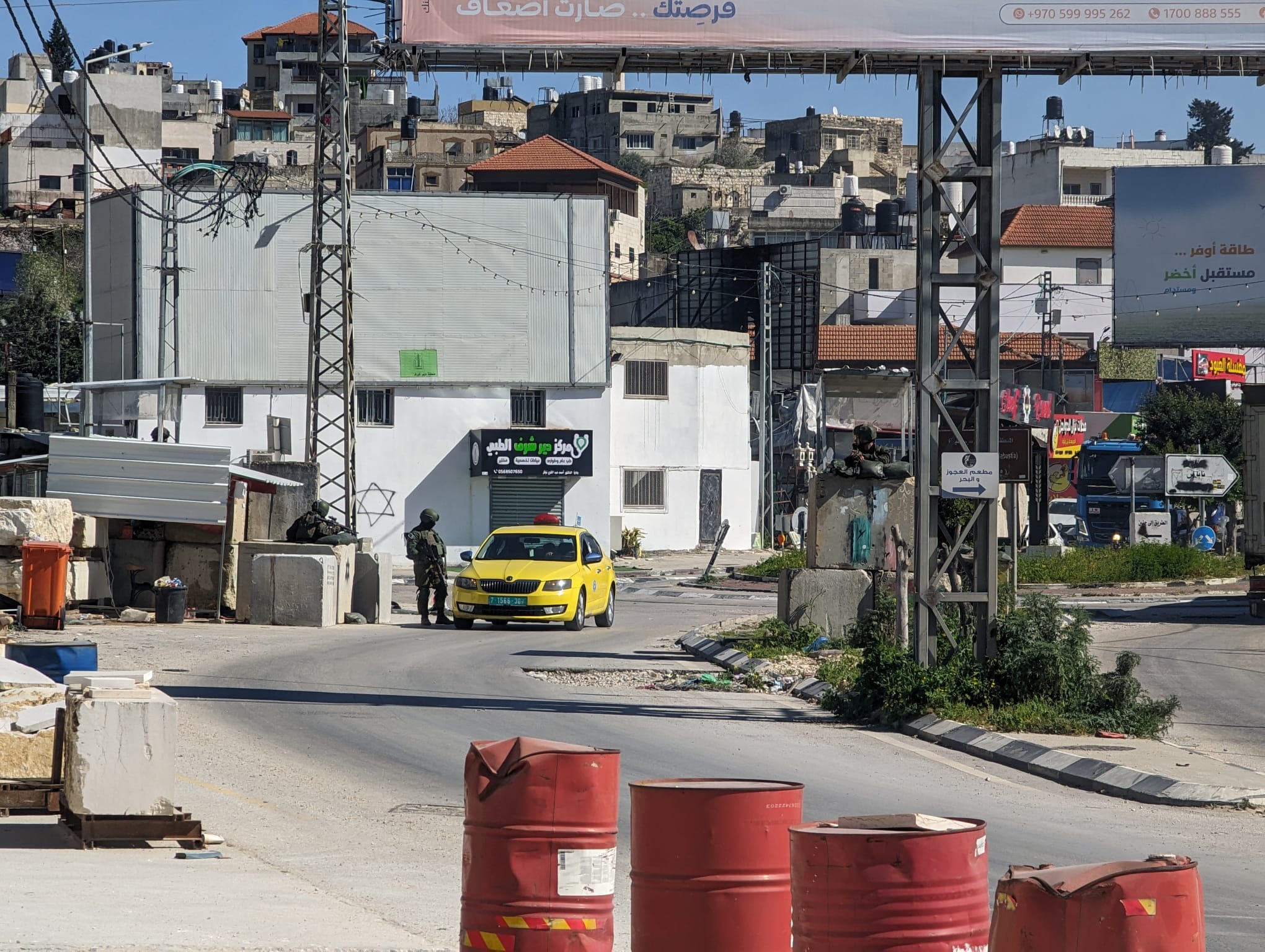 Nina SebaFeb-28-2024Deir Sharaf - the entrance to the village
-
Habla
See all reports for this place-
Habla CP (1393)
The Habla checkpoint (1393) was established on the lands of the residents of Qalqilya, on the short road that
connected it for centuries to the nearby town of Habla. The separation barrier intersects this road twice and cut off the residents of Qalqilya from their lands in the seam zone.(between the fence and the green line).
There is a passage under Road 55 that connects Qalqilya to the sabotage This agricultural barrier is used by the farmers and nursery owners established along Road 55 from the Green Line and on both sides of the kurkar road leading to the checkpoint.
This agricultural checkpoint serves the residents of Arab a-Ramadin al-Janoubi (detached from the West Bank), who pass through it to the West Bank and back to their homes. The opening hours (3 times a day) of this agricultural checkpoint are longer than usual, about an hour (recently shortened to 45 minutes), and are coordinated with the transportation hours of a-Ramadin children studying in the occupied in the West Bank.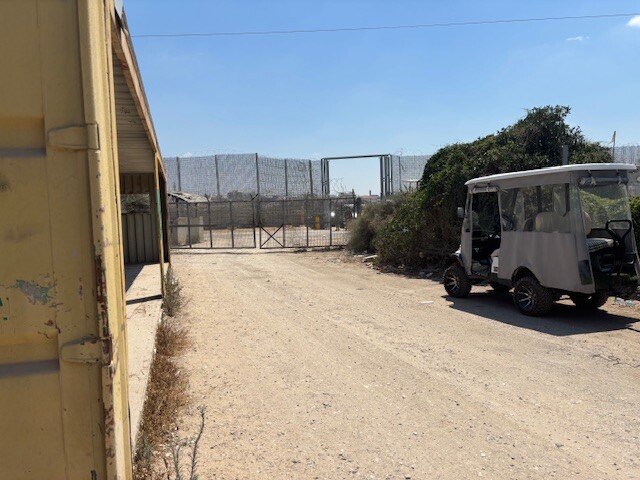 Nina SebaAug-18-2025Habla: The gate is in the process of closing
-
Huwwara
See all reports for this place-
The Huwwara checkpoint is an internal checkpoint south of the city of Nablus, at the intersection of Roads 60 and 5077 (between the settlements of Bracha and Itamar). This checkpoint was one of the four permanent checkpoints that closed on Nablus (Beit Furik and Awarta checkpoints to the east and the Beit Iba checkpoint to the west). It was a pedestrian-only barrier. As MachsomWatch volunteers, we watched therre since 2001 two shifts a day - morning and noon, the thousands of Palestinians leaving Nablus and waiting for hours in queues to reach anywhere else in the West Bank, from the other side of the checkpoint the destination could only be reached by public transport. In early June 2009, as part of the easing of Palestinian traffic in the West Bank, the checkpoint was opened to vehicular traffic. The passage was free, with occasional military presence in the guard tower. Also, there were vehicle inspections from time to time. Since the massacre on 7.10.2023, the checkpoint has been closed to Palestinians.
On February 26, 2023, about 400 settlers attacked the town's residents for 5 hours and set fire to property, such as houses and cars. Disturbances occurred in response to a shooting of two Jewish residents of Har Bracha by a Palestinian Terrorist. The soldiers stationed in the town did not prevent the arson and rescued Palestinian families from their homes only after they were set on fire. No one was punished and Finance Minister Smotrich stated that "the State of Israel should wipe out Hawara." Left and center organizations organized solidarity demonstrations and support actions for the residents of Hawara.Hawara continued to be in the headlines in all the months that followed: more pogroms by the settlers, attacks by Palestinians and a massive presence of the army in the town. It amounted to a de facto curfew of commerce and life in the center of the city. On October 5, 2023, MK Zvi established a Sukkah in the center of Hawara and hundreds of settlers backed the army blocked the main road and held prayers in the heart of the town all night and the next day. On Saturday, October 7, 23 The "Swords of Iron" war began with an attack by Hamas on settlements surrounding Gaza in the face of a poor presence of the IDF. Much criticism has been made of the withdrawal of military forces from the area surrounding Gaza and their placement in the West Bank, and in the Hawara and Samaria region in particular, as a shield for the settlers who were taking over and rioting.
On November 12, 2023, the first section of the Hawara bypass road intended for Israeli traffic only was opened. In this way, the settlers can bypass the road that goes through the center of Hawara, which is the main artery for traffic from the Nablus area to Ramallah and the south of the West Bank. For the construction of the road, the Civil Administration expropriated 406 dunams of private land belonging to Palestinians from the nearby villages. The settlers are not satisfied with this at the moment, and demand to also travel through Hawara itself in order to demonstrate presence and control.(updated November 2023)
. Shoshi AnbarMay-18-2025Huwara: The old houses in Area C
-
Za'tara (Tapuah)
See all reports for this place-
Za'tara (Tapuah) Za'tara is an internal checkpoint in the heart of the West Bank, at the intersection of Road 60 and Road 505 (Trans-Samaria), east of the Tapuah settlement. This checkpoint is the "border" marked by the IDF between the north and south of the West Bank, in accordance with the policy of separation between the two parts of the West Bank that has been in place since December 2005. At the Za'tara checkpoint, there are separate routes for Israelis and Palestinians. In the route for Israelis, there are no inspections and the route for Palestinians inspects. The queue lengthens and shortens suits. The checkpoint is open 24 hours a day. The checkpoint is partially staffed and the people who pass through it are checked at random.
 Shoshi AnbarSep-27-2023Za'atra (Tapuah Intersection). Signs
-