
Deir Sharaf, Habla, Irtah (Sha’ar Efrayim), Jubara (Kafriat), Sun 26.6.11, Afternoon
Summary
Today’s shift was a glorious demonstration of the IDF’s prominence and visibility in the OPT, together with its hubris and exasperating way of thinking and acting. But then whoever said or thought that Occupation is pleasing or pleasant?
Habla, Gate 1392
13:02 the soldiers are there, quite a few of them, huddled in the middle of the Separation Barrier, and the gates on our side are closed, although, for once, the pedestrian gate is open. Two painters come from the far side, having their paint pots thoroughly examined. A truck arrives, the gate is opened for it, then closed again, each time a piece of razor wire twisted from one side of the gate to the gate on the other side, clearly endangering the soldier or military policewoman who has to go about this stupid performance again and again. When we call the commander to ask why the gate is closed each time, he replies in beautiful illogical fashion: “It’s open until 2:0O,” when, before our eyes, the gate is clearly closed. True, it’s not padlocked each time.
The greengrocer’s son arrives in a truck, is told to stop at the closed gate by one of the soldiers (there are four of them visible, plus one in the checking booth and the inevitable military policewoman), and he calls out that he is “zero, zero,” which has a meaning we don’t catch. It seems, however, that this is enough to let him pass, whereas two other men, who are not “zero zero” are made to wait at the pedestrian gate.
13:10 a bicycle arrives, and the young man on it is told to stop long before he gets to the closed gate.
For a group of three young men, pedestrians, it takes five minutes for them to pass through the concrete checking booth and on to the other side.
Another young man arrives on a bicycle, and the commander, now smoking a cigarette, beckons him to come forward, this time with a piercing whistle, pointing to the pedestrian gate, since he has, again, closed the center gates for vehicles.
13:15 on the other side, we spy a frisky horse and cart and a young boy, maybe ten years old, who is turned back from crossing by three of the soldiers. We can see that the woman is delighted to show off her authority to the reservists who seem to flounder, whereas the commander, who again proceeds to close the gates on our side, is clearly nervous and also seems to have no eyes, since immediately the horse and cart cross the Separation Barrier, bearing a young father and his smiling small daughter to a gate which the commander has quickly to open yet once again.
13:20 by now, there’s nobody except the army present in this gentle and peaceful landscape. The Occupation continues.
13:30 Gate 109 (known thus to the Palestinians, and as Sha’ar Eliahu to Israelis).
We wonder whether readers can guess what is going on here. Building, yes, a bigger and better entry point to the OPT, at least five kilometers east of the Green Line with, doubtless, more stringent regulations against the Palestinians. Again, proof that the Occupation continues and/or that the colonization of Palestine will go on and on.
Route 55
An enormous number of army vehicles, Border and blue police too on the roads today, jeeps, Hummers, Safaris, seemingly in all directions and throughout all our shift. But they were clearly also expected to set up temporary checkpoints – at the junction with Route 60 on Route 57, near Shavei Shomron and on the way to the terminal building at Irtah (please read below).
14:30 a Hummer and soldiers at the Junction of Routes 57 and 60
15:00 half an hour later, Border Police on Route 57, just around the corner from the now disappeared soldiers, seemingly guarding a brand new water pipe contraption, similar to the one produced about two months ago near Qedumim, on Route 55.
15:15 Jubara
The latest West Bank OCHA report tells of 72 structures demolished, displacing over 200 people, mainly in the Jordan Valley (reported by two MachsomWatchers); continuing settler violence and changes in the Separation Barrier, namely, in the area of the OPT monitored by us. Recently, the Israeli authorities began rerouting a section of the Barrier next to Khirbet Jubara village, following an Israeli court decision from 2007. Once the old section is dismantled, the over 300 residents of the village will be ʺreleasedʺ from the ʺSeam Zone,” the closed area between the Barrier and the Green Line, and reconnected to the rest of the West Bank. According to OCHA’s report, the village council, states that the new route will isolate around 600 dunams of the village’s agricultural land, planted with olive trees which will remain behind the Barrier. We should be able to see what this means to the village of Jubara, but the new Barrier section is still located in the OPT. In other words, as we all know, the Barrier continues to be in contravention of international law.
What’s visible now is the white cliff top that has been gouged out to make some kind of new barrier, and Abu Ghatem’s house looks squeezed almost out of existence (but maybe that’s the idea)! We need to touch base with him and his family….
The soldiers at the checkpoint are, for once, completely uninterested in who we are, where we’re going or where we come from.
15: 25 Irtah (Sha’ar Efraim)
As we leave Route 57 and turn right, off the road to the back-to-back facility, at the junction where we again turn right, a group of soldiers has stepped out of an army vehicle and look as if they’re about to create a rolling checkpoint.
It’s quiet at the terminal building and very hot, not many people around, and the civilian guard is even civil. Some men cross the open gateway on their way home, as we stand and observe, telling us how inconsistent the mornings are, sometimes good, sometimes terrible. But we’ve always said that one aspect of Occupation is inconsistency, which keeps the Occupier busy, wondering what he can do next to continue the harassment, and keeps the Palestinians wondering if and when they’ll get to work or reach home.
Today is one of those days. As we leave the terminal building, we note no minibuses or contractors’ cars bringing workers back to the terminal. Instead, a stream of people walking, including women bearing goods on their heads, and they still manage to lift a hand and wave… They, and the other workers with permits, are walking all the way from the junction, at least a kilometer from where we’d seen the makings of a temporary checkpoint earlier.
15:55 sure enough, the army vehicle is standing across the roadway, now preventing anybody from even walking towards the terminal building. We go to the soldiers, and ask the commander, who says there is a fire in the field and it’s not safe to let people travel that way in a vehicle. We’ve just come from there, have not seen a fire, just many, many people walking in horrendous heat in an area where there’s no shade. The commander again says there’s a fire, and we do now see some smoke emanating from the area where we just drove. A bit of smoke…. We call the DCO officer, who at least sounds surprised, and says he will find out what is going on. He calls back five minutes later, repeats what the commander has said and reports that the fire brigade is on its way. More people are sent away, some go straight on to the back-to-back facility, a few walking, others in the vehicles that have brought them from their work and, driving there, we see workers scrambling up a hilly slope to the road which leads to the terminal building. By now there are, indeed flames in a small area, and there’s even a fire engine which appears to be just doing nothing but driving around the fire.
16:05 back at the junction leading to the terminal, a new barricade has been created by the civilian head of Irtah, somebody we know well, since he loves to explain why something is or is not done there. He now proceeds to say that there is no way the workers can clamber up the slope near the back-to-back facility (a facility which is, of course, well fenced in) but a few minutes later, he seems to renege and walks after the workers, whose only aim is to get home and out of the broiling sun.
Conclusion: strange that the temporary checkpoint was created when no fire was yet visible (!) and even stranger the dramatic and overblown actions of the Occupier.
Deir Sharaf checkpoint
See all reports for this place-
Deir Sharaf checkpoint is located west of Nablus and south of the settlement of Shavei Shomron, at the entrance to the village of Deir Sharaf on the road leading to Nablus. The checkpoint was activated in early March 2009 after the Beit Iba checkpoint was closed. Palestinians are allowed through the checkpoint , but not for Israelis. Unlike the checkpoints leading to Qalqilya and Tulkarm, crossing of Israeli Palestinians is only allowed on Saturdays.
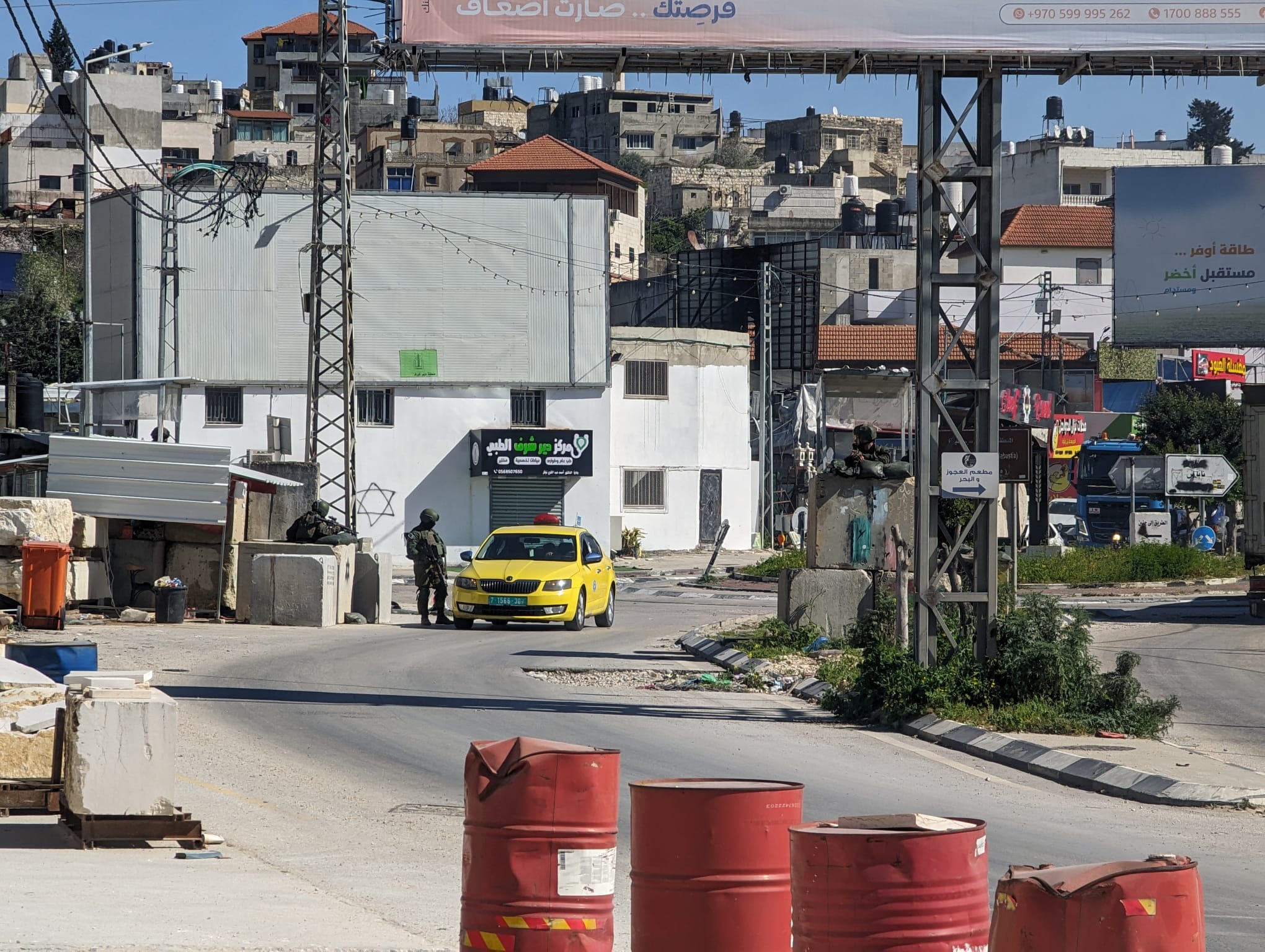 Nina SebaFeb-28-2024Deir Sharaf - the entrance to the village
-
Habla
See all reports for this place-
Habla CP (1393)
The Habla checkpoint (1393) was established on the lands of the residents of Qalqilya, on the short road that
connected it for centuries to the nearby town of Habla. The separation barrier intersects this road twice and cut off the residents of Qalqilya from their lands in the seam zone.(between the fence and the green line).
There is a passage under Road 55 that connects Qalqilya to the sabotage This agricultural barrier is used by the farmers and nursery owners established along Road 55 from the Green Line and on both sides of the kurkar road leading to the checkpoint.
This agricultural checkpoint serves the residents of Arab a-Ramadin al-Janoubi (detached from the West Bank), who pass through it to the West Bank and back to their homes. The opening hours (3 times a day) of this agricultural checkpoint are longer than usual, about an hour (recently shortened to 45 minutes), and are coordinated with the transportation hours of a-Ramadin children studying in the occupied in the West Bank.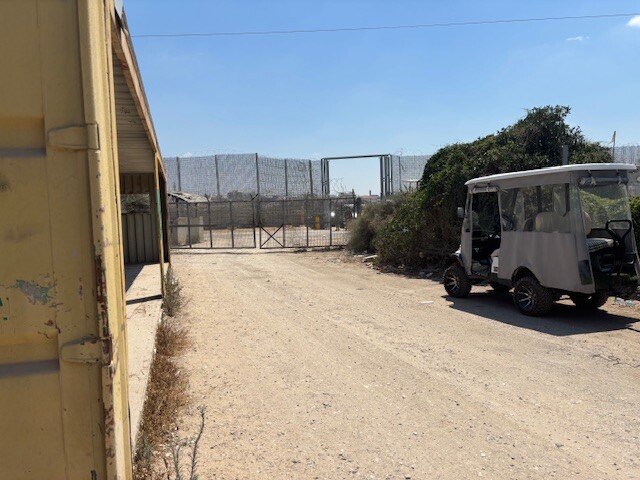 Nina SebaAug-18-2025Habla: The gate is in the process of closing
-
Irtah (Sha'ar Efrayim)
See all reports for this place-
The checkpoint is for Palestinians only. It is the main barrier to the passage of workers from the northern West Bank to Israel. Workers with a permit to work in Israel and also for trade (with appropriate permissions), medicine, and visiting prisoners. One can cross the checkpoint only on foot. The checkpoint is located north of Road 557 and south of Tulkarm. Operated by a civil security company, opening hours: between 4:00 and 19:00 on weekdays. As members of Machsom Watch, we began our shifts to this location in 2007. We arrived before it opened at 4 in the morning and report since, on the harsh conditions and the long and crowded queues of workers. The workers who pass by continue their journey by transportation to work throughout Israel. In the first period of its activity, about 3,000 and then 5,000 people passed through this checkpoint every day. Due to the small number of checking points and arbitrary delays for long periods of time in the "rooms", workers feared losing their transportation. Hence workers leave their homes at 2:30 at night to be among the first. Today, 15,000 pass and the transition is faster. Workers are still leaving their homes very early to get past the checkpoint at 7 p.m. In an adjacent compound, there is a terminal for the transfer of goods on a commercial scale, using the back-to-back method.
-
Jubara (Kafriat)
See all reports for this place-
The Jabra checkpoint was on Road 557, south of Tulkarm, on the side of the Figs Pass, which is located within the Palestinian Authority (a few kilometers east of the Green Line), and serves as an entry barrier from the territories to Israel. The checkpoint to the village of Jubara, which until 2013 was in the seam area, blocked and surrounded by a fence, was intended for the passage of the family members of the house next to the checkpoint, and also for the MachsomWatch volunteers (with special permission only), on their way to checkpoint 753. on the other side of the village. The soldiers supervising the "fig crossing" also supervised the crossing at this checkpoint, in our shifts we often waited a long time until the key was found and the gate opened. The checkpoint was abolished and became part of the separation fence that was moved west following the High Court.
-