
Deir Sharaf, Habla, Irtah (Sha’ar Efrayim), Sun 17.4.11, Afternoon
Summary
It’s impossible to take part in a MachsomWatch shift the day before Passover starts without the notion of freedom being uppermost in our minds. The question is freedom for whom? Surely that entails a commitment to all who are not free. Today was a textbook example of what the Occupation is all about: the negation of freedom, and what Occupation does to Palestinians and what, ultimately, such denial of freedom does to Israelis.
Habla, Gate 1392
13:55-14:05 – a small group of people waits at the gate. The soldiers have arrived but make no attempt to open the gates. One of the waiting Palestinian men requests, in Hebrew, that a sick child (we are shown the scar on his chest by his mother) should not go into the concrete checking house, and our suspicions are confirmed that there is, indeed a metal detector inside. The mother is, evidently afraid of “radiation.” Nothing happens. Nothing moves in the unnatural heat of this April day. No hurry on the part of the soldiers, and one military policeman who is not inside the concrete checking building. We call to them to let the child and his mother pass on their way to Habla, and failing that, to have them wait in the unused soldiers’ concrete shelter, which has a roof and benches. But, no, the soldiers indicate that only the hot and dirty former Zim container, recycled into a shelter, so called, for the waiting Palestinians, away from the Separation Barrier, is where the boy and his mother should wait.
The soldiers still make no attempt to let people through, and the one who closes the gate in our faces and those of the waiting Palestinians, mutters something about “we have work to do… problems with the computer.” We call the DCO, the first of many times today. Still nobody is let through, but the Matak has some effect, the woman and sick child walk straight across, and a few minutes later, the smaller of the Bedouin school buses comes from the Habla side to take the children home.
14:05 – the soldiers now close the gates completely, we call out to them in vain, the group of Palestinians near us tries to shout at them, but they get into their jeep and drive off. By this time, the DCO’s phone is not answering, and we wait and wonder what we can do. It is unbearably hot, and one member of the MachsomWatch monitors goes back to the nearby greengrocer to get water for the approximately eight people now waiting on our side of the Separation Barrier.
13:30 – a jeep approaches the gates, goes a bit further, turns and disappears into the hot, dusty Separation Barrier again.
13:35 – the jeep, or another like it, returns five minutes later, and thirty five minutes after the gates should have been opened, the gates are indeed opened. The driver of the jeep sits in the shade, again with his bottle of soda, just as he did earlier. It’s as if this is a film strip, and it has been stopped and is now being rewound to start all over again. A sick film, to be sure.
The officious military policeman, who tells us that his name is “Shin,” acts aggressively to each and every passing Palestinian and spends as much time on the Barrier as in the checking booth. He acts as if he’s the commander, but that is E., a second lieutenant’s role. E. is pleasant much of the time, although refusing to let through a Palestinian with a painfully swollen, probably infected eye, when he requests. He has to wait, indeed all the people on our side of the Barrier have to wait, as those on the far side — people, as well as vehicles – are let through, one after the other. No taking turns or no fairness here. But this is Occupation, and the occupier can do whatever he wills whenever he so wills. Another soldier keeps the angry Palestinians surrounding us at bay, saying he doesn’t decide who can pass or when they can do so.
From our side, we see a pregnant woman with a small girl in her arms waiting and waiting on the far side of the Barrier. Again, the military policeman is outside of the checking house, and it is he who goes into the second large Bedouin school bus, uncovers grasses in a horse cart, which has already been passed by another soldier and turns it back. His ugliness and officiousness is something that grates. But the uncertainty and randomness of occupation is not unusual.
14:00-14:15 – there are still people waiting to cross, “Shin” stands and talks, loudly and violently with the commander who does and says little. As the gate is finally closed at 14:15, “Shin” calls out to us that we should “write the reality” (in our report). We have done so but wonder whether our presence in fact made things even worse today?
Discussions of Palestinians with our Arabic speaker visitor were an interesting “first” for our shift and, once again, the willingness of the Palestinians to engage with us was demonstrated. To sum up today’s Seam Zone encounters, we should quote one of the Palestinians, “What will be tomorrow (vis à vis the occupation) we don’t know.” Indeed.
16:30 Junction of Route 57 and 60
Not far from Shavei Shomron, a rolling checkpoint. Standing by a jeep, a Border policeman has stopped a Palestinian taxi, another Border policeman, with arms at the ready, stands off on the side of the road.
17:00 Irtah (Shaar Efraim)
Many workers returning, laden with packages, but there is no checking as they stream through the terminal building and wend their way home. One tells us that the closure (for the Passover holiday) will be for “ten days.” The guard at the entrance of the compound says closure will be from tomorrow morning, that “it will be three days,” but he’s not sure, other than it will be “for as long as the festival takes.” Again, withholding information and keeping the Palestinians off balance is yet another piece of Occupation.
Deir Sharaf checkpoint
See all reports for this place-
Deir Sharaf checkpoint is located west of Nablus and south of the settlement of Shavei Shomron, at the entrance to the village of Deir Sharaf on the road leading to Nablus. The checkpoint was activated in early March 2009 after the Beit Iba checkpoint was closed. Palestinians are allowed through the checkpoint , but not for Israelis. Unlike the checkpoints leading to Qalqilya and Tulkarm, crossing of Israeli Palestinians is only allowed on Saturdays.
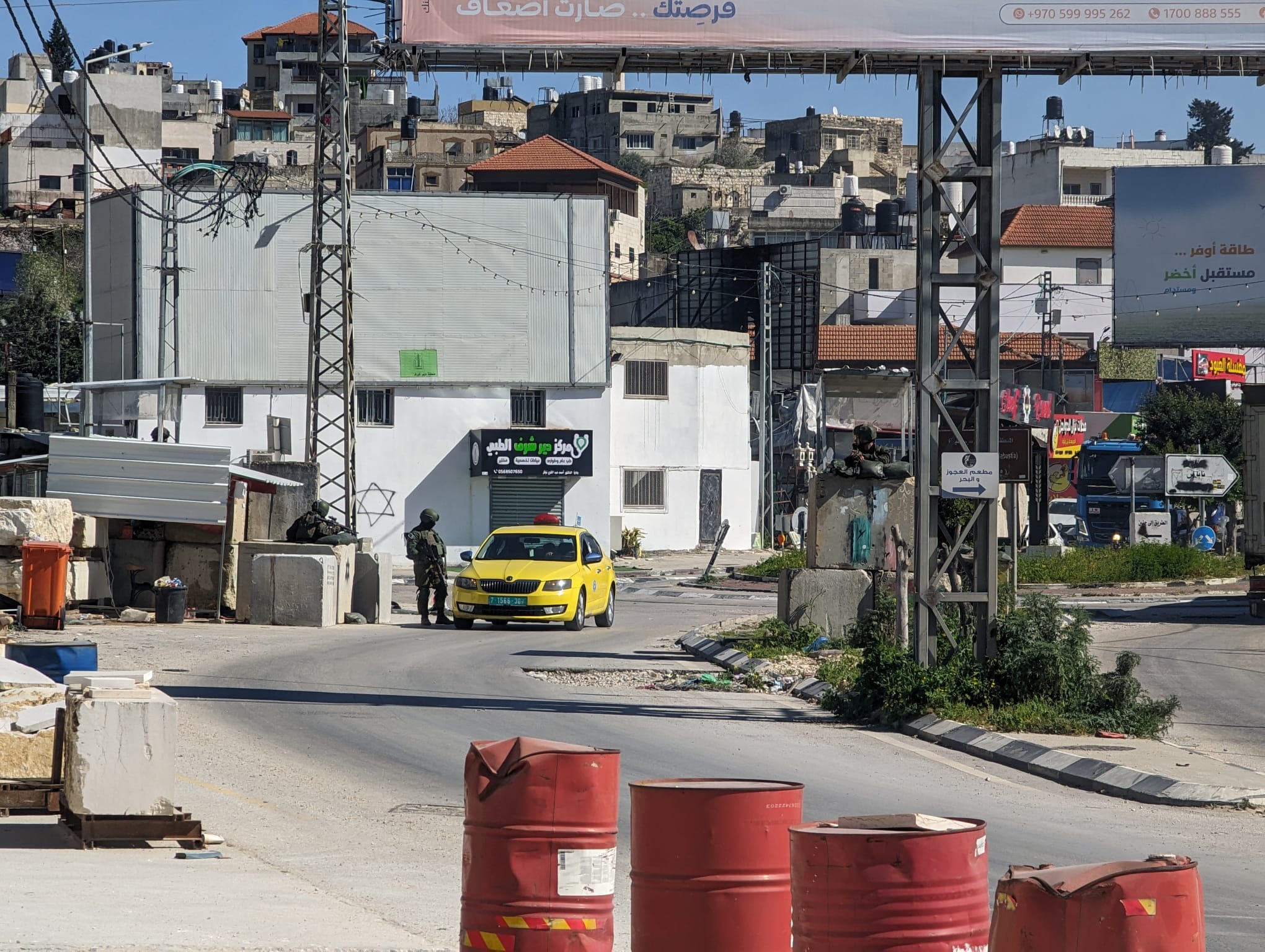 Nina SebaFeb-28-2024Deir Sharaf - the entrance to the village
-
Habla
See all reports for this place-
Habla CP (1393)
The Habla checkpoint (1393) was established on the lands of the residents of Qalqilya, on the short road that
connected it for centuries to the nearby town of Habla. The separation barrier intersects this road twice and cut off the residents of Qalqilya from their lands in the seam zone.(between the fence and the green line).
There is a passage under Road 55 that connects Qalqilya to the sabotage This agricultural barrier is used by the farmers and nursery owners established along Road 55 from the Green Line and on both sides of the kurkar road leading to the checkpoint.
This agricultural checkpoint serves the residents of Arab a-Ramadin al-Janoubi (detached from the West Bank), who pass through it to the West Bank and back to their homes. The opening hours (3 times a day) of this agricultural checkpoint are longer than usual, about an hour (recently shortened to 45 minutes), and are coordinated with the transportation hours of a-Ramadin children studying in the occupied in the West Bank.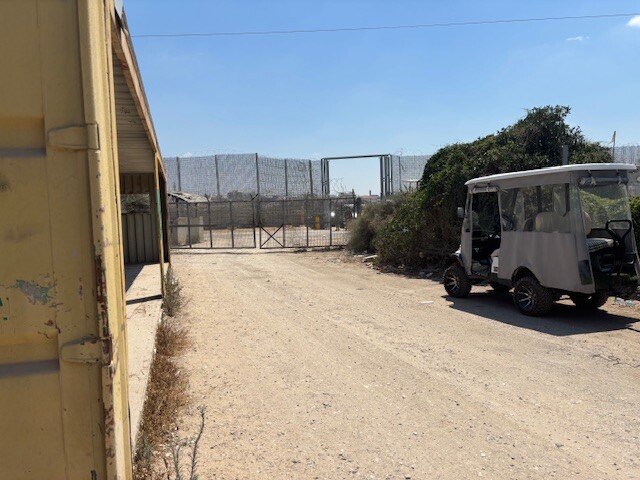 Nina SebaAug-18-2025Habla: The gate is in the process of closing
-
Irtah (Sha'ar Efrayim)
See all reports for this place-
The checkpoint is for Palestinians only. It is the main barrier to the passage of workers from the northern West Bank to Israel. Workers with a permit to work in Israel and also for trade (with appropriate permissions), medicine, and visiting prisoners. One can cross the checkpoint only on foot. The checkpoint is located north of Road 557 and south of Tulkarm. Operated by a civil security company, opening hours: between 4:00 and 19:00 on weekdays. As members of Machsom Watch, we began our shifts to this location in 2007. We arrived before it opened at 4 in the morning and report since, on the harsh conditions and the long and crowded queues of workers. The workers who pass by continue their journey by transportation to work throughout Israel. In the first period of its activity, about 3,000 and then 5,000 people passed through this checkpoint every day. Due to the small number of checking points and arbitrary delays for long periods of time in the "rooms", workers feared losing their transportation. Hence workers leave their homes at 2:30 at night to be among the first. Today, 15,000 pass and the transition is faster. Workers are still leaving their homes very early to get past the checkpoint at 7 p.m. In an adjacent compound, there is a terminal for the transfer of goods on a commercial scale, using the back-to-back method.
-