
Demolitions in Masafer Yatta

Masafer Yatta
Thanks to Muhammad who has no equal, we drove with a vehicle suitable for the road through the rocky road to Fahith, Marcaz, and Jimba, small villages scattered throughout the land of no one and which interfere with settlement plans there.These are villages which are under threat of demolition because it is claimed that they are in a firing zone. The truth be known – for some reason the terror of the firing zone does not apply to the illegal outposts, and ceases to be dangerous when Jews settle there.
In Jimba they have only received demolition orders for barns and some miserable buildings which they dared to build.
We got there via Mufakara.
In Fahith is a conference at the school: a lot of people. They are waiting for the Minister of Justice and media of the Palestinian Authority.
We also met people from peace organizations who had been in Hebron at the time: from Venezuela, Norway and the United States.
They are very happy to meet. They had heard about us and greatly appreciate our actions. We could not wait there until the VIPs arrived.
We drove to Marcaz which is in ruins. They said it was first demolished two months ago and recently again, a week and a half before we arrived.
From there we drove to Jimba. No demolitions yet, but the man said there are demolition orders both from a year ago and a new one – for some sheds used as cow sheds, and one shabby hut we sat in. It has existed for 3 years and used as a makeshift house for a family usually living in a cave.
The man says there are documents proving that these lands are theirs. These are papers that he received in Etzion DCL for NIS 2,000 that he paid and gave to an attorney. Since the matter is in legal treatment, it has not yet been destroyed.
In Jimba we also saw that they blocked a road leading to Arad, because illegal workers try to pass there – people who want to bring bread home and can not.
When the loopholes in the fence are closed, people are looking for and finding other ways into Israel.
In Jimba we were told that about 15 families live in the village. They were originally from Yatta, but came here to preserve their lands. They live in these difficult conditions so that they will not be taken from them. The authorities are of course interested in deporting them.
Mesafer Yatta
See all reports for this place-
This is happening in Fire Area 918 in the South Hebron Hills
On the eve of Remembrance Day (the day before Israel Independence Day), 4th May, 2022, the Israeli High Court decided on the transfer and expulsion of residents from 8 Palestinian communities in the area of Masafar Yata in the South Hebron Hills. Residents of the villages have been living under the threat of demolition, evacuation and expropriation since the IDF issued evacuation orders in 1999 based on the 1980s proclamation of their area of residence as a firing zone for IDF drills. None of the nearby settlements were included in this zone. The Masafer Yata Palestinian villages retain a special lifestyle and ancient agricultural culture. They also posess a clear historical documentation that testifies to a Palestinian settlement in this area, generations before the establishment of Israel, long ago in the caves and at later times outside them.
Evacuating residents from the area means destroying these historic villages and leaving entire families (about 2,000 people, children, adults, and the elderly) homeless. This is contrary to international law.
In June 2022, a firing drill started, and life became harder.
-
South Hebron Hills
See all reports for this place-
South Hebron Hills
South Hebron Hills is a large area in the West Bank's southern part.
Yatta is a major city in this area: right in the border zone between the fertile region of Hebron and its surroundings and the desert of the Hebron Hills. Yatta has about 64,000 inhabitants.
The surrounding villages are called Masafer Yatta (Yatta's daughter villages). Their inhabitants subsist on livestock and agriculture. Agriculture is possible only in small plots, especially near streams. Most of the area consists of rocky terraces.Since the beginning of the 1980s, many settlements have been established on the agricultural land cultivated by the Palestinians in the South Hebron Hills region: Carmel, Maon, Susia, Masadot Yehuda, Othniel, and more. Since the settlements were established and Palestinians cultivation areas have been reduced; the residents of the South Hebron Hills have been suffering from harassment by the settlers. Attempts to evict and demolish houses have continued, along with withholding water and electricity. The military and police usually refrain from intervening in violent incidents between settlers and Palestinians do not enforce the law when it comes to the investigation of extensive violent Jewish settlers. The harassment in the South Hebron Hills includes attacking and attempting to burn residential tents, harassing dogs, harming herds, and preventing access to pastures.
There are several checkpoints in the South Hebron Hills, on Routes 317 and 60. In most of them, no military presence is apparent, but rather an array of pillboxes monitor the villages. Roadblocks are frequently set up according to the settlers and the army's needs. These are located at the Zif Junction, the Dura-al Fawwar crossing, and the Sheep Junction at the southern entrance to Hebron.
Updated April 2022
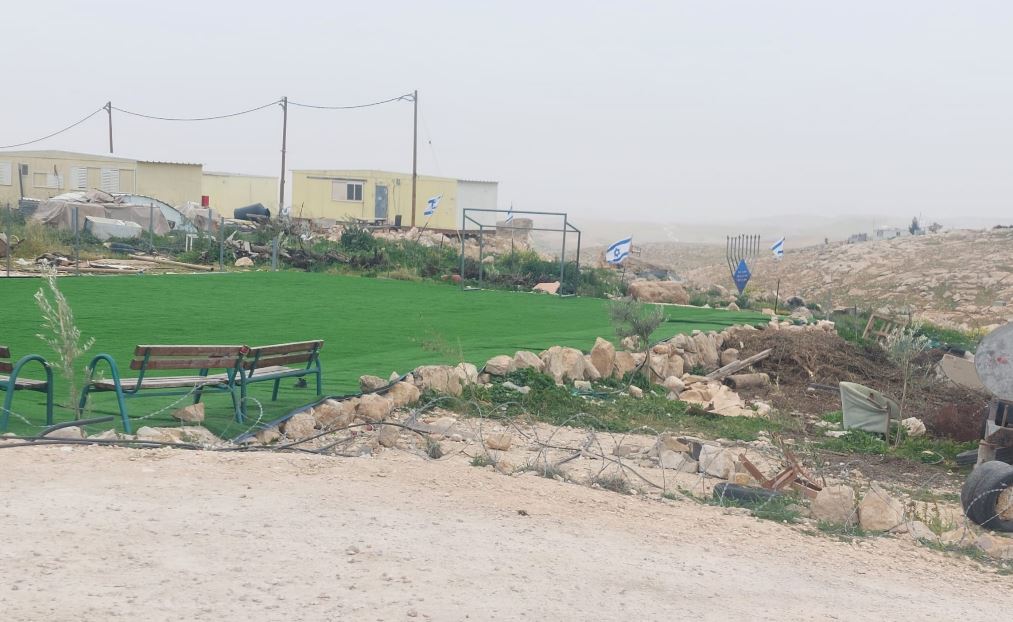 Michal TsadikFeb-17-2026Umm al-Khair: The soccer field for Palestinian children is surrounded by new trailers and lots of Israeli flags
-