
Duma, Jordan Valley-Never ending water shortage
Duma
We visited the local council and met with M.D., the councilman. We showed interest in the state of the village. “Rotten,” said M.D. in fluent Hebrew that he had mastered during his years of work in Israel.
The main problem is water, a problem that becomes even more severe as summer grows close. The village is located over the springs of Umm Rashrash and En Duma south of the village, controlled by the Israeli water company Mekorot. The village has 2,700 inhabitants and cannot afford the pipe infrastructure that Mekorot demands, so, for now, the water supply is from Bir Rajoub, controlled by the Palestinian Authority. However, Bir Rajoub also provides water to Yanoun, Majdal Bani Fadal, Talfit, Kusra, Jawarish, Karyut, and Nablus city. So Duma is only entitled to 24 m2 for the whole village. This amount is insufficient for humans and livestock during the hot summer days.
When this runs out, villagers pay 700 shekels + transport per water tank (about 10 m2) from En Samia.
Due to the water shortage, as well as the problem of dwindling grazing grounds, there are only 1,500 sheep left in the village.
Settler colonies
The settler colonies of Esh Kodesh, Shevut Rachel, Shilo, Kochav Hashachar, and others surround Duma. These settler-colonists kept harassing Duma, more than other villages, and especially its shepherds. They throw stones, block the road and stop cars, disrupt the olive harvest, and cut down trees. Since the incendiary attack on the Dawabsha home that had ended in horrendous tragedy, four more fires were set in the village, but, M., thank goodness there were no more casualties. Occasionally the settler-colonists sneak into the village and set cars on fire.
Lands
Lately, there has been growing interest in the village lands, especially on the part of Bedouins from Yatta (South Hebron Hills) and even from the Jerusalem area. Villagers began selling public lands or lots that did not belong to them. Things are not handled with the registry or in an orderly fashion. Sometimes the sale is carried out for cash in return for a piece of paper. The council has been fighting this phenomenon but in vain. The people who bought land established their claim on the land and blocked access to other lots. Conflicts and fights over land arise within the village. The council has asked the PA to intervene but justice is slow to act and registering lands costs a lot.
The School
400 students attend the high school and the council cannot afford to renovate the building. It is in precarious condition and M. fears that a disaster is just a matter of time. His requests for help from the PA have so far been bureaucratically delayed.
The council members are volunteers and must seek work in their profession. At the same time, the council’s job is demanding, especially now given the numerous hardships and the council’s very low income, so the problems just grow and there are no solutions in sight.
The situation is saddening and difficult. However the people whom we met – A.S. at the hardware store, Sheikh A. at the grocery store, and L. who was walking along with her daughter. All spoke with us; they were friendly, kind, and welcoming, as was the councilman who accompanied us out of the village, and even called to inquire whether we had arrived safely at Fasail, our next stop.
We ended our visit at the shop of Hussein Dawabsha, who welcomed us and bought groceries for H. in Fasail.
Fasail
The landscape is magnificent. Except for a single army vehicle, we saw no uniforms, which of course contributed to our well-being.
We reached H. She has family in Jericho, a father and a mother, and brothers who studied engineering in Italy, but her home is here in Fasail. Here she can make a living from the flock herded by her two sons, and enjoy the shade of the tree that grows near her tent. She loves the place. We have also met her sister N., who teaches history and geography at the local school and lives nearby.
On our way back to Israel, at the Maale Efrayim checkpoint, we saw the line of Palestinian vehicles on their way from the West Bank hills to the Palestinian Jordan Valley, At 14:00, we counted 12 vehicles.
Duma
See all reports for this place-
Duma
A village in the Nablus governorate, with 3,000 residents. They owned some 18,000 dunams, 500 dunams of which the village itself was built. However, after the settlement of Migdaleim annexed a large part of their land, their area was reduced to only 2,000 dunams.On July 31, 2015, two houses in the town were torched with petrol bombs. Sa'ad and Riham Dawabsha, and their infant, Ali Sa'ad Dawabsha, were burned to death. Another son was seriously injured. "Revenge" and "King Messiah" were spray painted on the walls of the house. The trial of the arsonist, the settler Amiram Ben Uliel, is still underway (2019), and a plea bargain was signed in May 2018 with the minor who participated in the planning of the arson.
The closure imposed by the army, the poor roads that they are forced use due to the lack of paving permits from the Civil Administration, along with the lack of public transportation, all these difficulties cut off the village from nearby Nablus and Ramallah.
-
Fasa'il
See all reports for this place-
An old community of shepherds in the Jordan Valley that is located between settlements and is exposed to the demolition of its residential buildings at times by the army and the abuses of the settlers. King Herod founded the city of Fatza'elis in 8 BC, and named it after his older brother, Petzal. The permanent settlement in the place began with Bedouins who migrated to the area as early as the 1950s after being expelled from the Tel Arad area. Over the years, additional Bedouin residents who were expelled from other places in the Jordan Valley joined. Areas that were declared as fire areas or state lands . As part of the Alon plan, a significant part of the lands in the area were expropriated and four Israeli settlements were established on them: Tomer, Gilgal, Fatza'el Netiv HaGdud. Illegal posts were erected over the years. Some of them were authorized during the 7th October War.
-
Jordan Valley
See all reports for this place-
Jordan Valley The Jordan Valley is the eastern strip of the West Bank. Its area consists of almost a third of the West Bank area. About 10,000 settlers live there, about 65,000 Palestinian residents in the villages and towns. In addition, about 15,000 are scattered in small shepherd communities. These communities are living in severe distress because of two types of harassment: the military declaring some of their living areas, as fire zones, evicting them for long hours from their residence to the scorching heat of the summer and the bitter cold of the winter. The other type is abuse by rioters who cling to the grazing areas of the shepherd communities, and the declared fire areas (without being deported). The many groundwaters in the Jordan Valley belong to Mekorot and are not available to Palestinians living in the Jordan Valley. The Palestinians bring water to their needs in high-cost followers.
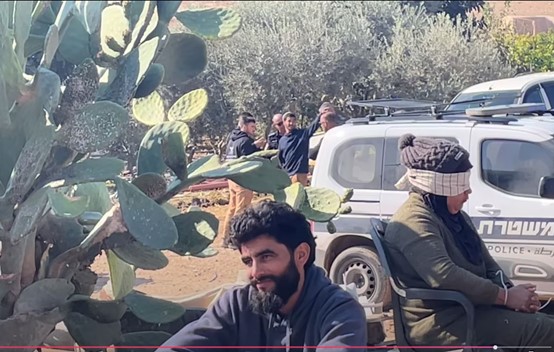 Rachel AfekDec-18-2025Hadidiya: On the right, the woman accused of throwing stones; on the left, the man accused of "something"; in the background, the settler is hanging out with soldiers and police officers
-