
Dura-Al Fawwar Junction, Hebron, South Hebron Hills
10:00 – 14:00
Hebron – remnants of the snow are visible everywhere and the children outside throw snowballs at one another.

The trees planted in the courtyard of the Cordova School above Shuhada Street, opposite Beit Hadassah, were uprooted in the night between Thursday and Friday, the day of the big storm. The police and Civil Administration staff come to the school. They haven’t yet viewed the film from the security cameras. Tomorrow the Palestinian Authority representative who’s in charge will come and examine the films. Everyone assumes the settlers who probably did it concealed their faces. No official complaint was made to the police. The policemen show A., the school’s custodian, remains of olive trees farther down the street, and another policeman doesn’t allow anyone to approach because they might find traces. The policeman guarding the remnants of the olive trees asks one of the settlers whether he saw anything and tells him that those who uprooted the seedlings apparently came from Beit Hadassah (that’s what Nili heard).

The plot that was destroyed; the policeman with A., the custodian; remains of olive trees.
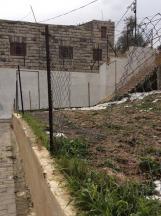
And where olive trees are uprooted…the evil and wickedness in the city of the patriarchs…
The canopy of the new restaurant below Beit Hameriva has been removed and a bus stop has been added… We run into the Ecumenical peace activist women, they haven’t yet heard about the uprooted seedlings.
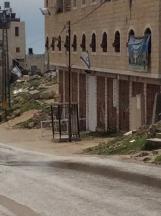
In the morning, at the Dura-al Fawwar junction, we see the following sight:
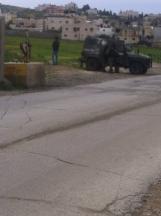
Since the Palestinian turned his back to us we thought we shouldn’t remain if he doesn’t wish us to, and we left. When we returned he was no longer there and the Border Police soldiers didn’t tell us why he’d been detained. And again at the junction, at 1 in the afternoon, when children come home from school, IDF soldiers with weapons for dispersing demonstrations are there – but there are no children throwing rocks.
Thirty-six housing units are being added in Sham’a (there’s money for that). The work proceeds apace.

Otherwise, nothing’s new.
Dura Al-Fawwar Junction
See all reports for this place-
Junction on Route 60: west - the town of El Dura, east - the Al Fawwar refugee camp. There is a manned pillbox at the junction. From time to time the army sets up flying checkpoints at the entrance to El Fawwar and Al Dura. Al-Fawwar is a large refugee camp (7,000 inhabitants in 2007) established in 1949 to accommodate Palestinian refugees from Be'er Sheva and Beit Jubrin and environs. There are many incidents of stone-throwing. In the vicinity of the pillbox there are excellent agricultural areas, Farmers set up stalls adjacent to the plots close to the road. In recent months the civil administration has set up dirt embankments thereby blocking access to the stalls, and making it impossible for the farmers to sell their vegetables. Updated April 2021, Michal T.
-
Hebron
See all reports for this place-
According to Wye Plantation Accords (1997), Hebron is divided in two: H1 is under Palestinian Authority control, H2 is under Israeli control. In Hebron there are 170,000 Palestinian citizens, 60,000 of them in H2. Between the two areas are permanent checkpoints, manned at all hours, preventing Palestinian movement between them and controlling passage of permit holders such as teachers and schoolchildren. Some 800 Jews live in Avraham Avinu Quarter and Tel Rumeida, on Givat HaAvot and in the wholesale market.
Checkpoints observed in H2:
- Bet Hameriva CP- manned with a pillbox
- Kapisha quarter CP (the northern side of Zion axis) - manned with a pillbox
- The 160 turn CP (the southern side of Zion axis) - manned with a pillbox
- Avraham Avinu quarter - watch station
- The pharmacy CP - checking inside a caravan with a magnometer
- Tarpat (1929) CP - checking inside a caravan with a magnometer
- Tel Rumeida CP - guarding station
- Beit Hadassah CP - guarding station
Three checkpoints around the Tomb of the Patriarchs
 Raya YeorDec-18-2025Hebron - Yusri Jaber and part of his family
-
South Hebron Hills
See all reports for this place-
South Hebron Hills
South Hebron Hills is a large area in the West Bank's southern part.
Yatta is a major city in this area: right in the border zone between the fertile region of Hebron and its surroundings and the desert of the Hebron Hills. Yatta has about 64,000 inhabitants.
The surrounding villages are called Masafer Yatta (Yatta's daughter villages). Their inhabitants subsist on livestock and agriculture. Agriculture is possible only in small plots, especially near streams. Most of the area consists of rocky terraces.Since the beginning of the 1980s, many settlements have been established on the agricultural land cultivated by the Palestinians in the South Hebron Hills region: Carmel, Maon, Susia, Masadot Yehuda, Othniel, and more. Since the settlements were established and Palestinians cultivation areas have been reduced; the residents of the South Hebron Hills have been suffering from harassment by the settlers. Attempts to evict and demolish houses have continued, along with withholding water and electricity. The military and police usually refrain from intervening in violent incidents between settlers and Palestinians do not enforce the law when it comes to the investigation of extensive violent Jewish settlers. The harassment in the South Hebron Hills includes attacking and attempting to burn residential tents, harassing dogs, harming herds, and preventing access to pastures.
There are several checkpoints in the South Hebron Hills, on Routes 317 and 60. In most of them, no military presence is apparent, but rather an array of pillboxes monitor the villages. Roadblocks are frequently set up according to the settlers and the army's needs. These are located at the Zif Junction, the Dura-al Fawwar crossing, and the Sheep Junction at the southern entrance to Hebron.
Updated April 2022
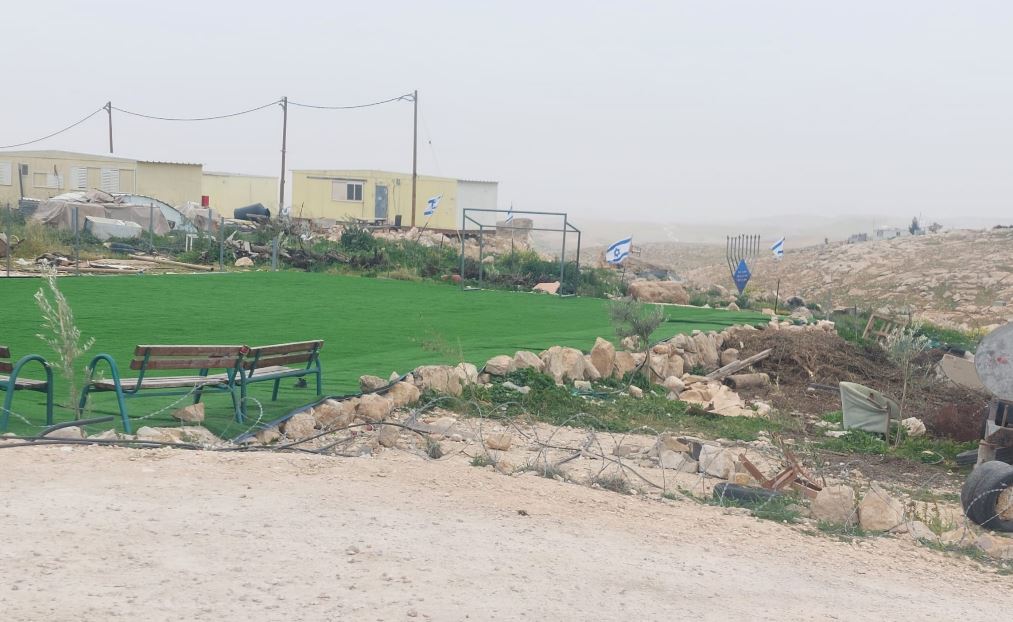 Michal TsadikFeb-17-2026Umm al-Khair: The soccer field for Palestinian children is surrounded by new trailers and lots of Israeli flags
-