
Dura-Al Fawwar Junction, Sansana (Meitar Crossing), South Hebron Hills, Tarqumiya
08:30-14:30
Meitar crossing – Deserted. The closure applies to all permit holders from Hebron. The parking lot is empty. The merchandise crossing is also deserted (no trucks are unloading sand, and none are loading).
Very few cars on Highway 60.
Eshtamoa outpost – Permanent structures have been added and more soldiers are on guard.
Deir Razek – Soldiers come mostly at night, enter homes and turn everything upside down, the children are very frightened. They’ve entered about 50 homes. We spoke to a Palestinian family; they’re all tired, think Bibi is forcing them to begin another intifada. The young man tells me they don’t even have strength for the World Cup and are worried about what will happen during Ramadan (which begins in five days).
We went to Dura to pay our respects to the Dudin family, which is in mourning. We arranged that M., from B’Tselem, would join us. Dura looks like a very attractive town, with a lovely main street and shops, everyone’s in the streets, there’s no closure, nor were there soldiers when we were there. M. tells us that the army entered about 100 homes in Dura.
The night they came (about 1000) no one slept, no one knew when it would be their turn. The soldiers came around midnight and left at dawn.
Mahmoud, who’s 13, was afraid the soldiers would come to his house, and was still upset after his mother closed the gate to the house and fled through the window to join a group of youths throwing stones. They were all about three years older than he; he just stood there. The soldiers didn’t use non-lethal means to disperse them but fired live ammunition from 80 meters away, and hit him in the chest. He died immediately.
His uncle told us the funeral was the largest he’d seen during his entire life, and he’s 51 years old. Today an art fair opened in Dura, named for Mahmoud. His mother, whose grief was terrible, sat with us for about an hour, a broken woman. She has twin daughters, aged 7, and is surrounded by family members. We gave her information about the Palestinian forum of bereaved families. We hope they’ll be a support group. Everyone we spoke to condemned the abduction, or didn’t believe it occurred, feel Israel is backing them into a corner, doesn’t want peace, why is the blood of their child worth less than that of a Jew?
The bereaved parents at the Dura-al Fawwar junction.
Traffic flows freely. A group of Palestinian youths stand on a hill across the way singing protest songs and throwing rocks. The army fires smoke grenades at them and a fire starts.
The youths aren’t there on our way back, but the army still is.
Beit Haggai – The balloon is in the air. The entrance to Hebron is open; there are no soldiers.
Kvasim junction – Entry to Hebron is unobstructed, soldiers in the pillbox.
Har Manoah – The military base of the Yehuda region brigade, a bulldozer loaded on a truck, a press tent that appears deserted.
Shuyukh – Hebron – The entrance to Hebron is blocked by the gate and soldiers together with Border Police are there 24 hours a day, seven days a week. The girls school is deserted because of summer vacation. M. told us that soldiers also entered all the schools while exams were underway, and searched wells, cisterns and any place under ground. On the other side, under the canopy, Palestinian taxi drivers were sitting, in a very foul mood. Their obvious despair is heartbreaking. They said soldiers didn’t enter many homes in Shuyukh. The soldiers didn’t allow us to go to his home – so we spoke next to the concrete barriers. The Palestinian taxi drivers on the other side of the plaza didn’t want us to photograph them.
Ukafim junction (Highway 60/Highway 35). Traffic flows freely. Many logistical military vehicles in the parking lot opposite the pillbox.
Hazayit crossing- Soldiers there don’t interfere with the free flow of traffic.
Halhul-Hebron bridge – Military vehicles, traffic flows freely.
Highway 35 – Many soldiers above Beit Kahil and in the tunnel from Hebron to Beit Kahil. An extensive search is underway. We run into all the military correspondents. It has been declared a closed military area.
All the wells and cisterns are being emptied; the Palestinian farmers may face a severe water shortage.
(More photos on Machsom Watch’s Facebook page).
Idna and Tarqumiyya – The owner of the grocery store tells us that army units had just come through Tarqumiyya to Beit Kahil; Tarqumiyya is open, there’s no curfew. But Idna has been under curfew since the abduction. It was lifted once for two hours; people move about only on foot.
Here’s a view of the Idna checkpoint:
People there are also in despair. They say laborers aren’t allowed through the Tarqumiyya crossing, they have no money, no work and are very desparate.
On our way home we visited the Ja’abari family near the entrance to Kiryat Arba, talked to them, had tea, ate mulberries from their orchard, sharing fantasies of better days.
Dura Al-Fawwar Junction
See all reports for this place-
Junction on Route 60: west - the town of El Dura, east - the Al Fawwar refugee camp. There is a manned pillbox at the junction. From time to time the army sets up flying checkpoints at the entrance to El Fawwar and Al Dura. Al-Fawwar is a large refugee camp (7,000 inhabitants in 2007) established in 1949 to accommodate Palestinian refugees from Be'er Sheva and Beit Jubrin and environs. There are many incidents of stone-throwing. In the vicinity of the pillbox there are excellent agricultural areas, Farmers set up stalls adjacent to the plots close to the road. In recent months the civil administration has set up dirt embankments thereby blocking access to the stalls, and making it impossible for the farmers to sell their vegetables. Updated April 2021, Michal T.
-
Meitar checkpoint / Sansana
See all reports for this place-
Meitar Checkpoint / Sansana The checkpoint is located on the Green Line and serves as a border crossing between Israel and the West Bank. It is managed by the Border Crossing Authority of the Defense Ministry. It is comprised of sections for the transfer of goods as well as a vehicle checkpoint (intended for holders of blue identity cards, foreign nationals or diplomats and international organizations). Passing of Palestinians is prohibited, except for those with entry permits to Israel. Palestinians are permitted to cross on foot only. The crossing has a DCO / DCL / DCL / DCL (District Coordination Office), a customs unit, supervision, and a police unit. In the last year, a breach has been opened in the fence, not far from the crossing. This breach is known to all, including the army. There does not appear to be any interest in blocking it, probably as it permits needed Palestinian workers without the bureaucratic permits to get to work in Israel. Food stalls and a parking area economy have been created, but incidents of violent abuse by border police have also been recorded. Updated April 2022
-
South Hebron Hills
See all reports for this place-
South Hebron Hills
South Hebron Hills is a large area in the West Bank's southern part.
Yatta is a major city in this area: right in the border zone between the fertile region of Hebron and its surroundings and the desert of the Hebron Hills. Yatta has about 64,000 inhabitants.
The surrounding villages are called Masafer Yatta (Yatta's daughter villages). Their inhabitants subsist on livestock and agriculture. Agriculture is possible only in small plots, especially near streams. Most of the area consists of rocky terraces.Since the beginning of the 1980s, many settlements have been established on the agricultural land cultivated by the Palestinians in the South Hebron Hills region: Carmel, Maon, Susia, Masadot Yehuda, Othniel, and more. Since the settlements were established and Palestinians cultivation areas have been reduced; the residents of the South Hebron Hills have been suffering from harassment by the settlers. Attempts to evict and demolish houses have continued, along with withholding water and electricity. The military and police usually refrain from intervening in violent incidents between settlers and Palestinians do not enforce the law when it comes to the investigation of extensive violent Jewish settlers. The harassment in the South Hebron Hills includes attacking and attempting to burn residential tents, harassing dogs, harming herds, and preventing access to pastures.
There are several checkpoints in the South Hebron Hills, on Routes 317 and 60. In most of them, no military presence is apparent, but rather an array of pillboxes monitor the villages. Roadblocks are frequently set up according to the settlers and the army's needs. These are located at the Zif Junction, the Dura-al Fawwar crossing, and the Sheep Junction at the southern entrance to Hebron.
Updated April 2022
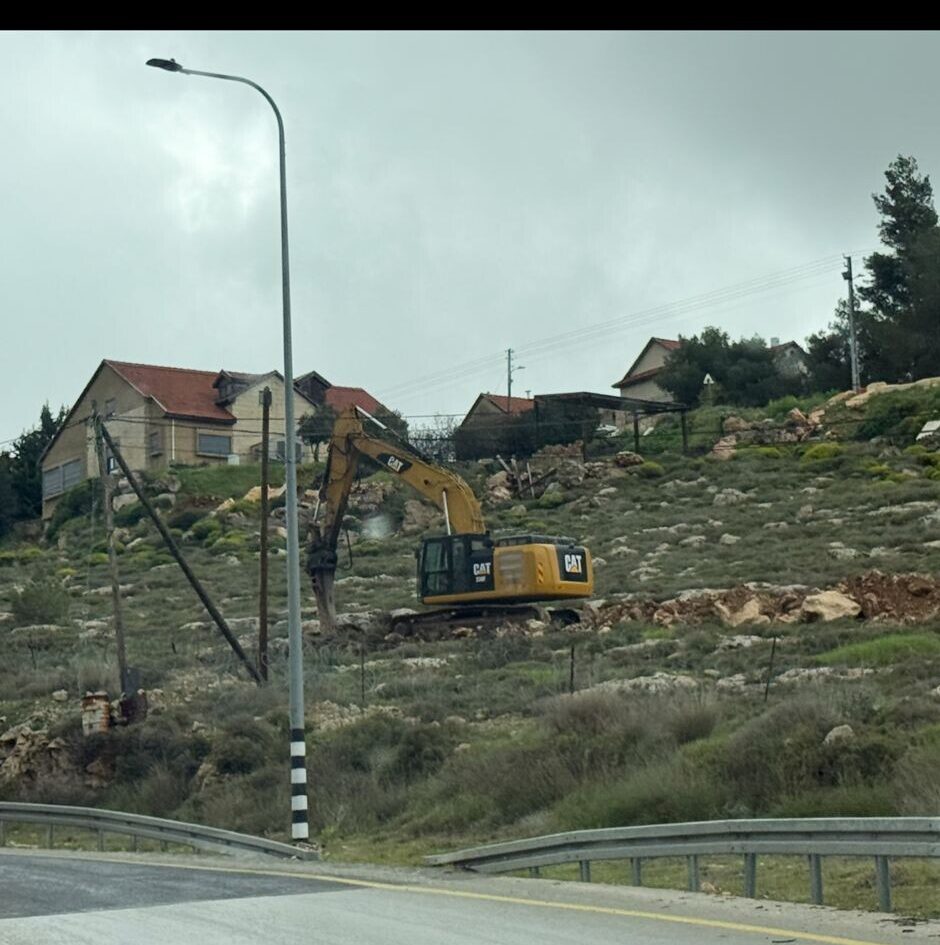 MuhammadFeb-24-2026South Hebron Hill, Beit Hagai: Paving an internal security road
-
Tarqumiya CP
See all reports for this place-
The Tarqumiya Checkpoint is one of the largest and busiest checkpoints where people and goods cross into Israel. It is located on the Separation Barrier close to the Green Line, on Road 35 (connecting Beer Sheva and Hebron). It is run by the Israel Defense Ministry’s Crossings Administration with civilian secuirty companies running the day to day operations. The checkpoint is indeed open to vehicles in both directions 24/7, but Palestinians are prevented from crossing in vehicles, except in special cases. MachsomWatch activists visit the checkpoint as it opens at 3:45 am, in order to observe the daily passage of nearly 10,000 Palestinian workers. The workers arrive from throughout the Southern West Bank. Our activists report on the tremendous overcrowding at this checkpoint; they have observed young men climbing and scrambling on the fences and roofs of the ‘access cages’. This is how the work day begins for those who ‘build the land of Israel’. updated November 2019
-