
Ein al-Hilweh: Morning, noon and night, together and apart, the army and settlers make Life Unbearable for Shepherding Communities
A troubled Sabath – All around the clock, the settlers and soldiers, sometimes working together and sometimes separately, did not leave the shepherding communities in peace.
On Thursday (Aug. 21), the Civil Administration arrived with bulldozers to demolish the home compound of the K. family in Ein al-Hilweh — despite an active demolition freeze order until September 3. The family had hoped things would be resolved. Behind the scenes, officials shifted the justification for the demolition — not “illegal construction” as originally claimed, but rather that the buildings were “too close to a junction and posed a risk.”
Fortunately, the family’s herds were grazing near Tayasir at the time, so the animals were spared. But soldiers prevented the two elderly family members who were present from removing anything. They crushed belongings with cruelty — broken troughs and shattered metal bars from the pens were strewn everywhere. Slashed and smashed water containers, kitchenware flattened and thrown about. All this beside broken block walls of the space that served as a lovely hospitality room. The solar panels were destroyed and disconnected too, except for one that happened to survive, which K. and his wife S. used to power a refrigerator to keep a little fresh food and cold water brought from neighbors.
By Friday afternoon, despite their devastation and despair, the family decided not to leave. They had nowhere else to go. Using what strength they had left, they built a small makeshift shelter for shade during the day and rest at night. They placed the surviving refrigerator inside, along with some mattresses and blankets. They also hung up a piece of cloth to create a shaded area where visitors could sit — people who came to mourn with them over the loss of their 60-year-old home, where they had raised their entire family, now destroyed in an hour.

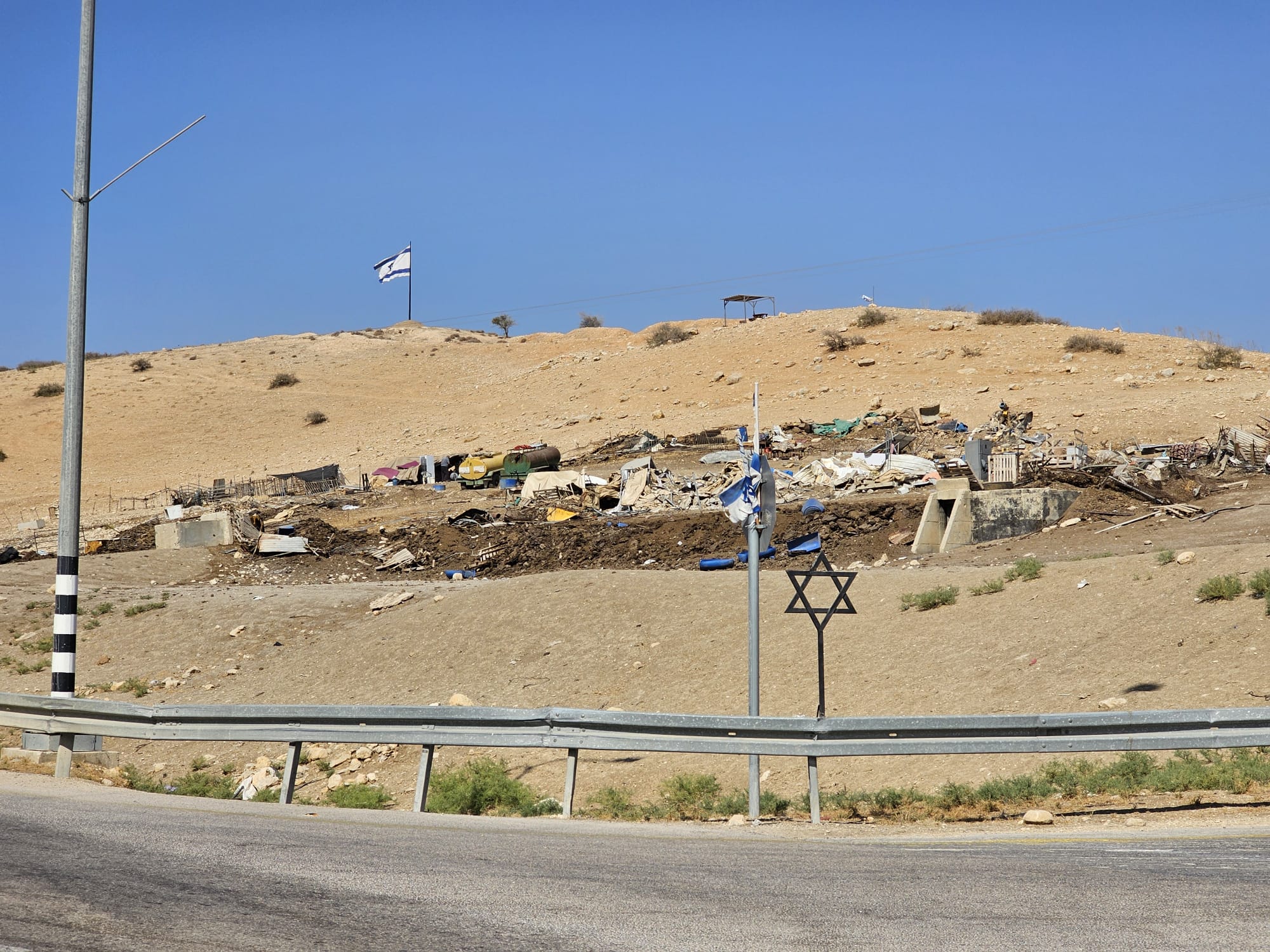

But the army and settlers wouldn’t even allow them that. Around 8:00 p.m. Friday night, a civilian vehicle with flashing lights arrived, carrying the armed security coordinator from Maskiyot. He entered the compound and demanded they immediately dismantle their tiny 4-square-meter shelter. Half an hour later, three soldiers and a reservist arrived. They arrested K., the head of the family, without explanation — handcuffing him, blindfolding him, and taking him to a nearby base. Four hours later, he was released, again with no explanation. At 4:00 a.m. the family lay down on the bare ground with no shelter.
The ordeal continued. At 8:00 a.m. Saturday morning, another civilian vehicle arrived marked “Transport Unit,” with soldiers inside. They refused to speak to the escorts. Instead, they ordered the father to remove the cloth canopy providing shade. The family tried to explain it was all they had left — so the mother could rest without sitting in the blazing sun — but the soldiers were unmoved. It felt like talking to robots.
Another hour in the sun, the police arrived with a Border Police unit — an entire convoy with vehicles, weapons, and uniforms. A local “nice” police officer from Maskiyot, Aviasaf Cohen, arrived and told the activists to move away from the family and declared the area a “closed military zone,” though he showed no official document. Meanwhile, the family’s makeshift tent was again torn down, and belongings scattered. By 11:00 a.m., everyone — the family and their supporters — were left sitting in the burning sun.
Then, just as suddenly, the soldiers left. The family, escorts, and visitors stretched the piece of cloth again for shade, shared some food and water brought from the village of Ein al-Beida, and sat together. Despite the pain, frustration, and despair, the family repeated: “We will not break. We will stay. This is our home.
At 2:00 p.m., the Civil Administration returned for a third visit. They spoke to the father but told the escorts not to come near, accusing them of “inciting” the family and being the cause of their troubles (not the settlers who want their land). They assured the family they would “help them on Sunday.” After they left, K. turned to us and said: “Liars… They will never help.”
Elsewhere, things were relatively calmer. In Bardala, escorts walked with a farmer, opened irrigation taps near settler homes, and helped him pick hot peppers — his workers were too afraid to come. In Farisiya, settlers seemed to take a “day off” from harassment. In Ein al-Sakut, the herds grazed peacefully in the morning, and later rested near the pen.
But by evening, four settlers showed up again, circling the herd on an ATV. Escorts called for reinforcements, and the settlers eventually left — settling for a round of intimidation this time.
Late at night in Farisiya, four settlers came down toward the village homes. Escorts rushed out with a flashlight and managed to chase them away. But by morning it was clear they had caused damage before leaving — cutting electrical wires near L.’s home.
It was repaired, but this is no way to live.
Location Description
'Ein al-Hilwe
See all reports for this place-
Ein al-Hilwe is a natural spring and a Palestinian grazing area in the Jordan Valley that was used by the Palestinian shepherd communities for watering their flocks and for daily use. As of 2021, settlers from the Maskyot settlement took control of the spring: they fenced it off, built a wading pool and a mikveh, and installed flags and recreational facilities.
Palestinians are effectively denied access to the spring, and are forced to make do with running water in a remote wadi or, when the road is blocked, buy water from vendors at high prices.
The spring is located in the heart of an area where illegal outposts are being established, as part of a broader trend of pushing Palestinian communities away by denying them access to essential resources. Neighboring communities such as Umm Jamal and Khirbet Samra have already left due to the pressure.
Over the years, MachsomWatch members have reported arrests on false claims by settlers, harassment and violence, including damage to herds, intrusion into homes, and the intimidation of children. MachsomWatch volunteers participate in a protective presence in areas around the spring to prevent harassment of shepherds due to the presence of settlers.
-