
Elkana salient, ‘Azzun, Falamya north, Falamya south, Habla - a tour with 2 guests

10:45 “Hani gate” checkpoint (1649). Large heaps of sand and building materials which weren’t here on a previous visit. A man emerges from a car that approaches rapidly and parks beside the gate, ignores us, and after a minute a second car arrives, four people emerge and all move toward the refuse heaps.
I continue explaining how the separation barrier wasn’t erected on the Green Line, and created the seam zone in order to allow access to the settlements established in this area and elsewhere along the border without going through checkpoints, allowing one to ignore the fact they were erected on Palestinian land.
While I’m explaining about Hani’s house, and using maps to show the direct route from Siniriyya to Miskha, which has been interrupted twice by the barrier, the men return to the cars. I ask what they’re planning. They reply: four or five more settlements between here and Siniriyya – ‘insh’allah…
We drive along the fearsome wall surrounding ‘Azzun Atma to Oranit checkpoint (1442), which the army has decided to keep closed as collective punishment for all of ‘Azzun Atma’s inhabitants who are cut off from their lands by the separation barrier. We spoke to some of them in the greenhouses near Kafr Qassem. They asked us to explain to the army that it’s difficult for them to travel a few kilometers north on foot or in a cart harnessed to a small donkey to the Abu Salman gate checkpoint (1419), and it’s hard for the donkey to pull the cart up and down the steep inclines of the wadi beyond the checkpoint – instead of being able to reach their village directly along the blocked road.
On the way to the checkpoints farther to the north I pointed out where the Green Line crossed Highway 55, and the great distance to the Eliyahu checkpoint because of the Alfei Menashe settlement. I also indicated Bedouin villages that remained on this side of the fence even after it had been moved following the Supreme Court decision that returned four villages to the Palestinian side. We stopped for a few minutes in ‘Azzun, which seemed quiet, and continued via Jayous and Kafr Jamal.
12:30 Falamya checkpoint (914). We spoke with two Palestinians who own land beyond the fence. They said they’d had no difficulty obtaining permits valid for two years, that the gates open as scheduled, and in fact a few minutes later the soldiers arrived and opened them. Most traffic was heading east, toward home – some people on foot or riding bicycles, 5-6 tractors, most pulling carts on which people were riding, but no produce. They said the olive harvest began officially on October 1, but the Palestinian Authority instructed not to begin before October 10 to allow additional ripening.
We continued to Falamya south/Jayous north checkpoint (935), explaining about the fence that that been moved and the flourishing agriculture which developed as soon as access to the lands didn’t depend on the checkpoints. Only one tractor waited beyond the fence. We returned via Jayous and ‘Azzun. A military vehicle already waited left of the exit to Highway 55.
13:45 Habla checkpoint (1393). Heavy traffic of cars, mostly toward the plant nurseries. The soldiers (MP’s) inspect the cars energetically, opening doors and trunks. A small truck also exited with crates of seedlings (a one-time event, or policy change?). Petahya and Tziona arrive and we drive for a brief visit with A. The repeated crossing of checkpoints to get from his home in Qalqilya to his lands and the plant nursery is exhausting.
'Azzun
See all reports for this place-
Azoun (updated February 2019)
A Palestinian town situated in Area B (under civil Palestinian control and Israeli security control),
on road 5 between Nablus and Qalqiliya, east of Nabi Elias village. The inhabitants are allowed to construct and improve infrastructures. The Separation Fence has confiscated lands belonging to the town's people. In 2018 olive tree groves owned by one of its inhabitants were confiscated for the sake of paving a road to bypass Nabi Elias. Azoun population numbers 13,000, its economic state dire. Its infrastructures are poor, neglect and poverty rampant. In the meantime, the town council has completed paving an internal road for the inhabitants' welfare.
Because of its proximity to the Jewish settler-colony of Karnei Shomron and its outposts, the town suffers the intense presence of the Israeli army, especially at nighttime: soldiers enter homes, arrest suspects, trash the house and sometimes ruin it, as they do in numerous places in the West Bank. At times a checkpoint closes the entrance to the town, so no one can come in or get out.
-
Falamiya North (914)
See all reports for this place-
Falamiya North (914) Opens 3 times a day for about 40 minutes each time. This checkpoint has extremely important for all farmers in the area since the previous, Falamya checkpoint opening routine of continuously open for 12 hours has been discontinued. This took place after the separation fence was moved westward following the High Court of Justice.
-
Falamiya South (935)
See all reports for this placeHabla CP (1393)
See all reports for this place-
Habla CP (1393)
The Habla checkpoint (1393) was established on the lands of the residents of Qalqilya, on the short road that
connected it for centuries to the nearby town of Habla. The separation barrier intersects this road twice and cut off the residents of Qalqilya from their lands in the seam zone.(between the fence and the green line).
There is a passage under Road 55 that connects Qalqilya to the sabotage This agricultural barrier is used by the farmers and nursery owners established along Road 55 from the Green Line and on both sides of the kurkar road leading to the checkpoint.
This agricultural checkpoint serves the residents of Arab a-Ramadin al-Janoubi (detached from the West Bank), who pass through it to the West Bank and back to their homes. The opening hours (3 times a day) of this agricultural checkpoint are longer than usual, about an hour (recently shortened to 45 minutes), and are coordinated with the transportation hours of a-Ramadin children studying in the occupied in the West Bank.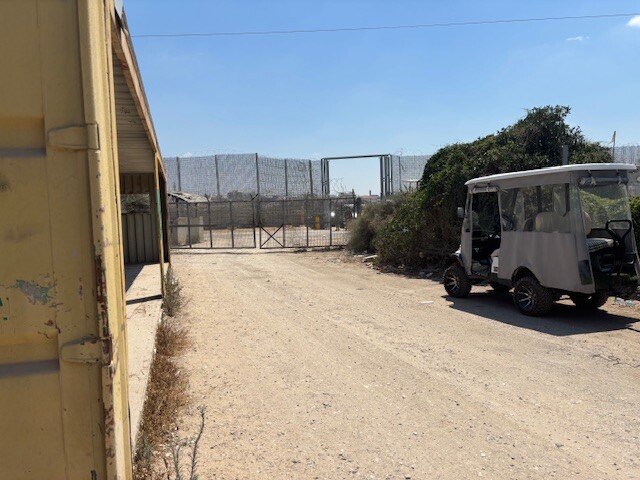 Nina SebaAug-18-2025Habla: The gate is in the process of closing
-