
Eyal Crossing, ‘Anabta, ‘Azzun, Deir Sharaf, Qalqiliya, Sun 26.7.09, Afternoon
Summary
Today's newspaper told us that "Israel will agree to temporarily freeze construction in settlements." Actually halt construction in the settlements? We thought we'd do some validation on a small number of "the detailed list of all projects in the West Bank currently under construction and which Israel believes cannot be halted." We can't be sure of the list that Defense Minister Ehud Barak has supplied to the Americans (but maybe we've provided him a few that he forgot)!
Around Qalqiliya (settlement of Alfei Menashe)
Habla and Ras Atiya are isolated from their "mother" city, Qalqiliya. Why? They are situated on the Separation Barrier whose aim is not only to encompass surrounding Israeli colonies but, as we saw today, to extend them more and more. On the way up to Alfei Menashe from Route 555, there's a brand new poster advertising new apartments: presumably a project that "cannot be halted." Indeed, as we climb the steep hills above the plant nurseries of Habla, we see that the brand new, blindingly white, retaining wall sits contentedly in the hot summer sun, and the new roadways carved behind it are preceding well — huge trucks working on "essential growth" of the original settlement which is, of course, quite a distance away.
Ras Atiya (on the seam line)
14:50 – three soldiers outside and a group of young men in a car trying to cross, leave their car, disappear into the checking house (not a hut, since it's built of concrete), and emerge soon after, some of them crossing by car, some walking, and two coming with us.
15:10 Qalqiliya
Two soldiers, their backs turned to traffic in the small lookout tower, completely oblivious to the traffic in and out of the city. And it must be a city, not the "village" touted on the large, red "Entering Area A" sign. The entry, past the old checkpoint, is a divided highway, planted with flowers and new palm trees. Further, we don't venture!
On Route 555
Back to the reality of Occupation, we're greeted by a hidden Hummer on the north side of the roadway, west of Azzun. The town itself is open, but we note, from the "apartheid
road" that, parallel to it, the road used by Palestinians when Azzun is put under siege, has been newly asphalted, perhaps in preparation for the closing of the town once again, who knows when and under whose whim.
New housing signs are taken note of at all the colonies we pass: Maale Shomron, Qarnei Shomron, the infamous Qedumim.
At Qedumim there's activity on the hillside, south of the road. A settler, distinctive hairdo and dress, wanders around the mouth of the wide open cave, a new "tent" has been perched on the hilltop, and, below, another indicator of "settlement" or "outpost" – a green plastic awning shelters a seated man, or a woman, from the strong sun.
Around Nablus
16:00 Deir Sharaf
Less traffic than usual, not so many vehicles with Israeli yellow plates (in spite of the huge month long shopping festival in Nablus which has attracted attention in Kuwait, Qatar and many other countries (other than this one). There are a lot of army vehicles, Hummers and jeeps all over the OPT today, more than has been normal of late, usually entering or exiting settlements.
At the entry to the checkpoint, on a boulder where the "big A" tells us that we, Israeli citizens (who happen not to be Palestinian in origin) are not welcome, is a lime green poster (which has been there for well over a week by now), telling: "Have you seen exceptional movements of the security forces? Do you have information on impending evacuation? Contact now the war room of the Settlements 052 630 2222." (Note: the wording is a literal translation of the Hebrew, but the intent is quite clear: what is odd is the placement of this notice on a boulder at a checkpoint, but on second thoughts, maybe not so odd!)
No checking at all, but the five soldiers, whose position is in the center of the said checkpoint, are more than a little displeased when we walk up to them to ask about the situation. One tells us that we cannot stand where we are; we tell him we need to ask questions. A second soldier, a woman, comes up to repeat the order and hovers over us as we make our way back to the start of the checkpoint. "You must stand 300 meters from the checkpoint." We assume she means from her and the other soldiers, but not from the checkpoint itself….
Around Tulkarm
16:20 Anabta
More Israeli cars (yellow license plates) here than at Deir Sharaf. A digger is busy at work, high above the new and expanded vehicle checkpoint, at the military camp overlooking everything. The five or six vehicles in line for checking, far from where we stand, when we arrive, increase soon to eleven or twelve. We already know from Palestinian sources that this checkpoint is alive and well and causes frequent bottlenecks and so hampers the new "freedom of movement."
Around Qalqiliya
16:55 Eyal
Groups of up to 20 workers move at a brisk pace from the parking lot to the terminal and emerge a couple of minutes later, homeward bound, although home may still be hours away from their access point to making a living…. There seem to be waves of returning workers: as a minibus disgorges its passengers, they make their way speedily homewards.
17:10 Zufim gate
Open, little traffic, but many settler cars returning "home". No Palestinians at the gate.
Note: all settlements we pass have huge roadside advertisements for housing. But Zufim has at least three ongoing housing projects at work. One, Pomegranate Heights, overlooks Route 555, and it's alive and well with the infrastructure well in place. Another project, boasts a huge sign in the middle of the settlement, facing north, and everywhere on the northern face of the hill are small signs advertising "plots" with a mobile phone number to call. A settler youth, headgear and hairdo to match, walks a donkey, incongruously, in this well kept and suburban looking colony, the towers of Ramat Gan and Tel Aviv clearly in view.
17:35 Habla Gate 1393 (on the Seam Line)
As at Ras Atiya, the two soldiers by the open gate (as of 17:30) do nothing but stand guard. A disembodied voice calls out from an enclosed structure (concrete, so not a hut or checking booth) on the far side of the Separation Barrier, "Next in line," and a few of the waiting men saunter over to get their IDs checked – in order to go home! Sometimes, they return to retrieve a bicycle, and then continue on their way, all seemingly in good and cheerful mood.
17:40 Here come the sheep! They need no checking or IDs, but they, too, seem to know the ropes of this weird existence, cross the Separation Barrier (about the color of their shorn coats) and wander off into the distance.
'Anabta CP
See all reports for this place-
'Anabta CP
The checkpoint is located south of the village of 'Anabta, at the intersection of Road 60 (leading to Nablus at the entrance to Area A), with Road (57, 557, 5576) facing west towards the Einav settlement and the checkpoint at the exit from the West Bank - Figs checkpoint. Until 2010 we used to watch the intersection and report the long columns created due to a slow inspection of the vehicles in both directions.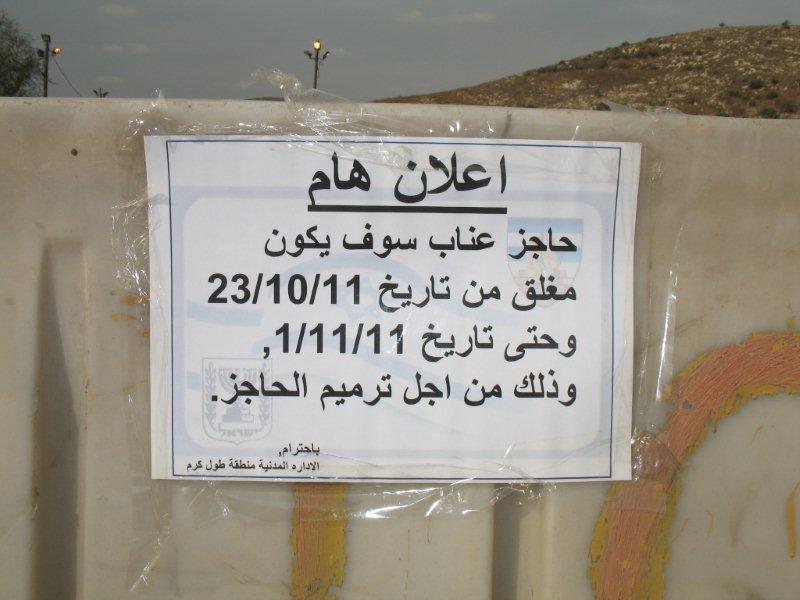 Oct-28-2011Anabta checkpoint 24.10.11
-
'Azzun
See all reports for this place-
Azoun (updated February 2019)
A Palestinian town situated in Area B (under civil Palestinian control and Israeli security control),
on road 5 between Nablus and Qalqiliya, east of Nabi Elias village. The inhabitants are allowed to construct and improve infrastructures. The Separation Fence has confiscated lands belonging to the town's people. In 2018 olive tree groves owned by one of its inhabitants were confiscated for the sake of paving a road to bypass Nabi Elias. Azoun population numbers 13,000, its economic state dire. Its infrastructures are poor, neglect and poverty rampant. In the meantime, the town council has completed paving an internal road for the inhabitants' welfare.
Because of its proximity to the Jewish settler-colony of Karnei Shomron and its outposts, the town suffers the intense presence of the Israeli army, especially at nighttime: soldiers enter homes, arrest suspects, trash the house and sometimes ruin it, as they do in numerous places in the West Bank. At times a checkpoint closes the entrance to the town, so no one can come in or get out.
-
Deir Sharaf checkpoint
See all reports for this place-
Deir Sharaf checkpoint is located west of Nablus and south of the settlement of Shavei Shomron, at the entrance to the village of Deir Sharaf on the road leading to Nablus. The checkpoint was activated in early March 2009 after the Beit Iba checkpoint was closed. Palestinians are allowed through the checkpoint , but not for Israelis. Unlike the checkpoints leading to Qalqilya and Tulkarm, crossing of Israeli Palestinians is only allowed on Saturdays.
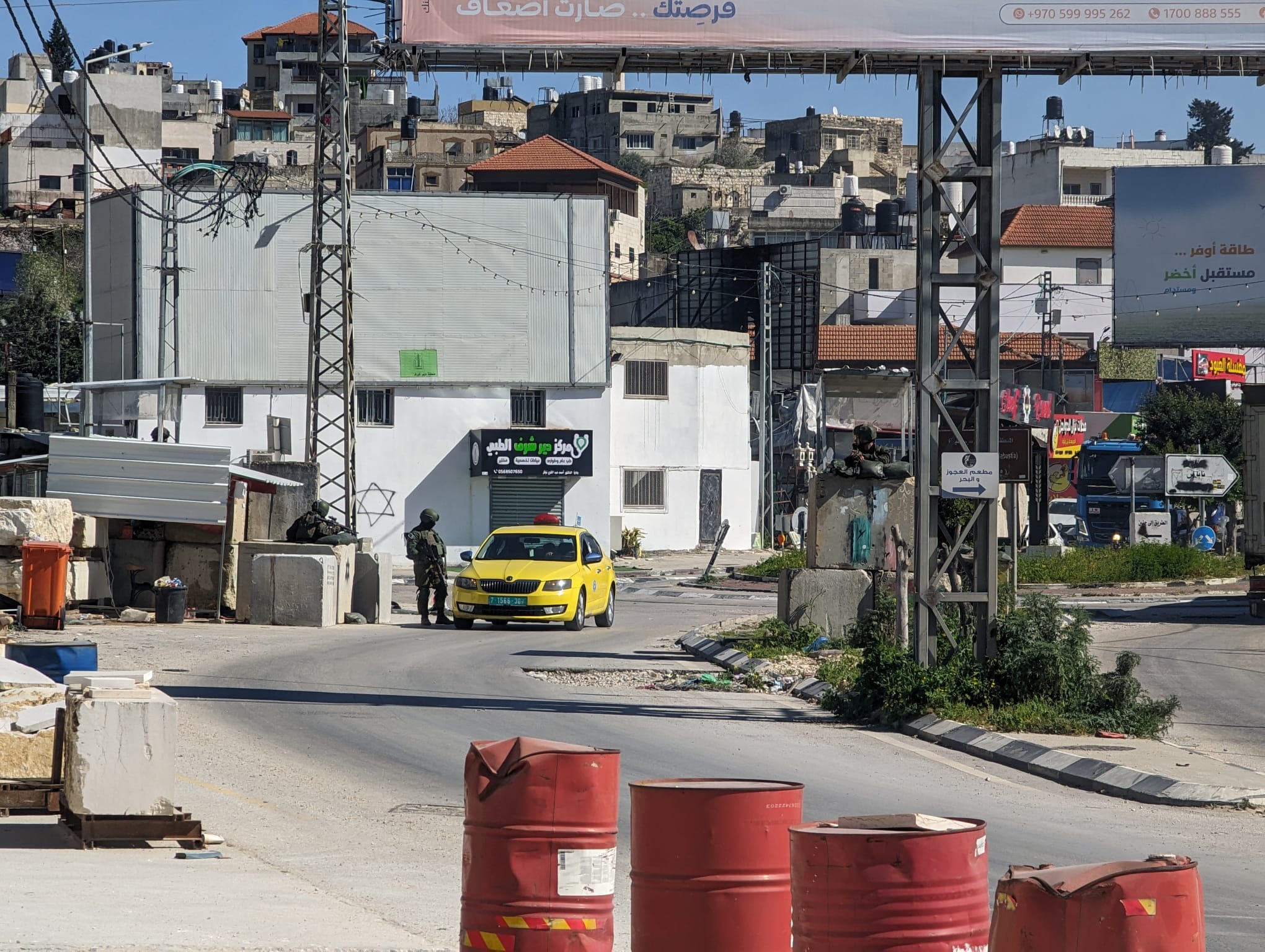 Nina SebaFeb-28-2024Deir Sharaf - the entrance to the village
-
Eyal Checkpoint / Crossing
See all reports for this place-
Eyal Checkpoint is intended for pedestrians and Palestinians only. This is the main barrier for workers to cross from the center of the West Bank. Workers with a work permit to enter Israel can pass through it for trade, medicine, and visiting prisoners. The checkpoint was built on the Green Line north of Qalqilya in the separation barrier that surrounds the city. The checkpoint began operating in 2004 by the military. Opening hours on weekdays from 04:00 to 19:00. We started holding shifts there in 2007. We arrived at the checkpoint before it opened at 4 in the morning. We reported on the difficult conditions and the long and cramped queues of workers who must continue their journey by commuting to work throughout Israel. At the end of June 2009, the checkpoint was operated by a civil security company, The transit time has been gradually shortened, today it is faster, but the Palestinians still have to arrive very early to make it to the transportation. Usually, about 15,000 people pass through.
-
Qalqiliya checkpoint
See all reports for this place-
Qalqilya is surrounded on all sides by the separation barrier. The only exit from the city is in the east of the city on the road that leaves the city in an easterly direction. This is where the checkpoint was located. When the checkpoint was active until 2009 our shifts watched long queues of cars being inspected at the only exit from the city to the West Bank. The checkpoint was canceled, but there is a military presence at the entrance to the city.
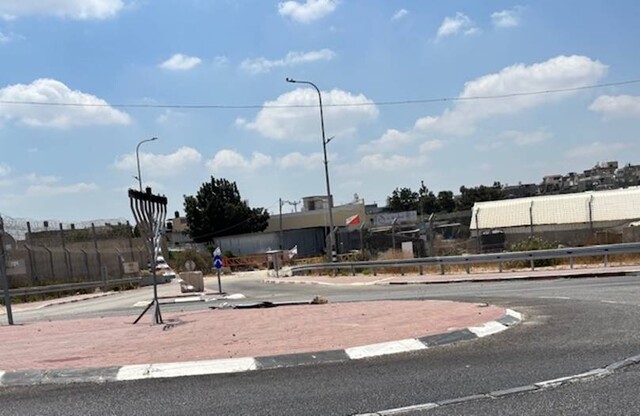 Nina SebaAug-18-2025Azzun: Enclosed by a high fence and the gate to the village is closed
-