
Eyal Crossing, ‘Anabta, Beit Iba, Irtah (Sha’ar Efrayim), Sun 28.6.09, Morning
06:45 Eyal Passage
This is the first day on which the passage was handed over from military to civil administration. The area has changed. On the one hand the square in front of the passage is cleaner than before, but on the other, lattice fences have been put up, which direct the workers from the passage to an exit lane, and which make our and their approach towards the workers' queue from the Palestinian side of the CP , more difficult. We approached all the same, just in order to see that tens of workers were still waiting at that hour to enter Israel through the passage.
While were were checking the time it took to get from the middle of the queue to the exit at the Israeli side (25 minutes)the director of the new CP came towards us screaming loudly. The fact that we were observing the queue on the Palestinian side was proclaimed by him as forbidden and dangerous. He repeatedly called to us to go away from the queue "you risk a mortal risk for yourself standing next to the queue, you are forbidden to approach there! This area is out of bounds for you. I cannot protect you if you approach again". Our attempts to say that we arrive at the place for many years, and are used to approach the queue of those waiting for the passage, didn't convince him. We recognized a certain hysterical reaction of somebody who doesn't know, is not well versed in the matter, and may be frightened. The director, after the stage of threats and intimidation, returned to the terminal building, which we are forbidden to enter. In the past, about a year ago, we entered without any problems in order to check the number of manned stations.
After the director left the square, the man in charge of the shift arrived and explained that it was the first day of the maintenance of the passage, and matters are still being studied. The Palestinians too treated the delays with understanding and forgiveness . It seemed that they preferred, both from an ideological and practical point of view, this is not always clear, the meeting with civilians at the passage, to the meeting with the army.
Orna tried to understand whether there were limitations on the transport of food, similar to what we read in the reports at other passages. The man responsible for the shift said there was just one limitation which he was unable to spell out, and the Palestinians too don't know what it was, but would understand with time. A strange answer which it is worthwhile to try and understand the real reason for.
Until 07:15 most of the workers left in the cars of the contractors with whom they work, or in taxis to Rosh Ha'Ayin (Ras El Ayin, the taxi drivers announce) and Tel Aviv. Irtah, Antaba, Beit Ibba – nothing. Open passages. The Antaba CP is located nearer the junction owing to renovations, but there is no queue. The passages at two sides are open. We drove to Beit Ibba in order to see again that the passage was open.
09:30 Return to Israel at the Kalkilya passage.
'Anabta CP
See all reports for this place-
'Anabta CP
The checkpoint is located south of the village of 'Anabta, at the intersection of Road 60 (leading to Nablus at the entrance to Area A), with Road (57, 557, 5576) facing west towards the Einav settlement and the checkpoint at the exit from the West Bank - Figs checkpoint. Until 2010 we used to watch the intersection and report the long columns created due to a slow inspection of the vehicles in both directions.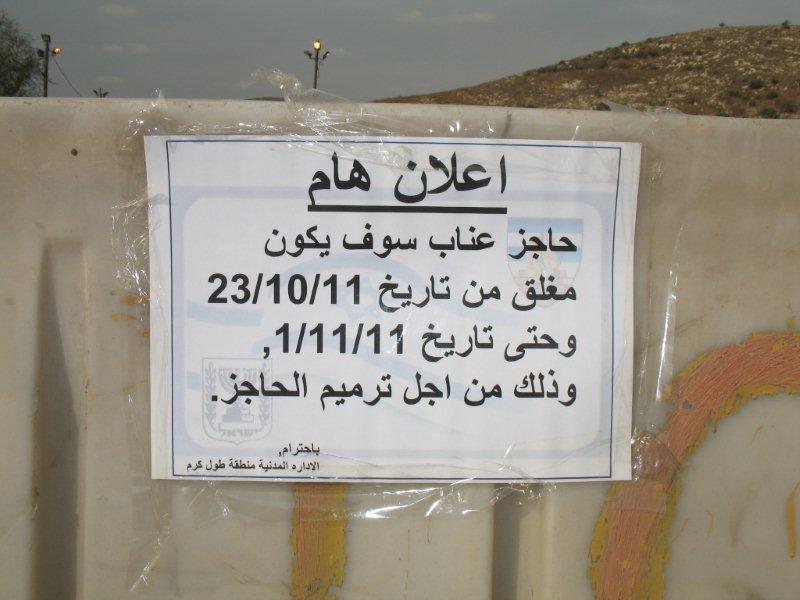 Oct-28-2011Anabta checkpoint 24.10.11
-
Beit Iba
See all reports for this place-
A perimeter checkpoint west of the city of Nablus. Operated from 2001 to 2009 as one of the four permanent checkpoints closing on Nablus: Beit Furik and Awarta to the east and Hawara to the south. A pedestrian-only checkpoint, where MachsomWatch volunteers were present daily for several hours in the morning and afternoon to document the thousands of Palestinians waiting for hours in long queues with no shelter in the heat or rain, to leave the district city for anywhere else in the West Bank. From March 2009, as part of the easing of the Palestinian movement in the West Bank, it was abolished, without a trace, and without any adverse change in the security situation.
 Jun-4-2014Beit-Iba checkpoint 22.04.04
-
Eyal Checkpoint / Crossing
See all reports for this place-
Eyal Checkpoint is intended for pedestrians and Palestinians only. This is the main barrier for workers to cross from the center of the West Bank. Workers with a work permit to enter Israel can pass through it for trade, medicine, and visiting prisoners. The checkpoint was built on the Green Line north of Qalqilya in the separation barrier that surrounds the city. The checkpoint began operating in 2004 by the military. Opening hours on weekdays from 04:00 to 19:00. We started holding shifts there in 2007. We arrived at the checkpoint before it opened at 4 in the morning. We reported on the difficult conditions and the long and cramped queues of workers who must continue their journey by commuting to work throughout Israel. At the end of June 2009, the checkpoint was operated by a civil security company, The transit time has been gradually shortened, today it is faster, but the Palestinians still have to arrive very early to make it to the transportation. Usually, about 15,000 people pass through.
-
Irtah (Sha'ar Efrayim)
See all reports for this place-
The checkpoint is for Palestinians only. It is the main barrier to the passage of workers from the northern West Bank to Israel. Workers with a permit to work in Israel and also for trade (with appropriate permissions), medicine, and visiting prisoners. One can cross the checkpoint only on foot. The checkpoint is located north of Road 557 and south of Tulkarm. Operated by a civil security company, opening hours: between 4:00 and 19:00 on weekdays. As members of Machsom Watch, we began our shifts to this location in 2007. We arrived before it opened at 4 in the morning and report since, on the harsh conditions and the long and crowded queues of workers. The workers who pass by continue their journey by transportation to work throughout Israel. In the first period of its activity, about 3,000 and then 5,000 people passed through this checkpoint every day. Due to the small number of checking points and arbitrary delays for long periods of time in the "rooms", workers feared losing their transportation. Hence workers leave their homes at 2:30 at night to be among the first. Today, 15,000 pass and the transition is faster. Workers are still leaving their homes very early to get past the checkpoint at 7 p.m. In an adjacent compound, there is a terminal for the transfer of goods on a commercial scale, using the back-to-back method.
-