
Eyal Crossing, ‘Anabta, Irtah (Sha’ar Efrayim), Mon 17.8.09, Afternoon
Unlike our usual route, we monitored the western route this time, beginning with Anabta. Soldiers manned the checkpoint but during out stay did not stop any vehicles. Most of the cars passing through were Israeli-license-plated.
We had some words with taxi drivers waiting in vain for fares. They told us traffic through the checkpoint flowed and mentioned as a constant fact that their livelihood has been constantly diminishing and barely put bread on the table.
On our way back through Jubara we were stopped at the checkpoint like everyone else, the woman soldier questioned where we were headed and when we mentioned Irtach and Eyal crossings she stared at us, amazed, and asked who we were. As we identified ourselves she said, ‘Ah, you’re the ones who are against us’. We assured her we were not ‘against’ thesoldiers bur rather ‘for’ a better state.
At Irtach as well as Eyal movement was lively – workers returning from their day’s work in small groups of several dozens disembarking from buses and other vehicles, and disappearing into the checkpoint entrances without delay.
One of the workers with whom we spoke explained that the delays and hardships were in the morning when they go out to work, and when they were all required to go through the ‘rooms’. He claimed there were usually no problems in the afternoon.
'Anabta CP
See all reports for this place-
'Anabta CP
The checkpoint is located south of the village of 'Anabta, at the intersection of Road 60 (leading to Nablus at the entrance to Area A), with Road (57, 557, 5576) facing west towards the Einav settlement and the checkpoint at the exit from the West Bank - Figs checkpoint. Until 2010 we used to watch the intersection and report the long columns created due to a slow inspection of the vehicles in both directions.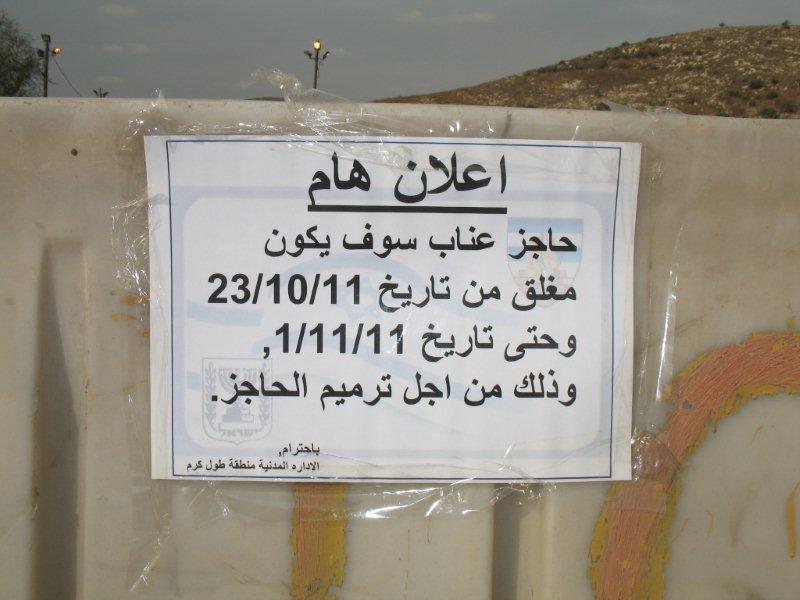 Oct-28-2011Anabta checkpoint 24.10.11
-
Eyal Checkpoint / Crossing
See all reports for this place-
Eyal Checkpoint is intended for pedestrians and Palestinians only. This is the main barrier for workers to cross from the center of the West Bank. Workers with a work permit to enter Israel can pass through it for trade, medicine, and visiting prisoners. The checkpoint was built on the Green Line north of Qalqilya in the separation barrier that surrounds the city. The checkpoint began operating in 2004 by the military. Opening hours on weekdays from 04:00 to 19:00. We started holding shifts there in 2007. We arrived at the checkpoint before it opened at 4 in the morning. We reported on the difficult conditions and the long and cramped queues of workers who must continue their journey by commuting to work throughout Israel. At the end of June 2009, the checkpoint was operated by a civil security company, The transit time has been gradually shortened, today it is faster, but the Palestinians still have to arrive very early to make it to the transportation. Usually, about 15,000 people pass through.
-
Irtah (Sha'ar Efrayim)
See all reports for this place-
The checkpoint is for Palestinians only. It is the main barrier to the passage of workers from the northern West Bank to Israel. Workers with a permit to work in Israel and also for trade (with appropriate permissions), medicine, and visiting prisoners. One can cross the checkpoint only on foot. The checkpoint is located north of Road 557 and south of Tulkarm. Operated by a civil security company, opening hours: between 4:00 and 19:00 on weekdays. As members of Machsom Watch, we began our shifts to this location in 2007. We arrived before it opened at 4 in the morning and report since, on the harsh conditions and the long and crowded queues of workers. The workers who pass by continue their journey by transportation to work throughout Israel. In the first period of its activity, about 3,000 and then 5,000 people passed through this checkpoint every day. Due to the small number of checking points and arbitrary delays for long periods of time in the "rooms", workers feared losing their transportation. Hence workers leave their homes at 2:30 at night to be among the first. Today, 15,000 pass and the transition is faster. Workers are still leaving their homes very early to get past the checkpoint at 7 p.m. In an adjacent compound, there is a terminal for the transfer of goods on a commercial scale, using the back-to-back method.
-