
Eyal Crossing, ‘Anabta, Irtah (Sha’ar Efrayim), Sun 16.8.09, Afternoon
This time, after coordinating with Nava, we took a different route starting at Anabta. Soldiers were keeping guard at the checkpoint, but while we were there they did not stop a single vehicle. They were all cars with yellow license plates.
We talked to the cab drivers who were waiting for work. They told us that the traffic at the checkpoint is flowing, adding that for a fact, work is becoming less and that they hardly make enough money to feed their families.
On our way back we were stopped at the Jubara checkpoint like everybody else. The female soldier asked us where we were going, and when we said Irtah and Eyal she was quite shocked. She asked us who we were, and when we told her she said, "Oh yes, the women who are against us." We told her that we are not against the soldiers and that we actually care about our country and want to make things better.
Both at Irtah and Eyal there was a lot of traffic and many workers were returning from work. Dozens of workers getting off buses and other vehicles passed through the gates without delay. One of the workers explained to us that the problems arise in the morning when all the people are delayed in the security rooms on their way to work. According to him there are hardly any problems in the afternoon.
'Anabta CP
See all reports for this place-
'Anabta CP
The checkpoint is located south of the village of 'Anabta, at the intersection of Road 60 (leading to Nablus at the entrance to Area A), with Road (57, 557, 5576) facing west towards the Einav settlement and the checkpoint at the exit from the West Bank - Figs checkpoint. Until 2010 we used to watch the intersection and report the long columns created due to a slow inspection of the vehicles in both directions.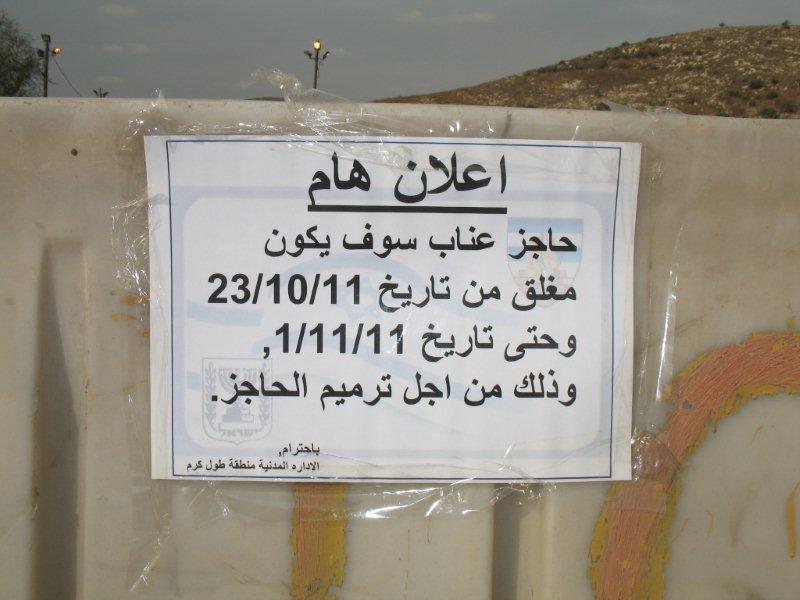 Oct-28-2011Anabta checkpoint 24.10.11
-
Eyal Checkpoint / Crossing
See all reports for this place-
Eyal Checkpoint is intended for pedestrians and Palestinians only. This is the main barrier for workers to cross from the center of the West Bank. Workers with a work permit to enter Israel can pass through it for trade, medicine, and visiting prisoners. The checkpoint was built on the Green Line north of Qalqilya in the separation barrier that surrounds the city. The checkpoint began operating in 2004 by the military. Opening hours on weekdays from 04:00 to 19:00. We started holding shifts there in 2007. We arrived at the checkpoint before it opened at 4 in the morning. We reported on the difficult conditions and the long and cramped queues of workers who must continue their journey by commuting to work throughout Israel. At the end of June 2009, the checkpoint was operated by a civil security company, The transit time has been gradually shortened, today it is faster, but the Palestinians still have to arrive very early to make it to the transportation. Usually, about 15,000 people pass through.
-
Irtah (Sha'ar Efrayim)
See all reports for this place-
The checkpoint is for Palestinians only. It is the main barrier to the passage of workers from the northern West Bank to Israel. Workers with a permit to work in Israel and also for trade (with appropriate permissions), medicine, and visiting prisoners. One can cross the checkpoint only on foot. The checkpoint is located north of Road 557 and south of Tulkarm. Operated by a civil security company, opening hours: between 4:00 and 19:00 on weekdays. As members of Machsom Watch, we began our shifts to this location in 2007. We arrived before it opened at 4 in the morning and report since, on the harsh conditions and the long and crowded queues of workers. The workers who pass by continue their journey by transportation to work throughout Israel. In the first period of its activity, about 3,000 and then 5,000 people passed through this checkpoint every day. Due to the small number of checking points and arbitrary delays for long periods of time in the "rooms", workers feared losing their transportation. Hence workers leave their homes at 2:30 at night to be among the first. Today, 15,000 pass and the transition is faster. Workers are still leaving their homes very early to get past the checkpoint at 7 p.m. In an adjacent compound, there is a terminal for the transfer of goods on a commercial scale, using the back-to-back method.
-