
Eyal Crossing, Habla, Qalqiliya, Tue 9.11.10, Afternoon
Summary
The Seam Zone, with its villages, herding areas and plant nurseries which have become “enclaves” formed by the construction of the Separation Barrier, are declared “closed” by the Israeli military authorities. Some Palestinians have to obtain permits to continue living in their homes, while others are required to obtain “visitor” permits to access their own lands. It’s harder and harder for a shepherd, notably the “cowboy” near Habla, to find enough grazing land for his sheep and for Palestinians living near the settlements of Alfe Menashe or Zufin to find work there. Overall, life is made more arduous with the near impossibility of obtaining a permit to work in Israel. All in all, all these instances form but a part of what constitutes the massive Civil Administration bureaucracy that underlies this endless Occupation. In addition, the Qalqiliya governorate is scattered with so-called “partial checkpoints” (those that have been dismantled but that can be operated by the military at any time) and by agricultural gates at the Separation Barrier that are manned daily, or seasonally, meaning that free, open or limitless access is restricted and controlled by the army of Occupation.
13:00 Gate 1392 Habla
The gate(s) open on time. Two soldiers stand there, one with gun at the ready; but for the 15 or so people waiting, on the north side of the shelter, which faces a blazing November sun, it’s another 12-15 minutes before they can proceed onwards across the Separation Barrier. Why so much delay? Today’s military “theme” is ”Go back, go back” as one or other of the two soldiers invokes this phrase over and over, sometimes to those standing where we do, at other times to those waiting on the far side of the Separation Barrier.
There’s the usual medley of trucks, tractors, horse and donkey carts, men and youth, vegetables and tree saplings, all waiting to cross, all waiting and waiting, as the process of getting to or from work is slow, so very slow in this late summer heat and dust.
13:25 — the bus bearing the Bedouin school boys from Arab ar Ramadin al Janubi, near Alfe Menashe, passes, but gets stuck, since there’s a cart with articles protruding from it, making passage past the ridiculous “shelter” formed out of a former Zim container more than a little difficult. The smiling, friendly bus driver has to maneuver extra carefully. One of the soldiers comes to “direct” the proceedings or, more likely, just to take a look…..
14:15 Qalqiliya
The former checkpoint is, today, unmanned, and all manner of vehicles make their way along the attractively planted road towards the city.
14:50 Eyal
A few Palestinian Israeli drivers wait for a few Palestinians to cross the terminal at this mid afternoon hour, waiting to take them to “villages” we know not where, but somewhere in the distance. The drivers talk of being at the terminal at 4:00 each morning, waiting for the last Palestinians to arrive before taking them to their places of work: the women as house cleaners in Bat Yam, or flower or strawberry pickers in Ranaana, the men, more likely to work in Haifa, Acco, etc., wherever a Palestinian lucky enough to get a work permit has to go or be driven back from.
A civilian passenger car stops by us, a lieutenant colonel get out, approaches us, gives us his name, A., asks for our names and proceeds to give his phone number to us, telling us that he’s the “new head of the DCO” at both Tulkarm (Irtah) and Qalqiliya (Eyal).
Eyal Checkpoint / Crossing
See all reports for this place-
Eyal Checkpoint is intended for pedestrians and Palestinians only. This is the main barrier for workers to cross from the center of the West Bank. Workers with a work permit to enter Israel can pass through it for trade, medicine, and visiting prisoners. The checkpoint was built on the Green Line north of Qalqilya in the separation barrier that surrounds the city. The checkpoint began operating in 2004 by the military. Opening hours on weekdays from 04:00 to 19:00. We started holding shifts there in 2007. We arrived at the checkpoint before it opened at 4 in the morning. We reported on the difficult conditions and the long and cramped queues of workers who must continue their journey by commuting to work throughout Israel. At the end of June 2009, the checkpoint was operated by a civil security company, The transit time has been gradually shortened, today it is faster, but the Palestinians still have to arrive very early to make it to the transportation. Usually, about 15,000 people pass through.
-
Habla
See all reports for this place-
Habla CP (1393)
The Habla checkpoint (1393) was established on the lands of the residents of Qalqilya, on the short road that
connected it for centuries to the nearby town of Habla. The separation barrier intersects this road twice and cut off the residents of Qalqilya from their lands in the seam zone.(between the fence and the green line).
There is a passage under Road 55 that connects Qalqilya to the sabotage This agricultural barrier is used by the farmers and nursery owners established along Road 55 from the Green Line and on both sides of the kurkar road leading to the checkpoint.
This agricultural checkpoint serves the residents of Arab a-Ramadin al-Janoubi (detached from the West Bank), who pass through it to the West Bank and back to their homes. The opening hours (3 times a day) of this agricultural checkpoint are longer than usual, about an hour (recently shortened to 45 minutes), and are coordinated with the transportation hours of a-Ramadin children studying in the occupied in the West Bank.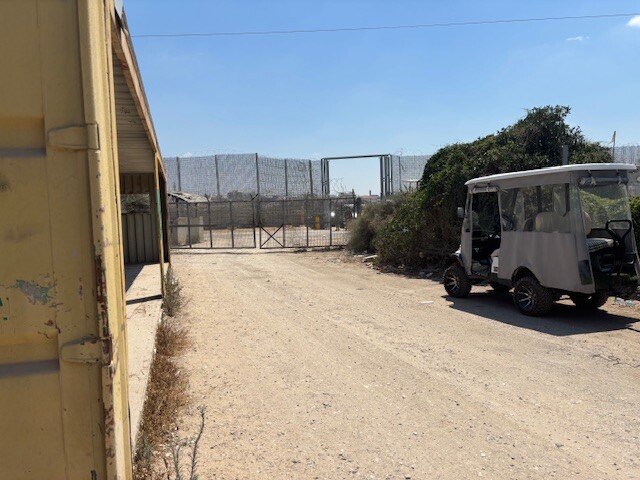 Nina SebaAug-18-2025Habla: The gate is in the process of closing
-
Qalqiliya checkpoint
See all reports for this place-
Qalqilya is surrounded on all sides by the separation barrier. The only exit from the city is in the east of the city on the road that leaves the city in an easterly direction. This is where the checkpoint was located. When the checkpoint was active until 2009 our shifts watched long queues of cars being inspected at the only exit from the city to the West Bank. The checkpoint was canceled, but there is a military presence at the entrance to the city.
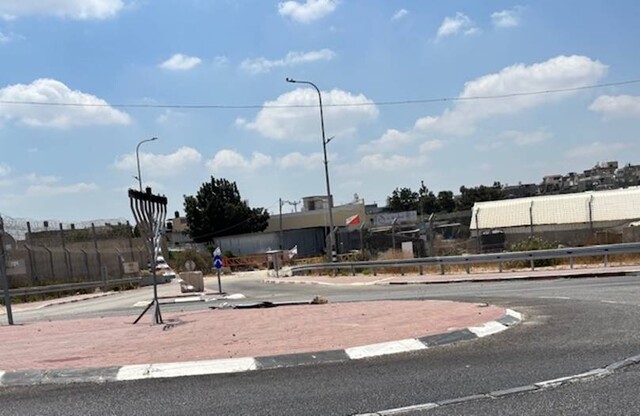 Nina SebaAug-18-2025Azzun: Enclosed by a high fence and the gate to the village is closed
-