
Eyal, Irtah (Sha’ar Efrayim), Qalqiliya, Thu 4.6.09, Afternoon
Translation: Bracha
Qalqilya, 16:00
There is light traffic at the checkpoint. Cars are passing through without being checked. We went on to the additional entrance to Qalqilya at the Eyal checkpoint.Driving on Road 55 to Road 444 via Road 5504 revealed that road 444 once passed through the outskirts of Qalqilya on the eastern side of the green line.
Eyal, 16:20
The gate to the entrance to the inspection points is wide open. Three inspection points are operating. The workers get out of their cars, walk quickly across the road to the entrance. They are not amazed as we are that the turnstile is empty, go in, pass through, and disappear behind the high fences.
Here and there we asked people who slowed down if it had ever happened that the gate was wide open, and they answered that this was the first time. Interesting. ON the other hand, the gate to the inner parking lot was closed.
17:20 Irtah Crossing
As soon as we arrived we went to see what was going on the Tulkarem side.
We found four people: three men and one woman, standing at the entry point to Israel and waiting to be let through. They are standing and waiting between the fences for someone to call them over the loudspeaker. They said that they had arrived at 16:30 and no one had yet been free to let them through.
We went to ask the security guards on the other side what the problem was. The answer we received was: “Do you want us to stop letting 500 people who are coming back in [to the West Bank] now in order to let four people through?”
We answered that only one inspection point was needed in order to let the four people through. We got the same answer. When we left at 18:00 three people were still waiting to go through. One had left.
The person who left, a businessman, lived in Tulkarem, and is married to a woman from Israel who lives in a community called Zemer. Her father and three children were waiting for him on the Israeli side to take him to visit the family. After waiting for two hours the man gave up and decided to give up on the visit. He said he would come another day.
The woman, an American married to a resident of Tulkarem, has been living there for 19 years, and is a member of the organization “Seeds for Peace”. She and another two men were on their way to a Jewish-Palestinian workshop in Tiberias. A bus from Tel Aviv was to have collected her from the checkpoint. We are not sure that things had worked out since they had not yet been allowed in when we left.
There were about 120 people crowded at the entrance to the inspection points (not 500 as they had claimed). Two were operating and they got through within 5 minutes.
At 17:45 a security guard stood in front of the road leading to the entrance to the facility and stopped people.
What happened? No answer.
.The first gate is also closed and dozens of workers (men and women) who got out of the cars that brought them, were crowded in front of the closed gate. They waited for 20 minutes until the gate was reopened.
At 18:10 the gate was reopened and we left. We don’t know why passage was halted.
Eyal Checkpoint / Crossing
See all reports for this place-
Eyal Checkpoint is intended for pedestrians and Palestinians only. This is the main barrier for workers to cross from the center of the West Bank. Workers with a work permit to enter Israel can pass through it for trade, medicine, and visiting prisoners. The checkpoint was built on the Green Line north of Qalqilya in the separation barrier that surrounds the city. The checkpoint began operating in 2004 by the military. Opening hours on weekdays from 04:00 to 19:00. We started holding shifts there in 2007. We arrived at the checkpoint before it opened at 4 in the morning. We reported on the difficult conditions and the long and cramped queues of workers who must continue their journey by commuting to work throughout Israel. At the end of June 2009, the checkpoint was operated by a civil security company, The transit time has been gradually shortened, today it is faster, but the Palestinians still have to arrive very early to make it to the transportation. Usually, about 15,000 people pass through.
-
Irtah (Sha'ar Efrayim)
See all reports for this place-
The checkpoint is for Palestinians only. It is the main barrier to the passage of workers from the northern West Bank to Israel. Workers with a permit to work in Israel and also for trade (with appropriate permissions), medicine, and visiting prisoners. One can cross the checkpoint only on foot. The checkpoint is located north of Road 557 and south of Tulkarm. Operated by a civil security company, opening hours: between 4:00 and 19:00 on weekdays. As members of Machsom Watch, we began our shifts to this location in 2007. We arrived before it opened at 4 in the morning and report since, on the harsh conditions and the long and crowded queues of workers. The workers who pass by continue their journey by transportation to work throughout Israel. In the first period of its activity, about 3,000 and then 5,000 people passed through this checkpoint every day. Due to the small number of checking points and arbitrary delays for long periods of time in the "rooms", workers feared losing their transportation. Hence workers leave their homes at 2:30 at night to be among the first. Today, 15,000 pass and the transition is faster. Workers are still leaving their homes very early to get past the checkpoint at 7 p.m. In an adjacent compound, there is a terminal for the transfer of goods on a commercial scale, using the back-to-back method.
-
Qalqiliya checkpoint
See all reports for this place-
Qalqilya is surrounded on all sides by the separation barrier. The only exit from the city is in the east of the city on the road that leaves the city in an easterly direction. This is where the checkpoint was located. When the checkpoint was active until 2009 our shifts watched long queues of cars being inspected at the only exit from the city to the West Bank. The checkpoint was canceled, but there is a military presence at the entrance to the city.
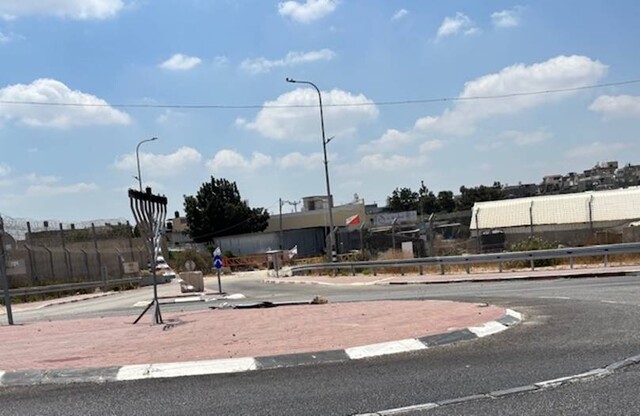 Nina SebaAug-18-2025Azzun: Enclosed by a high fence and the gate to the village is closed
-