
Fasa’il and Khirbet Twayel: Displacement and Settler’s Violence
T. and her daughters now sit in a tiny, moldy room with no windows. A pile of mattresses occupies half the space, and her sisters and their children, the entire neighborhood go in and out, trying to cheer her up. They don’t even have water. T. – no makeup, dressed in black – is showing her depression. I don’t know where A. and the sons sleep. We brought a car filled with food and shoes we bought the previous evening, but T. is desperate – they have to leave the miserable room within a week and have nowhere to go. A. is looking but has not yet found anything for rent in Auja. They face a harsh time, for even if they do find something in Auja, the families – parents, brothers, nephews – are all in Fasa’il. Although Auja is just a 10-minute drive away, how will they manage when no one has a car? What kind of work can A. find? How will he feed 8 children?
This is heart-rending. People groomed a good-looking albeit simple home, with a shaded garden for over 10 years, and now – the family is broken, homeless, all done by the Israeli DCO – at the bidding of Tomer settlers. Curse upon you, for your cruelty and evil deeds upon innocents, a family, children that did you no wrong whatsoever!
In addition, T. told us that after managing to wreck her own family, the settlers crossed the road and harassed the family of her husband and the children of the late Maryam, that blind woman whom I regularly drove to have her eye shots. Lately only 2 of Maryam’s offsprings are left there, 18-19 years old, one with special needs and the other a serious diabetic with difficulties in his legs. They don’t seem capable of coping with the settlers’ escalating violence.
1:30 p.m. – we arrive through deep mud to Khirbet a-Twayel. On our way we saw a settler with his goats, walking toward Khirbet a-Twayel. We are supposed to replace the 4 members of the morning shift, but as soon as we got there, a call summoned us to N.’s house for the settler and his goats have arrived through N.’s wheat field, which his flock is trampling and eating. Our callers wish to chase it away. After half an hour we must replace them in this torrential rain. We run and make noise with our stone-filled bottles to scare the goats away, while the settler runs around yelling on the other side, holding a stick to scare them. But animals have a more practical mind. The goats don’t feel like getting wet so they simply overtook the settler and walked toward the settlement, and he had no other choice but to follow them.
We entered the pen to hide from the rain (which didn’t really matter for we were already soaked), and N. and his brother served us hot tea. When the rain stopped, N. saw the settler and his goats coming back to his field and asked us to keep our distance, thinking that our clash with the settler would only spur him on. We did as we were told and kept our distance. Not long after that, N. called us urgently for the settler is already up to the house, walking around with his goats in the yard, trying to get in. We hurried there and for hours, with our noisy bottles and shouts, slowly got the flock of goats to keep its distance. At 4:30 p.m., the settler sat down on a rock and wrote stuff in a notebook he got out of his pack. Half an hour later he got up and prayed aloud, totally ignoring his goats. Nava and I took advantage of the moment and chased the flock away from the field and back to the settlement. The settler terminated his loud prayer, Michael and Ariel conducted a theological argument with him about God, faith and his chosen way. It was not an aggressive argument, but useless in my opinion. The settler is so brainwashed and blind to any other option that their words slid off him like oil. This only made us remain longer, wet and frozen in the cold wind, for we didn’t want to leave before the settler did. We left at 5:30 p.m.
We passed through Duma (the gate was open at 6 p.m.), buying oil from H”D for a friend who ordered it. He invited us in for dinner, but we wanted to get home and change clothes, so he packed a rice dish whose delicious smell drove us mad all the way home. He also sent with us a plateful to Raia, his friend.
Location Description
Fasa'il
See all reports for this place-
An old community of shepherds in the Jordan Valley that is located between settlements and is exposed to the demolition of its residential buildings at times by the army and the abuses of the settlers. King Herod founded the city of Fatza'elis in 8 BC, and named it after his older brother, Petzal. The permanent settlement in the place began with Bedouins who migrated to the area as early as the 1950s after being expelled from the Tel Arad area. Over the years, additional Bedouin residents who were expelled from other places in the Jordan Valley joined. Areas that were declared as fire areas or state lands . As part of the Alon plan, a significant part of the lands in the area were expropriated and four Israeli settlements were established on them: Tomer, Gilgal, Fatza'el Netiv HaGdud. Illegal posts were erected over the years. Some of them were authorized during the 7th October War.
-
Jordan Valley
See all reports for this place-
Jordan Valley The Jordan Valley is the eastern strip of the West Bank. Its area consists of almost a third of the West Bank area. About 10,000 settlers live there, about 65,000 Palestinian residents in the villages and towns. In addition, about 15,000 are scattered in small shepherd communities. These communities are living in severe distress because of two types of harassment: the military declaring some of their living areas, as fire zones, evicting them for long hours from their residence to the scorching heat of the summer and the bitter cold of the winter. The other type is abuse by rioters who cling to the grazing areas of the shepherd communities, and the declared fire areas (without being deported). The many groundwaters in the Jordan Valley belong to Mekorot and are not available to Palestinians living in the Jordan Valley. The Palestinians bring water to their needs in high-cost followers.
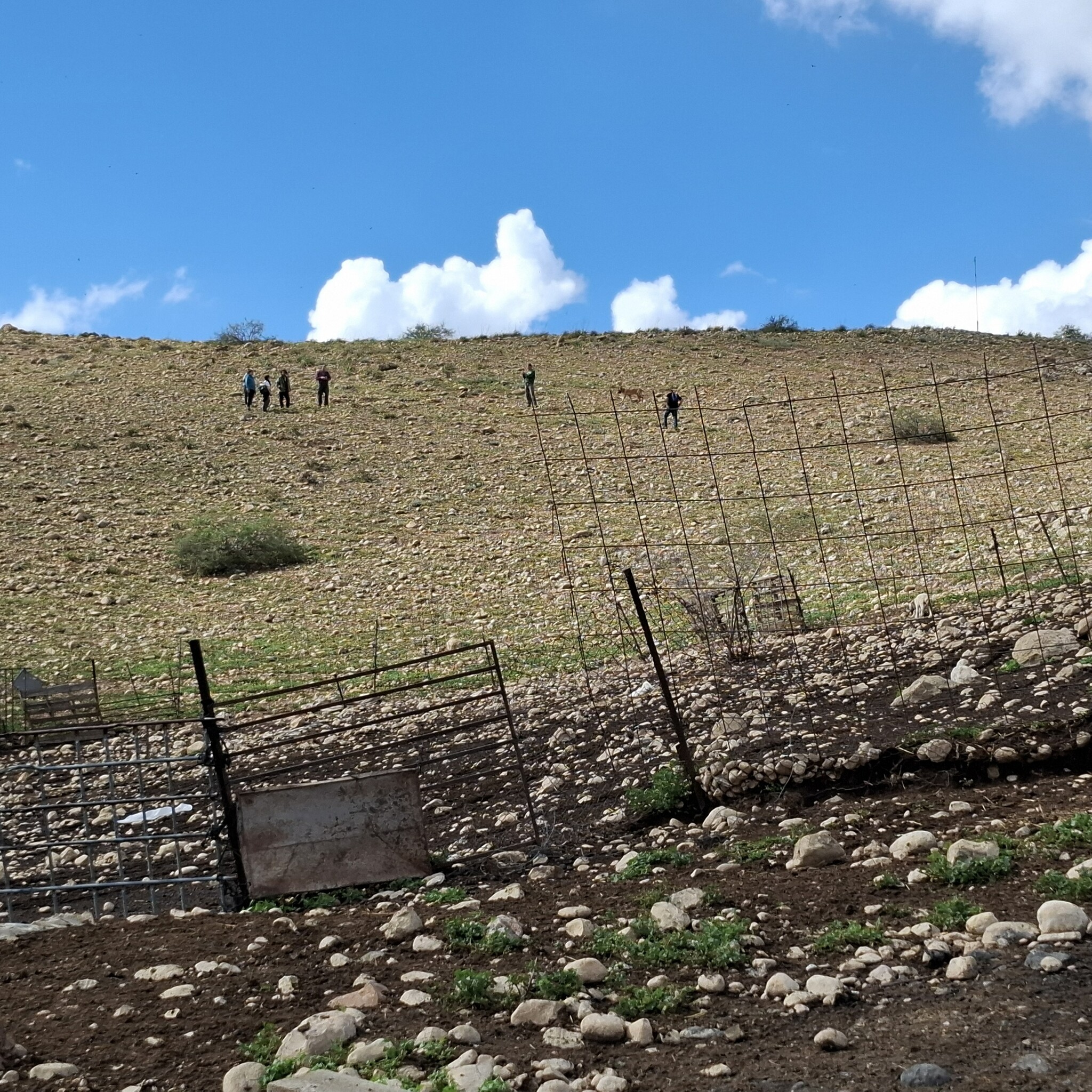 Daphne BanaiApr-7-2026Al-Farsiyya. Ruthie and Michael prevent the assailants from going down to A's camp
-