
Habla
14th of Adar in Israel, joy and happiness, celebrating Purim. And the Palestinians….that's another story. Closure imposed on the territories. The closure includes the agricultural checkpoints, which prevents the Palestinians from getting to their lands, which is opposed to the agreement when we built the separation wall. Who cares if their income is drastically harmed? If the plants in the nursery dry up, sheep and lambs must remain for a full day in heavy heat, with no water to quench their thirst?
13:30 – We travel to Habla. The gate at the agricultural checkpoint, leading to the nurseries and the fields of the Palestinians which are in the seam area, is supposed to be open at this hour. To our surprise, the path leading to the nurseries is empty. Usually there is a lot of traffic of customers and suppliers at this hour.
We stop in amazement: no cars parked at the side of the road. The gates of the nurseries are closed. All the gates at the checkpoint are closed. Not a single Palestinian waiting at the gate. Why? For the Jews there was gladness and joy; for the Palestinians – closure.
The heat was oppressive; 30 degrees C. We think about the plants in the nursery during such a heat wave, not being watered. And the sheep drying up with thirst with no help. Because "Purim is a great holiday for the Jews".
From a report which we received from A., it seems that more than 100 Palestinians waited this morning on the other side of the checkpoint, in hope of going through as usual to their place of work on the other side. Phone calls and requests at the DCO did not help. Our friend, Hannah B., succeeded in making contact with someone with influence in the security administration, to her credit, and with great generosity they let 8 workers go through. A rather small number in relation to the usual work load in maintaining the place. With bad luck, the team of A. was not among them. There seems to be a hierarchy in the distribution of permits.
17:00 – We returned to the Habla checkpoint. No traffic as there usually would be going toward the nurseries, but a few of them are open. Open, but there are no customers. The activity there is restricted to maintenance work. The nursery of A. is closed. A. is angry and discouraged. About the plants, he says "What there was is dead". It isn't easy for him to say this. Whoever knows this nursery understands how much work is required to keep the fresh and attractive appearance of the plants. We can hear the sheep crying, without water in 30 degree heat, not to mention the young lambs. His heart goes out to them. And this is what A. says to us: "They won't survive if their thirst is not quenched after a long day's heat wave without water." A heartbreaking sight.
It is already 17:30, a whole day waiting for a permit. A. arrives from the direction of highway #55, one worker accompanying him. A very small work force, but at least they would be able to save the lambs and the sheep from expiring in the heat, and to water the plants whose heads were already drooping.
It turned out that dozens of Palestinians with permits had been trying since 07:00 to go through the Eliyahu checkpoint which is open all hours of the day for Israelis and Palestinians who own lands in the seam area. Because of the arbitrary decision, totally thoughtless, they were not allowed to pass through. A decision about which the owners of businesses were not informed. Because, obviously, if they had been informed ahead of time, they would have organized a water supply for the plants and animals and the harm could have been avoided.
Habla
See all reports for this place-
Habla CP (1393)
The Habla checkpoint (1393) was established on the lands of the residents of Qalqilya, on the short road that
connected it for centuries to the nearby town of Habla. The separation barrier intersects this road twice and cut off the residents of Qalqilya from their lands in the seam zone.(between the fence and the green line).
There is a passage under Road 55 that connects Qalqilya to the sabotage This agricultural barrier is used by the farmers and nursery owners established along Road 55 from the Green Line and on both sides of the kurkar road leading to the checkpoint.
This agricultural checkpoint serves the residents of Arab a-Ramadin al-Janoubi (detached from the West Bank), who pass through it to the West Bank and back to their homes. The opening hours (3 times a day) of this agricultural checkpoint are longer than usual, about an hour (recently shortened to 45 minutes), and are coordinated with the transportation hours of a-Ramadin children studying in the occupied in the West Bank.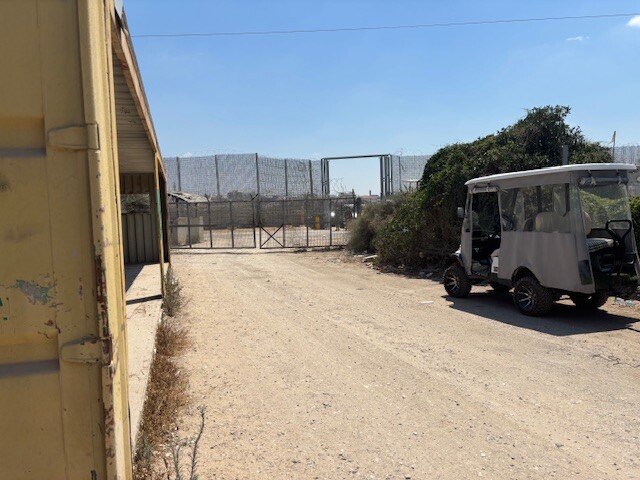 Nina SebaAug-18-2025Habla: The gate is in the process of closing
-