
Habla, Huwwara, Tue 24.5.11, Afternoon

13:50 – Habla:
An open barrier and hardly any people. Reservists man the gate. We were accorded a reprimand from a pleasant soldier who asked why we were late and told us that it was very important to arrive in the morning. He also pointed out how good it was that we were coming. When we turned to go another soldier came up to us, apologized and asked if we had been at the more northern gate, at CP 109? We answered in the affirmative. He asked us whether we had noticed that there are separate lanes for Israelis, settlers and Palestinians there. Again we answered in the affirmative. He insisted and asked if somebody was taking care of that. According to him one has to attend to this and there was no problem proving that the segregation exists. A personal comment: such an innocent – as if the Apartheid existed only at the gate…But is was a refreshing change to meet a reservist who cares and doesn't feel comfortable with the situation.
14:20- Izbat Tabib:
We met a rather elderly woman who told us that yesterday about 15 military vehicles had arrived and had begun to fence the road in. And indeed, a curled fence consisting of 5 spools (height over 2 meters) was placed all along the road up to about 200 meters from the entrance to the village. For the completion of the fencing Tsahal waits for the endorsement from the High Court of Justice (a claim had been submitted). The woman also said that a modest demonstration of the villagers (grown-ups and children) had been violently dispersed. The soldiers had sprayed the demonstrators with an unknown material, color of iodine and burning (my daughter, a demonstration veteran, infers from the description that this was mustard gas which is much worse that tear gas). A man from the village told us that he had just now washed and that his skin was still burning – over 24 hours after the injury. 4 inhabitants were evacuated by an ambulance and
released on the next day only. The woman continued and said that during the working day 2 olive trees had bee uprooted and that they had then been buried under stone heaps. The woman said she had not participated in the demonstration but had worked at the grass harvest and had a sickle in her hand. A soldier forcefully snatched the sickle from her and didn't return it. Now the situation is like this: it is not possible to go to work the fields by way of the road, so that a person who wants to work his fields, take care of the trees etc. has to get to the zone on foot, on an unpaved road full of stones.
Again one can burst into singing: "the whole country is barriers, barriers".
15:25
A military vehicle waits on the road on the Yitzhar/Huwwara junction.
It is occupied by drowsy soldiers.
15:30 – Huwwara.
At the gas station and at the sweets shop the local inhabitats tell us that on Sunday night soldiers entered Huwwara and threw shock grenades. Caused panic. They didn't leave their houses because they didn't want to confront the soldiers. The locals tell us that lately the Tsahal soldiers tend to irritate them.
16:10 –
The soldiers of the aforementioned CP woke up, went to the entrance road to Huwwara and began stopping incoming vehicles.
16:20 –
At the entrance from the village of Punduk to Jit – a military vehicle blocks half the road.
Also – there is a barrier on the road before the northern entrance to Punduk. 30 vehicles are waiting.
At the southern entrance at the junction with Jan Sapur – there is a military vehicle. Then before Kedumim.
There are two military vehicles at the entrance to Ma'ale Shomron.
At the entrance to Azzun – two military vehicles examines the people entering and departing.
16:55 –
two more military vehicles are added. 17 vehicles are waiting at the way out from Azzun. At the entrance to Nebi Elias and Isbat Tabib – there is a CP in both direction. 50 vehicles coming from the east are waiting. The car queue to the western entrance to Isbat Tabib goes up to the western entrance of Nebi Elias. How many cars are waiting? Tens, hundreds?
An innocent questions: if this is the situation when MKs only think of honoring Josef in his grave with their presence – what will happen when they'll carry their scheme out?
17:20 – the Habla gate is shut. It opens only at 17:45.
Habla
See all reports for this place-
Habla CP (1393)
The Habla checkpoint (1393) was established on the lands of the residents of Qalqilya, on the short road that
connected it for centuries to the nearby town of Habla. The separation barrier intersects this road twice and cut off the residents of Qalqilya from their lands in the seam zone.(between the fence and the green line).
There is a passage under Road 55 that connects Qalqilya to the sabotage This agricultural barrier is used by the farmers and nursery owners established along Road 55 from the Green Line and on both sides of the kurkar road leading to the checkpoint.
This agricultural checkpoint serves the residents of Arab a-Ramadin al-Janoubi (detached from the West Bank), who pass through it to the West Bank and back to their homes. The opening hours (3 times a day) of this agricultural checkpoint are longer than usual, about an hour (recently shortened to 45 minutes), and are coordinated with the transportation hours of a-Ramadin children studying in the occupied in the West Bank.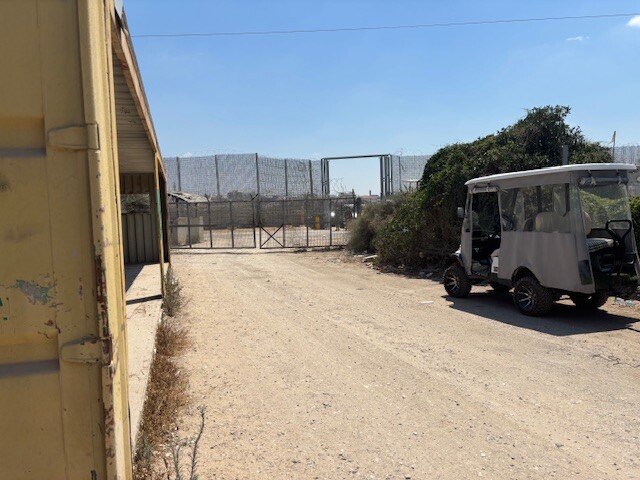 Nina SebaAug-18-2025Habla: The gate is in the process of closing
-
Huwwara
See all reports for this place-
The Huwwara checkpoint is an internal checkpoint south of the city of Nablus, at the intersection of Roads 60 and 5077 (between the settlements of Bracha and Itamar). This checkpoint was one of the four permanent checkpoints that closed on Nablus (Beit Furik and Awarta checkpoints to the east and the Beit Iba checkpoint to the west). It was a pedestrian-only barrier. As MachsomWatch volunteers, we watched therre since 2001 two shifts a day - morning and noon, the thousands of Palestinians leaving Nablus and waiting for hours in queues to reach anywhere else in the West Bank, from the other side of the checkpoint the destination could only be reached by public transport. In early June 2009, as part of the easing of Palestinian traffic in the West Bank, the checkpoint was opened to vehicular traffic. The passage was free, with occasional military presence in the guard tower. Also, there were vehicle inspections from time to time. Since the massacre on 7.10.2023, the checkpoint has been closed to Palestinians.
On February 26, 2023, about 400 settlers attacked the town's residents for 5 hours and set fire to property, such as houses and cars. Disturbances occurred in response to a shooting of two Jewish residents of Har Bracha by a Palestinian Terrorist. The soldiers stationed in the town did not prevent the arson and rescued Palestinian families from their homes only after they were set on fire. No one was punished and Finance Minister Smotrich stated that "the State of Israel should wipe out Hawara." Left and center organizations organized solidarity demonstrations and support actions for the residents of Hawara.Hawara continued to be in the headlines in all the months that followed: more pogroms by the settlers, attacks by Palestinians and a massive presence of the army in the town. It amounted to a de facto curfew of commerce and life in the center of the city. On October 5, 2023, MK Zvi established a Sukkah in the center of Hawara and hundreds of settlers backed the army blocked the main road and held prayers in the heart of the town all night and the next day. On Saturday, October 7, 23 The "Swords of Iron" war began with an attack by Hamas on settlements surrounding Gaza in the face of a poor presence of the IDF. Much criticism has been made of the withdrawal of military forces from the area surrounding Gaza and their placement in the West Bank, and in the Hawara and Samaria region in particular, as a shield for the settlers who were taking over and rioting.
On November 12, 2023, the first section of the Hawara bypass road intended for Israeli traffic only was opened. In this way, the settlers can bypass the road that goes through the center of Hawara, which is the main artery for traffic from the Nablus area to Ramallah and the south of the West Bank. For the construction of the road, the Civil Administration expropriated 406 dunams of private land belonging to Palestinians from the nearby villages. The settlers are not satisfied with this at the moment, and demand to also travel through Hawara itself in order to demonstrate presence and control.(updated November 2023)
. Shoshi AnbarMay-18-2025Huwara: The old houses in Area C
-