
Habla, Kufr Thulth
Kafr Thult and Habla agricultural gates,
12:30 Thult checkpoint. It’s open in the afternoon for one hour, 12:30-13:30, for farmers to access their lands in the seam zone and for those who went to their lands in the morning and are now returning. There’s no line, people are inspected and go through.
Some farmers we spoke to near the pumping station supplying water to groves in the seam zone asked for the checkpoint to remain open continuously for four hours during the day because they have fruit which must be transported immediately after it’s picked, za’atar which must stay fresh, etc. They’d submitted a request via the Palestinian Authority but said there’s no willingness to make the change.
They said sometimes the gates open late. We left a contact number in case of problems with the gates opening and refusal of permits.
13:15 Habla gate. No particular problems. The previous army unit was replaced and the new soldiers send people through quickly. One of the farmers crossing noted that these soldiers are very good. He particularly praises N., the officer. She’s very good.
But the banality of the occupation manifests itself this time as well.
A farmer wants to cross with his donkey cart, in which he has an old plastic cupboard someone had discarded by the side of the road. It measures 1.5 x 0.6 x 0.4 meters. The officer patiently explains he requires a permit. He tells her it’s for clothes in the field, but she patiently and pleasantly repeats that he can’t just bring it through, even a cabinet no one wants, without a permit.
That’s the law of occupation – we tried to phone the DCL but the farmer gave up, made a U-turn and threw the cabinet back where he found it. There’s no point making a request…he didn’t even get angry…
He’s adapted!
And the officer, like the other soldiers, who really tried not to make it harder on Palestinians at the checkpoint, while adhering to regulations…didn’t think it was possible to show flexibility.
What can you do. A law is a law. An order is an order. A rule is a rule. The banality of an occupation that isn’t cruel, but which says all that’s necessary.
Another day of occupation…
Habla
See all reports for this place-
Habla CP (1393)
The Habla checkpoint (1393) was established on the lands of the residents of Qalqilya, on the short road that
connected it for centuries to the nearby town of Habla. The separation barrier intersects this road twice and cut off the residents of Qalqilya from their lands in the seam zone.(between the fence and the green line).
There is a passage under Road 55 that connects Qalqilya to the sabotage This agricultural barrier is used by the farmers and nursery owners established along Road 55 from the Green Line and on both sides of the kurkar road leading to the checkpoint.
This agricultural checkpoint serves the residents of Arab a-Ramadin al-Janoubi (detached from the West Bank), who pass through it to the West Bank and back to their homes. The opening hours (3 times a day) of this agricultural checkpoint are longer than usual, about an hour (recently shortened to 45 minutes), and are coordinated with the transportation hours of a-Ramadin children studying in the occupied in the West Bank.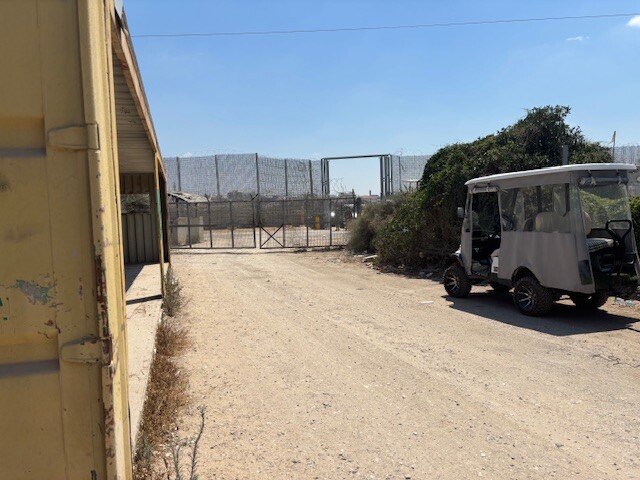 Nina SebaAug-18-2025Habla: The gate is in the process of closing
-
Kufr Thulth
See all reports for this place-
Kufr Thulth is located in the western part of the West Bank, in the Qalqiliya district. According to archeological evidence, this village was inhabited as early as the Early Bronze Age. Findings have been dated there to Hellenistic, Roman, and Byzantine times. The village is situated on road 446, south of the Palestinian town of Azoun and north of Qanah River. It numbers 5,606 inhabitants as of 2017.
After the signing of the Oslo Accords, the built-up southern part of the village was categorized as Area B, comprising about 11% of its area, but nearly all of its farmland is classified as Area C.
Israel has confiscated 367 dunams of the village lands, and the area of neighboring village Arab Al Hula, in order to construct the settler-colonies of Karnei Shomron, Ginot Shomron, Ma’ale Shomron, and Immanuel, as well as the Separation Fence (splitting the village itself), and prevented villagers to access their farmlands lying near the settler-colonies. The authorities declared the area a nature reserve, and thus prevented access or any tending that would change the nature of the local land.
The Israeli army and the settler-colonists continue to harass the Palestinian farmers who visit their own lands, attack their herds and destroy trees and any other kind of farm crop, uproot trees and pollute water sources with sewage or toxic waste in order to make the Palestinians leave.
For further information: http://vprofile.arij.org/qalqiliya/pdfs/vprofile/kufrthulth_vp_en.pdf
-