
Habla, Qalqiliya, Ras ‘Atiya, Mon 26.4.10, Afternoon
Summary
We're involved in "human rights" work, but sometimes it's good to remind ourselves of what being "human" means — and its relationship with humanitarianism and human rights. Being human is what all of us are, a part of the species, but we also tend to associate that with the "human condition," our experience of existence as human beings. Moreover, the nature of being human has psychological characteristics shared by all who are normal. Those characteristics range from positive aspects like compassion and altruism, along with aggression or similar negative aspects. Humanitarianism, as distinct from international humanitarian law (IHL), is related to being human and carries with it notions of kindness, benevolence and sympathy. But our own efforts to monitor the abuse of human rights in the OPT are surely based on the modern conception developed in the aftermath of World War II in part as a response to the Holocaust, culminating in the signing of the Universal Declaration of Human Rights by the United Nations General Assembly in 1948. Nevertheless, as part of the human species, we are not unaware when the Occupier displays positive aspects of being human in the Occupation's completely inhuman situation.
11:30 Gate 1392 Habla
Although it's busy now, the soldiers tell us that between 6:45 and 8:15 it's even busier (and we wonder, silently, why, during summer time, the gate isn't open even earlier)?
Horses and carts give way to trucks and pickups, one horse neighs uncontrollably, another stands meekly, waiting, like most of the drivers (of animal or mechanized vehicles). Meanwhile, workers in the field are picking a root vegetable, and only later do we recognize that these are potatoes, and that even the faded leafy part is being saved and transported by yet another horse, cart and driver through towards Habla.
11:50 — this particular horse objects to the length of time it takes for his master to go through the Separation Barrier, to the concrete house on the far side, to have his ID checked (yet again, since, of course, he had to come this way earlier this morning)! The horse makes its way across, driverless and alone, but another man grabs the reins and halts the horse as the soldiers look on. The horse's master takes 7-10 minutes before he rejoins his charge.
Now, another horse cart, with closed cardboard boxes, is thoroughly checked on the far side of the Separation Barrier.
In the other direction, a young man gives his ID to a soldier who keeps it until the young man returns from the far "Israeli" side of the Separation barrier.
11:55 — finally, not a man or boy, or truck or horse and cart on the Separation Barrier, on either side. People, however, still in the concrete checking bunker. Other invisible soldiers take care of this, so that the soldiers we do see have time to talk (the Armored Corps seem not to have heard the dictum that "it's forbidden to talk to MachsomWatch")! We mention how slow everything is – that's surely the policy…
12:30 Ras Atiya
Not a Palestinian around at first and the soldier from the lookout tower is perched in the shade of the concrete shelter – there for Palestinians. He's relaxed, and just then a man and wife come by, telling us that this is a good group of soldiers, but we should have seen them a couple of weeks ago: terrible! Here, as at Habla, it's very slow, surely a policy, since, we re soon told, by the other soldiers who join us that there's a lot of pressure here in the early mornings.
12:40 — everybody is checked, everybody has to get out of a vehicle or dismount from horse or donkey cart (the latter more prevalent here than at Habla), but an old lady, whose cart is laden with hay, has her ID taken by a soldier who brings it to the concrete checking bunker, has it checked and returns it to the old lady, still sitting atop her donkey cart.
12:45 — we're joined by the group of soldiers on duty here, also Armored Corps, as the Separation Barrier is empty of humans and vehicles, and one, in particular, wants to know what we do and what happens with our reports, etc. The last to join us is the commander, a sergeant who tells us not to ask personal questions of the soldiers, and then proceeds to wonder what we do for a living?! The commander goes back with two of the other soldiers to the middle of the checkpoint as children begin to become visible, on their way home from school. As we prepare to leave, the lone soldier in the shelter, pulls out a book from his kitbag, props his feet on the edge of the concrete wall of the shelter and starts to read!
Qalqilya
Although there is hardly any evidence of the former checkpoint, there's a mini, armored bunker, at ground level, which appears to be empty. On the military camp itself, the lookout tower is manned, and the roadway, towards the city of Qalqilya, is filled with colorful spring plantings.
Route 505
Along the way, huge white cow parsley, or Queen Anne's lace, blooms in the fields, now devoid of many colors, the summer mantle of brown having descended already on the landscape.
Before Qedumim
We note two pickup trucks that descend from the dirt path to a house, west of the former settler outpost at Shvut Ami, a house with yellow tractors always parked outside, that is clearly Palestinian (black water containers on the roof). Both trucks turn into the settlement of Qedumim. In the next weeks, it's important to monitor what is going on here.
__._,_.___
Habla
See all reports for this place-
Habla CP (1393)
The Habla checkpoint (1393) was established on the lands of the residents of Qalqilya, on the short road that
connected it for centuries to the nearby town of Habla. The separation barrier intersects this road twice and cut off the residents of Qalqilya from their lands in the seam zone.(between the fence and the green line).
There is a passage under Road 55 that connects Qalqilya to the sabotage This agricultural barrier is used by the farmers and nursery owners established along Road 55 from the Green Line and on both sides of the kurkar road leading to the checkpoint.
This agricultural checkpoint serves the residents of Arab a-Ramadin al-Janoubi (detached from the West Bank), who pass through it to the West Bank and back to their homes. The opening hours (3 times a day) of this agricultural checkpoint are longer than usual, about an hour (recently shortened to 45 minutes), and are coordinated with the transportation hours of a-Ramadin children studying in the occupied in the West Bank.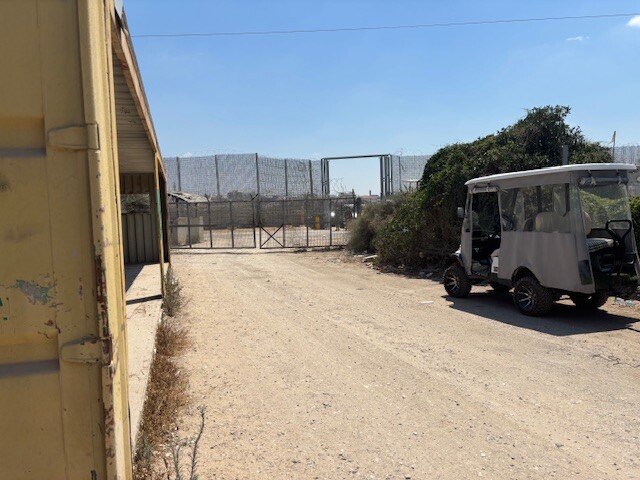 Nina SebaAug-18-2025Habla: The gate is in the process of closing
-
Qalqiliya checkpoint
See all reports for this place-
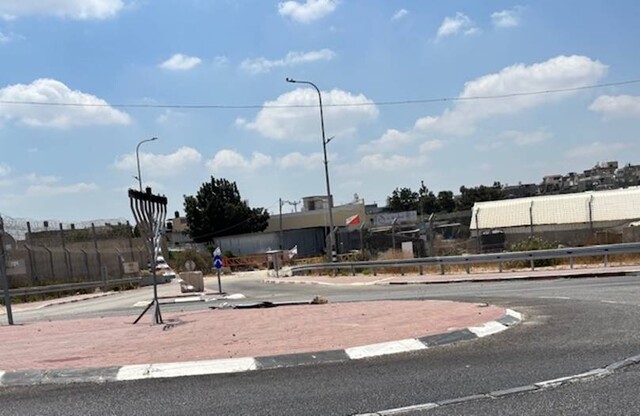
Qalqilya is surrounded on all sides by the separation barrier. The only exit from the city is in the east of the city on the road that leaves the city in an easterly direction. This is where the checkpoint was located. When the checkpoint was active until 2009 our shifts watched long queues of cars being inspected at the only exit from the city to the West Bank. The checkpoint was canceled, but there is a military presence at the entrance to the city.
 Nina SebaAug-18-2025Azzun: Enclosed by a high fence and the gate to the village is closed
-
Ras 'Atiya
See all reports for this place-
The checkpoint is presently on the Separation Barrier roadway, manned and open 12 hours a day, from 6:30 to 18:30. West of it is the large Seam Line village whose school is attended by children from the nearby villages east of the Barrier and many of whose inhabitants have permits to work in Israel. How long this checkpoint will remain in place is unknown, since construction of the Separation Wall, just by the settlement of Alfe Menashe, east of the present Separation Barrier, is endless, as is the creation of a new road and, obviously, a new checkpoint.
-