
Habla - two large holes in the checkpoint gate
During the Corona shutdown we accumulated a large amount of material for Z., our friend in Azzun. We went to bring him the treasures, which filled our car.
The road to Azzun was calm. The large plaza that had been constructed (on land belonging to Qalqilya residents, of course) regulates traffic, and some of the plant nurseries have relocated here, just past the bridge over Highway 6.
There’s no military presence at the entrance to Azzun. The town is quiet, even slumbering; Z. is also asleep. His wife and lovely children greet us. It’s hard to communicate, even though I’ve been studying Arabic for a long time because I still don’t speak at all fluently. We politely refuse an invitation to come inside, even though the courtyard visible from the gate appears cool and well-kept. When I’m able to carry on a conversation in Arabic I’ll be able to sit and chat with Z.’s pleasant wife.
We continue to Nabi Ilyas for a falafel brunch. Since the road bypassing Nabi Ilyas was opened there’s sparse traffic on the main street. Even though the owner of the falafel stand says it hasn’t hurt business, the number of customers seems to have declined. A father and son, Israelis without yarmulkes, also enjoy the fresh, inexpensive falafel (which was prepared in our honor).
We continue to A.’s plant nursery.
While waiting for the gate to open we trade stories. A. tells us about an annoying female soldier who’s now at the checkpoint, who sends everyone to be inspected in the bolem [an Israeli military term for a concrete blockhouse for conducting inspections]. That’s how we learned that Palestinians are not always sent through the bolem, but only sometimes. A. has a 00 permit that allows him to cross freely, but he’s also sent to be checked and must argue with the soldiers who don’t know whom they’re dealing with and dare to give him orders.

There are two large holes in the checkpoint gate. According to A., Palestinians go through them directly to the bus awaiting them on the Israeli side, which takes them for a ride. Soldiers come to the plant nurseries looking for the “infiltrators” and suspect A. helps them escape…
Greenhouses have been erected around the gate and a wire fence blocks access to the crossing from the fields. Construction continues all around, as well as plowing and other work.
A. says there have been no problems at the checkpoint during the past few days, despite the strict female soldier.
The occupation routine.
'Azzun
See all reports for this place-
Azoun (updated February 2019)
A Palestinian town situated in Area B (under civil Palestinian control and Israeli security control),
on road 5 between Nablus and Qalqiliya, east of Nabi Elias village. The inhabitants are allowed to construct and improve infrastructures. The Separation Fence has confiscated lands belonging to the town's people. In 2018 olive tree groves owned by one of its inhabitants were confiscated for the sake of paving a road to bypass Nabi Elias. Azoun population numbers 13,000, its economic state dire. Its infrastructures are poor, neglect and poverty rampant. In the meantime, the town council has completed paving an internal road for the inhabitants' welfare.
Because of its proximity to the Jewish settler-colony of Karnei Shomron and its outposts, the town suffers the intense presence of the Israeli army, especially at nighttime: soldiers enter homes, arrest suspects, trash the house and sometimes ruin it, as they do in numerous places in the West Bank. At times a checkpoint closes the entrance to the town, so no one can come in or get out.
-
Habla CP (1393)
See all reports for this place-
Habla CP (1393)
The Habla checkpoint (1393) was established on the lands of the residents of Qalqilya, on the short road that
connected it for centuries to the nearby town of Habla. The separation barrier intersects this road twice and cut off the residents of Qalqilya from their lands in the seam zone.(between the fence and the green line).
There is a passage under Road 55 that connects Qalqilya to the sabotage This agricultural barrier is used by the farmers and nursery owners established along Road 55 from the Green Line and on both sides of the kurkar road leading to the checkpoint.
This agricultural checkpoint serves the residents of Arab a-Ramadin al-Janoubi (detached from the West Bank), who pass through it to the West Bank and back to their homes. The opening hours (3 times a day) of this agricultural checkpoint are longer than usual, about an hour (recently shortened to 45 minutes), and are coordinated with the transportation hours of a-Ramadin children studying in the occupied in the West Bank.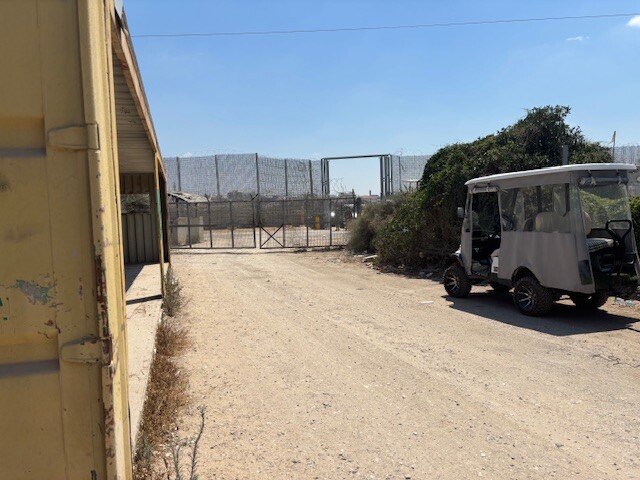 Nina SebaAug-18-2025Habla: The gate is in the process of closing
-