
Hamra (Beqaot), Ma’ale Efrayim, Tayasir, Za’tara (Tapuah), Sun 5.8.12, Afternoon
Translator: Charles K.
Notwithstanding the articles in “Haaretz” and the delegation of peace organizations to the Jordan Valley in protest against the army’s confiscation of water wagons from the Bedouin, the policy of confiscations continues unimpeded. Three days ago two tractors and a water wagon belonging to A. and O. were confiscated; they were told they’d be summoned to court and will be fined heavily for parking in a “firing range.” They were parked next to their family’s tent, but the entire area, except for the settlements, is a firing range! So even their presence is illegal.
The tractors are the Bedouin’s sole means of transportation, indispensable for making a living – bringing hay for the flock, water to the grazing land. You have to remember that these people are very poor; they meet their basic needs only with great difficulty. Where will they get the money to pay the occupying authorities? And tomorrow their equipment could be confiscated again.
Thus the Civil Administration, which is responsible for taking care of and dealing with the needs of the civilian population (in this case, the Bedouin), becomes an instrument of repression and dispossession in the hands of the military authorities.
12:55 Za’tara/Tapuach junction checkpoint. Only the guard towers are manned.
13:10 Ma’aleh Efrayim checkpoint – An Israeli police car on the road to the west is stopping vehicles which have yellow (Israeli) license plates.
Gitit settlement – New greenhouses west of the road.
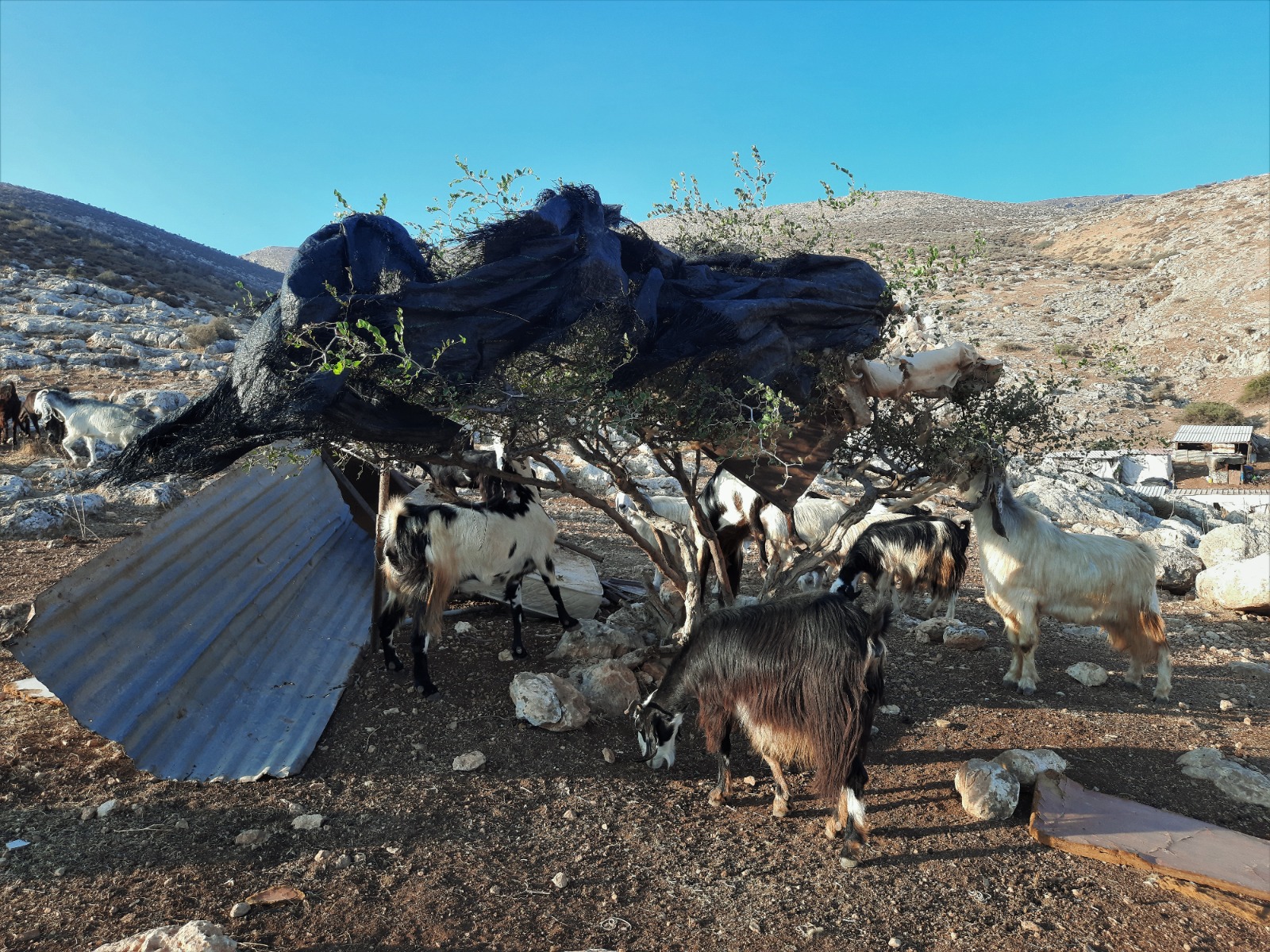
Between Gitit and Mechora – The temperature is 39 degrees Celsius; the sheep seek any bit of shade under the jujube trees. A tanker fills a water wagon in one of the grazing areas.
Mechora settlement – Many long-abandoned greenhouses. Large chicken houses have recently begun to be erected, five thus far.
13:30 Hamra checkpoint. A man from Tam’un waits for a patient coming from Hadassah hospital, a laborer who fell from a ladder in one of the settlements. His employer is bringing him from Jerusalem. The man complains that the Gochia crossing is always closed, which greatly lengthens the trip to the Jordan Valley for residents of Tam’un. He says that soldiers at the Tayasir checkpoint harass people who have to go through, unnecessarily delaying them for long periods. On the other hand, people cross through the Hamra checkpoint quickly, in a reasonable amount of time.
Three cars coming from the Jordan Valley wait on the road. Three minutes later they go through without inspection.
Ro’i settlement. Seedlings have been planted in a fenced field by the side of the road west of the settlement.
15:00-15:30 Gochia checkpoint
The gate is closed and locked. Zaharan, from the DCO, has been given a different assignment. We spoke to someone from the DCO situation room; she didn’t know what we were talking about, nor did she help. Later we managed to speak to Majid, the checkpoint non-com. He said they have cameras showing whether people are waiting at the gate; they send soldiers to open it. But since usually no one comes, there’s no point in opening it.
Someone should examine that claim. At one time, when a different unit was responsible for opening the gate, one of its officers told us they opened it in the morning but if no one went through there was no reason to re-open it in the afternoon. At that time, no one mentioned cameras. Meanwhile, it’s like the chicken and the egg: because the local Bedouin see the gate is always closed (it’s supposed to open three times a week for half an hour in the morning and in the afternoon) they don’t try to use it; as a result, as Majid says, there’s no point opening it.
16:40 Tayasir checkpoint. Very little traffic.
The checkpoint commander approaches us with another soldier to warn us not to go near the checkpoint. We asked them whether they know that the Gochia crossing is supposed to be opened, because the unit in the base near the checkpoint is responsible for doing so. He had no idea. We should note this unit is new here.
At K’s encampment
K. tells us about two people from the Hamam el Malih area who had tractors and a water wagon confiscated.
“My father is 90 years old. He’s been living here since before the 1967 war. Now they tell him – leave. All the land is ours. Where should he go?”
18:15 Ma’aleh Efrayim checkpoint.
Soldiers inspect Palestinian cars traveling to the Jordan Valley. Only those whose owner and driver are registered as being residents of the Jordan Valley are permitted to cross (why???). Each car is detained for about five minutes. First, documents are inspected. There’s a discussion/argument. Then the driver gets out to open the trunk. Only afterwards is he allowed to drive away.
As usual, cars belonging to settlers speed by at the same time. If the road is blocked the drivers make those waiting at the checkpoint move to the side, because they’re lords of the land. As are we.
A few months have passed since inspections were conducted here. Nothing out of the ordinary happened while we were present.
Hamra (Beqaot)
See all reports for this place-
One of the Jordan Rift Valley checkpoints that prevent direct transit between the West Bank and the Jordan Valley, in addition to Tayasir Checkpoint. Located next to Hamra settlement, on Route 57 and the Allon Road.
Read about the peple of the Jordan Valley and the quiet transfer happening there.
 Shahar ShilohNov-3-2021Ein Shibli: grazing begins close to home
-
Ma'ale Efrayim
See all reports for this place-
Ma'ale Efrayim On the road connecting Route 90 (the Jordan Valley road) to the Allon Road.
-
Tayasir CP
See all reports for this place-
Located on road 5799, It is one of the checkpoints control the passage between the northern West Bank and the Jordan Valley. For a long time, it stood empty and open, with only a sign next to it warning against entering Area A. It was adjacent to an old military camp - now everything is neglected. How much money was invested here, and how much brainwashing was done to the soldiers of Netzah Yehuda and Kfir.
Today, it is very difficult to pass there. Many delays. Often, teachers from Tubas are not allowed to pass into the Valley to villages like Ein al-Bida where the local schools are located, and there are no classes. There are additional days when the checkpoint is closed. In general, there is a wait there of about two to four hours to go towards the Valley and also to return. Many times the Palestinians are forced to use the Hamra checkpoint, which also leads into Tubas and the West Bank, but there is also a huge queue there and a long wait.
Following a deadly attack on soldiers at the nearby base in February 2025, the checkpoint was completely closed for the time being. (Updated March 2025)
-
Za'tara (Tapuah)
See all reports for this place-
Za'tara (Tapuah) Za'tara is an internal checkpoint in the heart of the West Bank, at the intersection of Road 60 and Road 505 (Trans-Samaria), east of the Tapuah settlement. This checkpoint is the "border" marked by the IDF between the north and south of the West Bank, in accordance with the policy of separation between the two parts of the West Bank that has been in place since December 2005. At the Za'tara checkpoint, there are separate routes for Israelis and Palestinians. In the route for Israelis, there are no inspections and the route for Palestinians inspects. The queue lengthens and shortens suits. The checkpoint is open 24 hours a day. The checkpoint is partially staffed and the people who pass through it are checked at random.
 Shoshi AnbarSep-27-2023Za'atra (Tapuah Intersection). Signs
-