
Hamra (Beqaot), Tayasir, Za’tara (Tapuah)

15:15 Za’tara checkpoint/Tapuach junction
The checkpoint is not manned, but never fear – the occupation has not relaxed its stranglehold. Soldiers are watching from the observation towers and there are two or three soldiers at every hitchhiking station. Next to the hitchhiking station toward the Jordan Valley, a roofed concrete position has been built. A very noticeable camouflage netting covers the entire structure.
The army has placed numbered concrete barriers all the way from the Za’tara checkpoint (which has been nationalized as “Tapuach”) to Migdalim, dividing the area into sub-areas. Their purpose is not clear.
Ma’aleh Efrayim checkpoint
Not manned.
15:45 Hamra checkpoint
People flow through without incident other than the “occupation routine.” There is no line on the eastern side, but on the west (toward Nablus) seven cars and trucks wait. We timed them – an average of seven minutes each. Later we will see how easy it is to reverse things, all part of the same occupation routine.
At Khalat Makhoul we visited Bourhan. His wife is in Tamoun with their newborn son, 40 days old. Conditions at Makhoul are too harsh for a newborn; this child, the first son after eight daughters, is being treated like a crown prince. Aviva asked why they do not plant trees in the village. Bourhan said the army uprooted trees because they represent permanent settlement; the residents expect to be expelled. Moreover, a tree needs water and they barely have enough for themselves and the sheep. While we drank tea Abu Khalif, their 76 year old neighbor joined us, then five of his grandchildren who’d come from Tamoun to help him (the entire Khalif family left because of the hardships; they live in Tamoun and elsewhere). The grandchildren described their lives as university graduates, the difficulty finding a job, their desire to see Israel, if only once, and, of course, about the terrible things happening in Gaza and how it affects them. A pleasant afternoon hour with a cool breeze and a friendly atmosphere.
17:50 Tayasir checkpoint
Light traffic. A taxi driver says that the checkpoint has been “OK” for the past few days. His colleagues, with whom we talk while waiting for the soldier to finally motion them forward, were made to get out of their cars, stand in a straight line, their documents and cars carefully inspected, including the trunk and the seats. Because of us?
19:30 Hamra checkpoint
Two young men stood next to the waiting area when we arrived. It turned out Z.’s brother had been arrested at the checkpoint yesterday in his car, which the soldiers said contained ammunition (What, exactly, does “ammunition” refer to? The soldier refused to say). Z. says his brother sells to supermarkets; the car contained fruits and vegetables. Today Z. came by taxi from Tubas to get his car; he’d only lent it to his brother. The soldiers immediately took his ID and that of R., the taxi driver, and made them stand off to the side. They had been waiting 3 ½ hours in the sun (which had set in the meantime) when we arrived, with no water. The taxi remained inside the checkpoint. Gentle men, patient, who didn’t really understand – justifiably – why they were being detained. We tried to talk to the soldiers, then to them again (“Do you know them? Do you know they’re dangerous, wanted men?” “Dangerous? Standing 20 meters from the soldiers, unguarded?”) We tried to reach Riam, the checkpoint officer, by phone, who did not answer, just sent an SMS that he is very busy; we tried another DCL officer, who was attending a funeral; we tried the operations room – nothing. Four hours had passed, they still had not been released, and only when we finally called Chana Barg, her energetic efforts finally resulted in their release after almost five hours (4 hours and 40 minutes). They did not get the car, of course.
They took the taxi from the checkpoint, made a U-turn, and waited for the soldier to wave them forward. He, just to annoy them, made them wait, and wait. Five whole minutes. For no reason. Another bit of harassment. And when they reached the checkpoint the driver had to get out, they opened the doors, inspected over and over again, opened the trunk, began emptying it – the jack and other items within… and all this for a taxi that had stood at the checkpoint under the soldiers’ watchful eyes!!! They finally ran out of excuses and released the two men.
As we walked to the car the soldiers called to us, “Satisfied?”
21:00 We left.
Hamra (Beqaot)
See all reports for this place-
One of the Jordan Rift Valley checkpoints that prevent direct transit between the West Bank and the Jordan Valley, in addition to Tayasir Checkpoint. Located next to Hamra settlement, on Route 57 and the Allon Road.
Read about the peple of the Jordan Valley and the quiet transfer happening there.
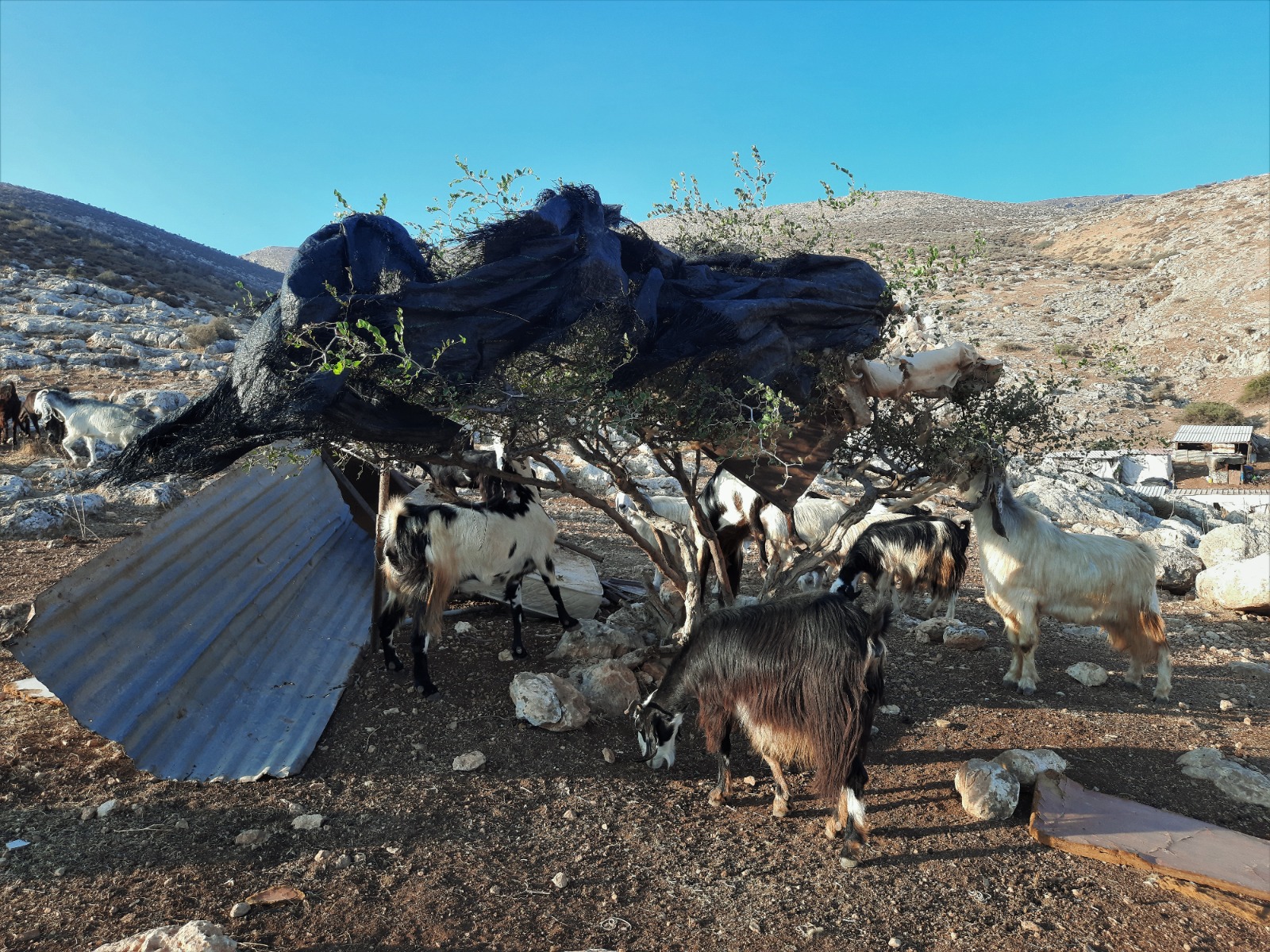 Shahar ShilohNov-3-2021Ein Shibli: grazing begins close to home
-
Tayasir CP
See all reports for this place-
Located on road 5799, It is one of the checkpoints control the passage between the northern West Bank and the Jordan Valley. For a long time, it stood empty and open, with only a sign next to it warning against entering Area A. It was adjacent to an old military camp - now everything is neglected. How much money was invested here, and how much brainwashing was done to the soldiers of Netzah Yehuda and Kfir.
Today, it is very difficult to pass there. Many delays. Often, teachers from Tubas are not allowed to pass into the Valley to villages like Ein al-Bida where the local schools are located, and there are no classes. There are additional days when the checkpoint is closed. In general, there is a wait there of about two to four hours to go towards the Valley and also to return. Many times the Palestinians are forced to use the Hamra checkpoint, which also leads into Tubas and the West Bank, but there is also a huge queue there and a long wait.
Following a deadly attack on soldiers at the nearby base in February 2025, the checkpoint was completely closed for the time being. (Updated March 2025)
-
Za'tara (Tapuah)
See all reports for this place-
Za'tara (Tapuah) Za'tara is an internal checkpoint in the heart of the West Bank, at the intersection of Road 60 and Road 505 (Trans-Samaria), east of the Tapuah settlement. This checkpoint is the "border" marked by the IDF between the north and south of the West Bank, in accordance with the policy of separation between the two parts of the West Bank that has been in place since December 2005. At the Za'tara checkpoint, there are separate routes for Israelis and Palestinians. In the route for Israelis, there are no inspections and the route for Palestinians inspects. The queue lengthens and shortens suits. The checkpoint is open 24 hours a day. The checkpoint is partially staffed and the people who pass through it are checked at random.
 Shoshi AnbarSep-27-2023Za'atra (Tapuah Intersection). Signs
-