
Hamra (Beqaot), Tayasir, Za’tara (Tapuah)
Za’tara checkpoint – no soldiers, other than in the guard tower, nor when we returned in the afternoon.
Ma’aleh Efrayim checkpoint – No soldiers, nor when we returned.
10:35 Hamra checkpoint – Sparse traffic. We spoke with the checkpoint commander about the value of this checkpoint which is more than an hour’s drive from the Green Line and separates the Jordan Valley from the remainder of the West Bank. He stubbornly insisted that the checkpoint is to prevent attacks, and even if only one terrorist is “caught” every few years and that prevents, perhaps, “the killing of a girl,” he’s willing to stand here all day.
Khalt Makhul
Six months ago a demolition order was issued against all the structures in the village – the tents and shacks they live in and for the sheepfolds (they make their living from the sheep). They sued in the Supreme Administrative Court in Jerusalem and have been waiting for its decision. Meanwhile the structures have been rebuilt with the aid of humanitarian organization. The decision is to be issued October 1. It’s important for as many supporters as possible to attend. Details will be announced soon.
The village is adjacent to the Hemdat settlement. There’s usually no contact between the two communities – neither good nor bad. But about two weeks ago a shepherd resting not far from the settlement’s fence was shot at by one of the settlers, from inside a house (i.e., without having made even eye contact). Luckily for the shepherd the bullet hit the ground between his legs and fragmented.
Did they file a complaint? With the police, for example? Of course not. They have no trust in Israel’s “institutions of justice.”
Construction has been underway for a while at the Maskiyot settlement. Two public buildings are being built. One may be a synagogue (that’s what the architecture look like); there are also a few houses.
12:15 Tayasir checkpoint
Little traffic here also. A soldier came to speak with us; it’s been a long time since I’ve talked to such a nice soldier, intelligent, open and tolerant. Even more so because he’s religious and lives in a settlement. We spoke about various topics, including serving in the army these days and the effect of military service on one’s political outlook.
K’s tent encampment at El Malih
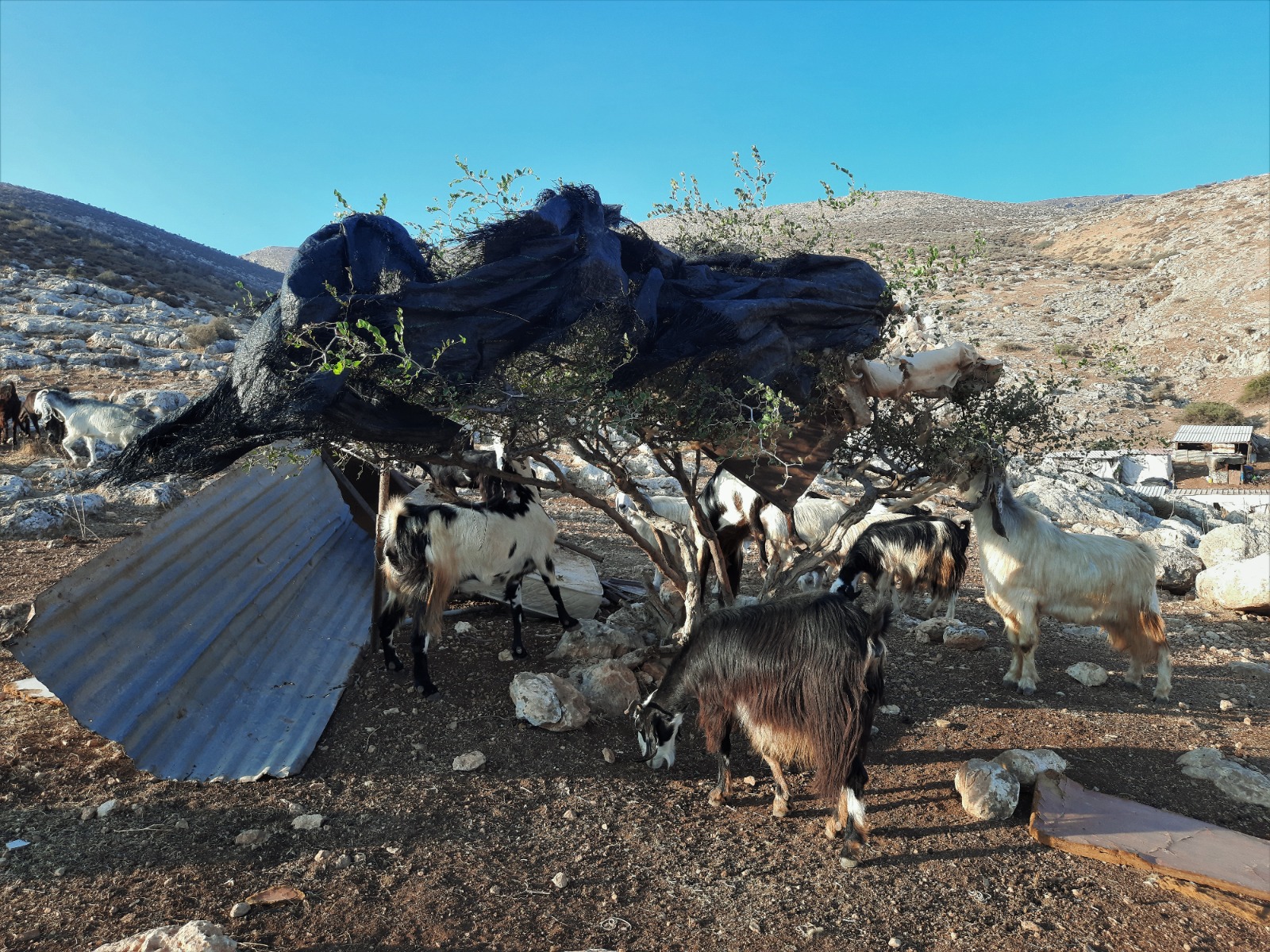
They told us that two weeks ago a goat belonging to one of the neighbors climbed the hill on which Maskiyot settlement is located and didn’t return, and they have no way of learning what became of it.
Why didn’t they telephone the settlement’s security coordinator (with whom they’d already had many problems)? Because he’ll deny it, of course. And the police? They have no faith that the police will do anything about injustices suffered by Palestinians. From what I know about the history of this family with the police, they’re absolutely correct. Two years ago one of the sons was badly beaten by the security coordinator of the Rotem settlement while he was grazing his flock. There were witnesses (Jews). The son was hospitalized for two days. A complaint was filed with the police and a year later they were told the file had been closed.
H. arrived, an Israeli from one of the settlements who’s employed by the police. “A friend of ours,” according to the family. He came with an empty egg carton. The family has a few chickens. We didn’t wait for the “transaction” but it seemed that only eggs, but no money, would change hands. We’ll find out on our next visit, and if we’re mistaken will eat as many hats as you wish.
Meanwhile the guest and hosts talked. He asked (or interrogated) them about some problem whose nature I don’t remember. They did all they could to help him. Their obsequiousness was difficult to watch. We asked him disingenuously whether he felt the status of his Bedouin hosts was equal to that of the settlers. He replied seriously, with a smug smile that never left his face during the entire conversation, that the Bedouin have more freedom of movement than the settlers because they can graze their sheep wherever they wish (as far as we know, that’s not true), while the settlers are restricted by the fence around the settlement.
He told us that Maskiyot settlement has suffered at the hands of its Bedouin neighbors who’d taken fence posts to sell the metal and the police weren’t able to identify the thieves. “But, you (addressing his hosts), you know who did it,” and pointed to the encampment on the other side of the road. And added, “They also had a flock stolen which numbered a few hundred head,” and again turned to the hosts with the same smug smile, “You know who did it.”
“They always know,” he said to us.
He also had a ready reply regarding the allocation of water in the Jordan Valley, the injustice of which cries out to the heavens: “They” steal our water. Break the Mekorot water pipes (which carry most of the water to the settlements with not a drop for the Bedouin).
Again he turns to his hosts: “You know where the pumps are, don’t you?”
And to us: “They always know!”
We could no longer stand his lies, and especially his smugness and self-satisfaction, and we left.
15:00 Hamra checkpoint (on our way back)
A police vehicle parked in the checkpoint area. The policeman is talking to one of the Palestinian drivers waiting at the checkpoint. A soldier explains that’s the normal procedure. Policemen come a few times a week to issue tickets to drivers who have no choice but to go through the checkpoint. The police remain there for an hour or two each time.
As far as we could understand, the Israeli police often check Palestinian vehicles and issue tickets to the drivers for any possible reason. An additional way to embitter the lives of Palestinians and make money. We never saw the police pay similar attention to the settlers.
Hamra (Beqaot)
See all reports for this place-
One of the Jordan Rift Valley checkpoints that prevent direct transit between the West Bank and the Jordan Valley, in addition to Tayasir Checkpoint. Located next to Hamra settlement, on Route 57 and the Allon Road.
Read about the peple of the Jordan Valley and the quiet transfer happening there.
 Shahar ShilohNov-3-2021Ein Shibli: grazing begins close to home
-
Tayasir CP
See all reports for this place-
Located on road 5799, It is one of the checkpoints control the passage between the northern West Bank and the Jordan Valley. For a long time, it stood empty and open, with only a sign next to it warning against entering Area A. It was adjacent to an old military camp - now everything is neglected. How much money was invested here, and how much brainwashing was done to the soldiers of Netzah Yehuda and Kfir.
Today, it is very difficult to pass there. Many delays. Often, teachers from Tubas are not allowed to pass into the Valley to villages like Ein al-Bida where the local schools are located, and there are no classes. There are additional days when the checkpoint is closed. In general, there is a wait there of about two to four hours to go towards the Valley and also to return. Many times the Palestinians are forced to use the Hamra checkpoint, which also leads into Tubas and the West Bank, but there is also a huge queue there and a long wait.
Following a deadly attack on soldiers at the nearby base in February 2025, the checkpoint was completely closed for the time being. (Updated March 2025)
-
Za'tara (Tapuah)
See all reports for this place-
Za'tara (Tapuah) Za'tara is an internal checkpoint in the heart of the West Bank, at the intersection of Road 60 and Road 505 (Trans-Samaria), east of the Tapuah settlement. This checkpoint is the "border" marked by the IDF between the north and south of the West Bank, in accordance with the policy of separation between the two parts of the West Bank that has been in place since December 2005. At the Za'tara checkpoint, there are separate routes for Israelis and Palestinians. In the route for Israelis, there are no inspections and the route for Palestinians inspects. The queue lengthens and shortens suits. The checkpoint is open 24 hours a day. The checkpoint is partially staffed and the people who pass through it are checked at random.
 Shoshi AnbarSep-27-2023Za'atra (Tapuah Intersection). Signs
-