
Hamra, Ma’ale Efrayim, Tayasir, Za’tara (Tapuah), Mon 12.4.10, Afternoon
Summary
The new military Order Regarding Prevention of Infiltration and Order Regarding Security Provisions does not define what a valid permit is, but is so ambiguously worded that, theoretically, it allows the military to empty the West Bank of almost all its Palestinian inhabitants. Recently, a number of articles in the media have asked "What does Netanyahu want?" The question is, in fact, posed too specifically, since it's not a question of Netanyahu but of the "Israeli authorities," including the army that seems to be creating facts on the ground which can have no good ending for either Palestinians or Israelis. But in the Jordan Valley, it seems remarkably clear, particularly in the vast area that constitutes the Jordan Valley: "colonization," "land grab," "transfer," "evacuation of people," "eviction." Whatever its nomenclature, it's all an affront to the most fundamental principles of human rights.
12:00 On Route 5
At Marda, before Zeita, traffic, Palestinian and Israeli vehicles, grind to a complete halt. No movement of traffic in either direction for a while. People get out of cars, we place our MW flag and signs, and still nothing moves. Ten minutes later, a few cars come from the East. A Palestinian car stops by us, the driver leaning out of his window, saying, only slightly puzzled, "Who knows what's going on? Maybe something on the road?" As he speaks, a settler car hoots loudly and viciously behind him. They both move on, westwards.
12:20-12:30 Zaatara-Maale Efraim Jct.
The large junction at Zaatara seems to be flowing smoothly, no traffic stops here, and the Maale Efraim checkpoint is a joke. It is there, as are soldiers who pay no heed to passing vehicles.
Route 508 to Hamra
A beautiful winding road, on the east side of a mountain, with extensive views over the Jordan Valley proper, the Hashemite Kingdom of Jordan and the mountains of Moab in the distance. The greens at this time of year are still startlingly bright, and the reflection of the scudding clouds on the distant mountains is particularly arresting. The settlements here are rural, not like the suburban ones around Tulkarm, Qalqilya and Nablus. They are, or were, agricultural, but several of them, such as Mekhora, look in pretty bad shape. Others grow grapes, clearly a new crop, and everywhere the Mekorot water plants, closely guarded by barbed wire and fencing, provide the settlements, failing or otherwise, with water.
12:55 Hamra and Route 578 to Tyasir
As we arrive at the checkpoint, we note a pickup truck that has to turn back in the Nablus direction.
13:00 Two soldiers approach us. The commander, I., looks clueless although he protests that he has heard of MachsomWatch and insists that we`re "not to bother the soldiers."
We have no chance to do much of anything, as S. approaches us, a volunteer of Jordan Valley Solidarity, remembers meeting us before, and suggests that we accompany F. as there are plenty of "interesting" things going on. By now, F., also of Jordan Valley Solidarity, who has crossed the checkpoint in his car, whereas S. has had to walk, joins us, and we now begin to follow his car in ours, past the settlements of Beqaot and Roi and through a gate, which, we notice, is electrically wired, albeit open at this early afternoon hour.
F. speeds along a rutted dirt path, hardly a road, as we try to steer our way over the rocky terrain. On one side of us, the well tilled fields of the settlement, on the other side, the hilltop, already brown and barren, which has what we don't know beyond. Eventually, after a bend in the road, a few Bedouin tents appear, and, sure enough, there is F.'s car.
As we sit with a few men and one woman, including, clearly, the man who is the "pater familias" in a far different world, we learn that the gate of El Hadidiye has already been closed for a few weeks, and, as an aside, the Guchia Gate likewise: (before, the latter was opened sporadically, but no more).
Now, the latest of a series of harassments: the water has been cut off to El Hadidiye, and the community consists not just of this family but many more on the hilltop above. We noted, of course, the large Mekorot pumping station just below the tents and, but for today's strong wind, no doubt we could hear its engines purring. Three tiers of barbed wire, and, according to F., an alarm system which warns of infiltrators (although how anybody can get past this barricade is beyond us).
Then, another story, that anybody going out from this community in a Palestinian car, beyond the electrically wired gate, would be taken to Hamra checkpoint, to be dealt with by soldiers. An open-air prison, a ghetto without walls: that's life, if it can be called thus, for these Bedouin Palestinians. The media have been informed of the cut water, but the story is not "policy" per se, rather an individual Mekorot employee who wishes to flex his muscles (to look good to his bosses?), but nevertheless, a man, Israeli, who is willing to take sheep and vegetables from the poverty stricken Bedouin whenever his whim dictates that he does so. Life under Occupation; and the Occupation makes everything rotten, as we know.….
More wisely than many an Israeli analyst or journalist, F. tells us, "The State is destroying itself." Indeed.
To try to understand what is going on, we look at the vast landscape before us, the hills, the mountains beyond, the settlement's green houses and planted fields, and it's obvious what "they" want. To add these pastures and this hillside to their own settlement, to water it from the plant which is already in place. What could be easier? Or more evil?
14:00 — just to remind us where we are, amidst baby goats and lambs and small children, an army helicopter, ugly in its dark colors against the muted colors of this landscape, hovers overhead.
And following this intrusion, we observe a tractor arrive, laden with what looks from the distance like wilted lettuce. Indeed it is. These lettuces from the settlement beyond aren't good enough for the European or Israeli market, and the Palestinian tractor driver has been asked to bring this load and to dump it, or sell it, in the Nablus market. F. will take some samples to the Ministry of Agriculture in Palestine.
We continue along Route 578, noting the numerous fresh dark earth colored hillocks, dug up by the army, with trenches below, making certain that no Palestinians cross them or come in the vicinity of any settlement along the way.
The headquarters of Kfir (Young Lion) Brigade is a huge military camp, an eyesore in this beautiful landscape.
At the turn off to Tayasir, we don't note anything amiss with the area around Al-Malik, although we've been told, that, as of today, it's a closed military area. Plenty of shepherds, waving cheerfully to us as they walk alongside their animals or accompany them on a donkey. A little further up the road, soldiers, in a perfectly carved out "bowl" in the natural beauty of the countryside, are "playing at soldiers:" it's a shooting range, complete with flags and little jeeps standing about.
Another Bedouin encampment supports a roadside sign, "Supporting Vulnerable Households in the OPT," a project supported the European Union, in partnership with Oxfam.
15:00 Tyasir
Four soldiers stand in the middle of the checkpoint; except for a few cars, which are checked quickly in either direction, not much action until a group of women arrive in a taxi. Two soldiers move to the side of the checkpoint where we stand. "Move elsewhere," we're told by one, and we remain where we are. The sergeant commander comes over and says to his soldier that where we are standing is just fine. The three women then pass, showing their IDs to the soldier, nobody inside the checking booth today, and then one, completely covered woman is told to remove her veiling. We are shocked. We tell the soldier, "That's not ok," and realize it's useless to talk to him or his mate. Instead, we approach the sergeant commander, M., who's again in the center of the checkpoint. We complain. He tells us, "We don't do that," and we tell him we've just seen this happening with our own eyes. Meanwhile, the two soldiers now shout at us, at the sergeant commander, who now insists, "Oh, well, he had to check her." As we leave, a truck full of goats and sheep makes its way past the checkpoint, and we drive off: that's the memory we prefer to take with us.
Hamra (Beqaot)
See all reports for this place-
One of the Jordan Rift Valley checkpoints that prevent direct transit between the West Bank and the Jordan Valley, in addition to Tayasir Checkpoint. Located next to Hamra settlement, on Route 57 and the Allon Road.
Read about the peple of the Jordan Valley and the quiet transfer happening there.
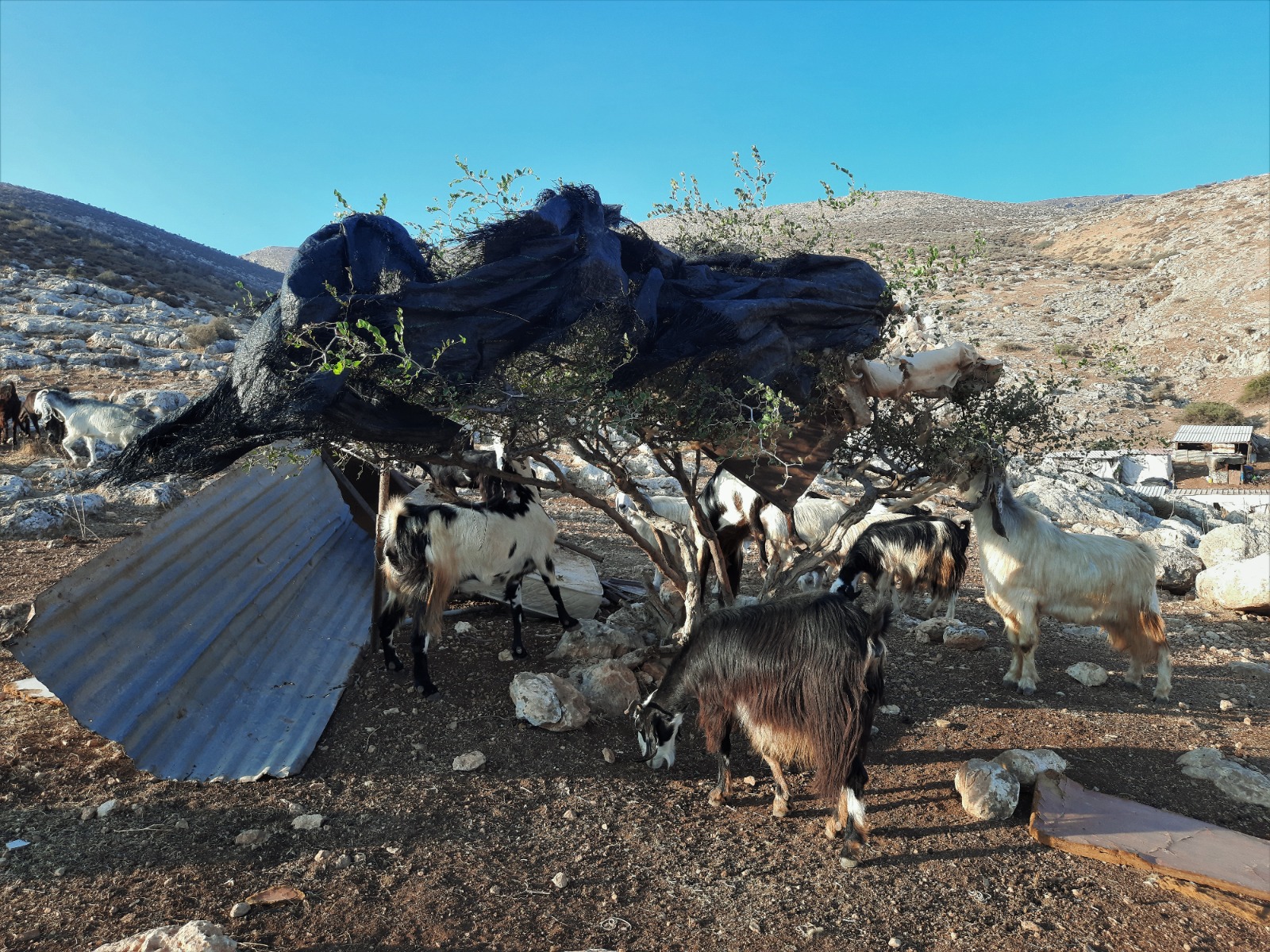 Shahar ShilohNov-3-2021Ein Shibli: grazing begins close to home
-
Ma'ale Efrayim
See all reports for this place-
Ma'ale Efrayim On the road connecting Route 90 (the Jordan Valley road) to the Allon Road.
-
Tayasir CP
See all reports for this place-
Located on road 5799, It is one of the checkpoints control the passage between the northern West Bank and the Jordan Valley. For a long time, it stood empty and open, with only a sign next to it warning against entering Area A. It was adjacent to an old military camp - now everything is neglected. How much money was invested here, and how much brainwashing was done to the soldiers of Netzah Yehuda and Kfir.
Today, it is very difficult to pass there. Many delays. Often, teachers from Tubas are not allowed to pass into the Valley to villages like Ein al-Bida where the local schools are located, and there are no classes. There are additional days when the checkpoint is closed. In general, there is a wait there of about two to four hours to go towards the Valley and also to return. Many times the Palestinians are forced to use the Hamra checkpoint, which also leads into Tubas and the West Bank, but there is also a huge queue there and a long wait.
Following a deadly attack on soldiers at the nearby base in February 2025, the checkpoint was completely closed for the time being. (Updated March 2025)
-
Za'tara (Tapuah)
See all reports for this place-
Za'tara (Tapuah) Za'tara is an internal checkpoint in the heart of the West Bank, at the intersection of Road 60 and Road 505 (Trans-Samaria), east of the Tapuah settlement. This checkpoint is the "border" marked by the IDF between the north and south of the West Bank, in accordance with the policy of separation between the two parts of the West Bank that has been in place since December 2005. At the Za'tara checkpoint, there are separate routes for Israelis and Palestinians. In the route for Israelis, there are no inspections and the route for Palestinians inspects. The queue lengthens and shortens suits. The checkpoint is open 24 hours a day. The checkpoint is partially staffed and the people who pass through it are checked at random.
 Shoshi AnbarSep-27-2023Za'atra (Tapuah Intersection). Signs
-