
Hamra, Tayasir, Tue 29.6.10, Morning
Translator: Charles K.
Bezeq checkpoint 05:30

Morning at the checkpoint whose Israeli name is “Valley Crossing.” As we arrive at the checkpoint, the streetlights go out. East of the road, opposite the village of Bardala, we see greenhouses in ruins. Something about the bent iron rods and uprooted metal arches makes us think that the greenhouses haven’t just fallen apart naturally. We stopped to photograph. A tractor driver we asked what happened couldn’t understand our “barely Arabic” language. “Jish?” No, not Jish” [not the army]. We tried to go over to other farmers working farther away. The unpaved route, in poor condition, brought us back to the main road.
We met another tractor driver on the way back who said
that the greenhouse was “ta’abaneh” [tired] – e.g., collapsed because the materials wore out?
Tayasir 06:15 “They’re standing here taking notes, and as far as I’m concerned that interferes with our job”
It’s early, and still pleasant outside. The flag is new, spotless and large.
Two soldiers in the position on the road. Two more seem to be where pedestrians go though. That position is closed. The soldier’s protective vests are lying outside it. There’s almost no traffic. A car arrives and goes through. A boy riding in it waits to be told to go through. We hear, over the walkie-talkie, “The checkpoint is open. The police are on the way. How many are there? Two.” Maybe they’re also referring to us. One of the soldiers (not an officer, but he sounds like a commander) approaches and looks directly at us. We understood that he was interested in our badge; that they’re discussing us.
The commander: “Wake up! Wake up! Move your equipment inside. Wake up! Start letting people through.”
A soldier comes out, moves the equipment inside, complains, “I won’t work here.”
One of the soldiers on the road calls out, “Is the computer working?”
Another soldier calls over the loudspeaker: “Come!.”
A youth crosses.
You can tell that the soldier who “won’t work here” is irritated. The commander sends him to the tower. “If that doesn’t work, I’m sending you away.” The soldier gathers his equipment and drags himself over to the position on the road, where he picks up a book (it looks like a prayer book) and continues slowly to the tower.
Six people waiting to cross. A young man with his hair in a braid comes out of the tower, a newspaper in his trouser pocket. He’s in no hurry.
“Guy, are you coming?”
“Wait a minute…”
He reaches the position, removes his protective vest and puts on another (why?) and stands ready to receive the people coming through. Meanwhile, another taxi arrives.
A voice over the loudspeaker: “Come forward!” “Another one!” “Another one!” “Tell them, one at a time.” “No, tell them two at a time.” “Come forward!…Come forward!”
Fifteen people went through on foot in that manner, and Guy, the soldier, turns his attention to the newspaper in his pocket. As he does, the commander asks over the walkie-talkie for someone to authorize our standing there. “They standing here taking notes, and as far as I’m concerned that interferes with our job.”
06:45 We left. The road is deserted, and no “higher up” arrived to authorize our presence. As we left we saw a military jeep leave the army camp for the checkpoint and immediately turn around and go back. 06:50 We’re farther away, and see a civilian police pickup truck coming toward us on its way to the checkpoint.
West of the road to the Hamra checkpoint, after the settlement of Ro’i, the earthen berm seems to have been renewed and raised higher.
07:10 Hamra checkpoint. “Everything here is as it should be. The soldiers are pleasant.
We arrived after the morning rush. The place is full of soldiers. The DCO jeep, a larger jeep with camouflage netting. Reservists. One female soldier with a dog in the position on the road and another without a dog. A green and black.flag. New barbed wire stretched near the pedestrian crossing. Palestinians come through holding their belt in the hands, as usual. Women with children and babies returning home – to the Jiftlik.07:20 An officer leaves in a vehicle along with 4-5 soldiers. One of remaining soldiers distributes cups of soda to the others.
Light traffic in both directions.
We moved toward the position on the road; the checkpoint commander indicates that we shouldn’t approach him. But we ask to speak to the DCO representative. He arrives and asks whether we’re Dafna. We ask whether he knows anything about the demolished greenhouses we saw on the way. He says it’s not his business; he’s responsible only for the checkpoint. “Everything here is as it should be. The soldiers are pleasant.”
07:40: A small truck wants to cross to the east. “You can’t cross here. It’s for residents only.” The driver continues, makes a u-turn, comes back to the position on the road, gets his green ID card and drives back to the west.
07:50 We left.
08:00 Gochya gate
The gate is open. The cars that transport the workers are parked next to the greenhouses.
8:30 Bezeq checkpoint A male and a female guard. “Hello, what’s up?” (They’re required to hear us
speak).
“Awesome!”, we reply.
The female guard: “Great” (and bursts out laughing).
Hamra (Beqaot)
See all reports for this place-
One of the Jordan Rift Valley checkpoints that prevent direct transit between the West Bank and the Jordan Valley, in addition to Tayasir Checkpoint. Located next to Hamra settlement, on Route 57 and the Allon Road.
Read about the peple of the Jordan Valley and the quiet transfer happening there.
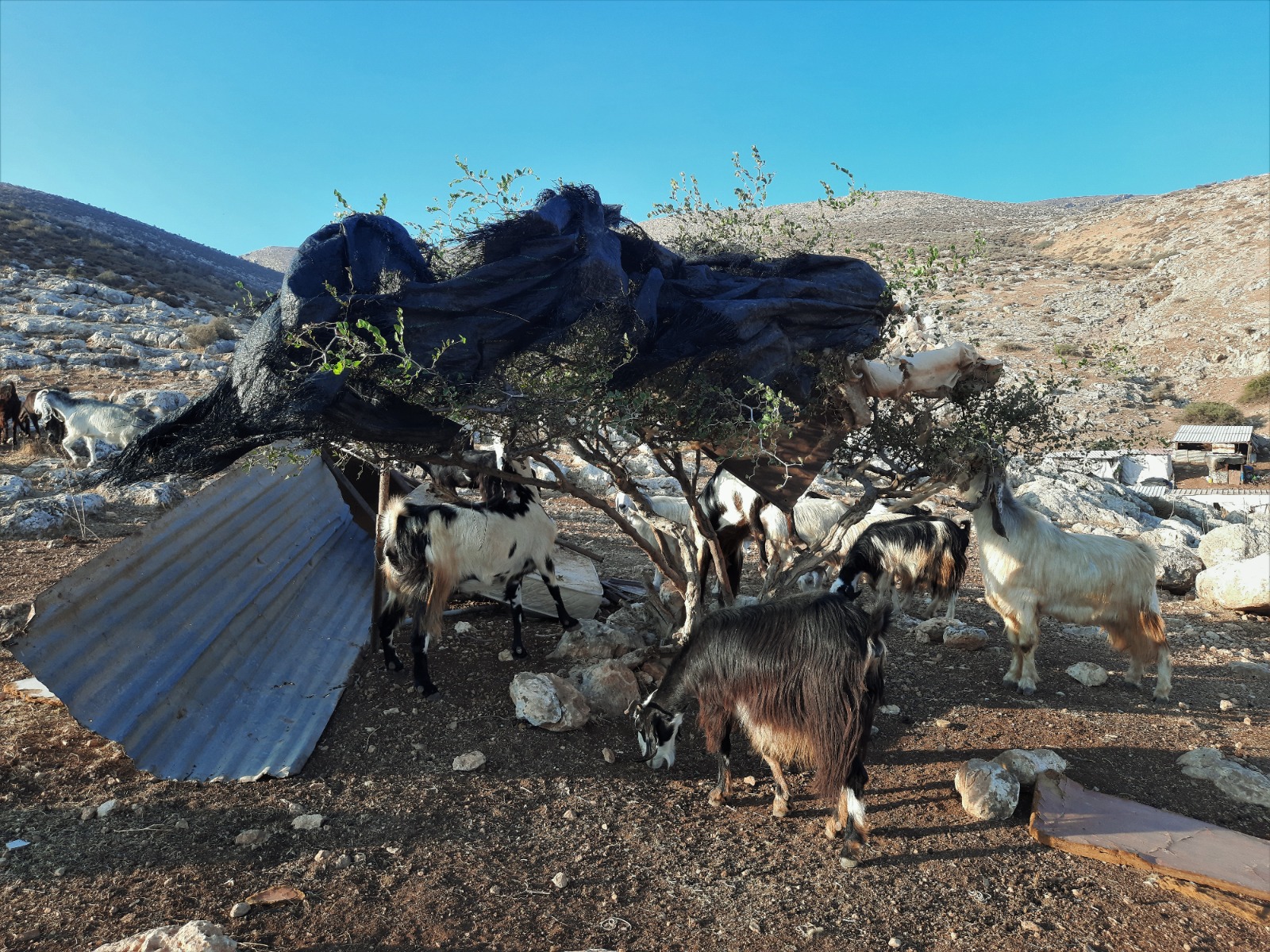 Shahar ShilohNov-3-2021Ein Shibli: grazing begins close to home
-
Tayasir CP
See all reports for this place-
Located on road 5799, It is one of the checkpoints control the passage between the northern West Bank and the Jordan Valley. For a long time, it stood empty and open, with only a sign next to it warning against entering Area A. It was adjacent to an old military camp - now everything is neglected. How much money was invested here, and how much brainwashing was done to the soldiers of Netzah Yehuda and Kfir.
Today, it is very difficult to pass there. Many delays. Often, teachers from Tubas are not allowed to pass into the Valley to villages like Ein al-Bida where the local schools are located, and there are no classes. There are additional days when the checkpoint is closed. In general, there is a wait there of about two to four hours to go towards the Valley and also to return. Many times the Palestinians are forced to use the Hamra checkpoint, which also leads into Tubas and the West Bank, but there is also a huge queue there and a long wait.
Following a deadly attack on soldiers at the nearby base in February 2025, the checkpoint was completely closed for the time being. (Updated March 2025)
-