
Hebron, Sa’ir, South Hebron Hills, Wed 27.2.13, Morning
in the photos:
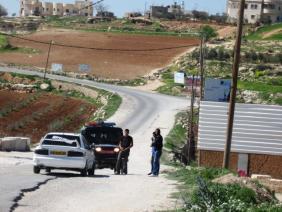
1. Israeli police detaining an israeli vehicle at the enterance to Yatta, in area A, where Israelis are prohibited to enter.
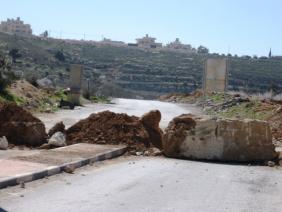
2. A new blockage (put only yesterday) on the way connecting the vineyard belonging to the settler Menachem Livni and Bani Na'im.
Translator: Charles K.
Southern Hebron Hills
We drove to Hebron on Highway 317 to meet a man from Yatta and give him a present from our northern colleagues and from me in honor of his son’s birth. He thanks us very much, feels uncomfortable: “Isn’t it enough that you help me; must you also give me a present?”
I tell him that I hope he’ll soon be able to support his family and won’t need our help, but for now we women understand what it’s like for someone who’s just given birth and ask him to buy whatever she and the baby need.
People tell us that the police enter Area A at Yatta, arresting and fining people, even though they’re not allowed to do so. We actually saw them, and asked the police officer whether they’re permitted. “Of course,” they say, “because we’re using a security vehicle; it’s armoured.” So they’re allowed, and anyway “stop bothering us and leave.” An ill five year old boy lies in the detained vehicle. The police officers say he’s ok, they talked and joked with him; he’s pretending to be very sick just because we’re here. We didn’t want to make trouble so we “bothered” them only a little more, and drove away hoping the situation would be quickly resolved. Someone should check with the Israeli police to determine whether they’re outside/above the law and permitted to enter Area A, like they’re allowed to park in a handicapped spot, etc.?!
Beni Na’im, Sa’ir, Kvasim junction, Dura al Fawwar
We drove to the area of the vineyard belonging to Menachem Livni, the settler, bordering the town of Bani Na’im. There’s in fact a new roadblock between them. “There were disturbances yesterday,” we’re told. We saw the rocks and debris left behind by the fury. We wanted to see whether there were any signs on Highway 60, particularly at the entrance to Sa’ir, of demonstrations during the funeral there yesterday of the prisoner who died in the Kishon jail. Other than the military presence at the Beit Anun junction and at the entrance to Sa’ir, all was quiet.
On the way back, at Kvasim junction and at the Dura al Fawwar junction the soldiers who came down from the pillbox appear to have been sent reinforcements. Reservists wander around.
Hebron
Construction has resumed on Bassam’s roof – Amira Hass wrote about his suffering from the proximity to Beit Hameriva. Let’s home the hoodlum settlers let him be.
A small boy – 12 years old, we’re told – has been detained at Curve 160. The soldiers say he threw rocks. His mother and other adults were talking to the soldiers when we got there. After a discussion the boy is released; he and his mother walk to their home in the Jabel Johar neighborhood. People from TIPH are also there, writing down details of the incident. We tell them we’re afraid that the boy was released because of us, but that they’ll come arrest him at night. We gave them our phone numbers and asked to be notified if that happens.
Soldiers everywhere on Shuhadah Street. There are also police at the cemetery. A funeral is underway; the family “benefits” from a military and police escort. “Why?”, we ask. A veteran police officer whom we recognize tells us that the route is guarded during a funeral. The soldiers call it the Chicago route.
We continued along Shuhadah Street. Two soldiers at Gross Square stop us: “Are you allowed to drive here?”, they ask. “Aways,” we reply. “Why should today be any different?”
“It’s forbidden,” they say.
“And who are you?”, one of them asks, noticing M., our driver.
“I’m a human being,” he replies.
The super-motivated soldier wants to detain M. to check his identity. We inform him there’s no reason to detain or to check him and drive on, to his annoyance. He calls for us to stop; his cries echo in our ears. Someone apparently explained to him that he’d gone overboard. We were able to continue.
Soldiers as usual at all the checkpoints on Shuhadah Street and at Tel Rumeida.
Hebron
See all reports for this place-
According to Wye Plantation Accords (1997), Hebron is divided in two: H1 is under Palestinian Authority control, H2 is under Israeli control. In Hebron there are 170,000 Palestinian citizens, 60,000 of them in H2. Between the two areas are permanent checkpoints, manned at all hours, preventing Palestinian movement between them and controlling passage of permit holders such as teachers and schoolchildren. Some 800 Jews live in Avraham Avinu Quarter and Tel Rumeida, on Givat HaAvot and in the wholesale market.
Checkpoints observed in H2:
- Bet Hameriva CP- manned with a pillbox
- Kapisha quarter CP (the northern side of Zion axis) - manned with a pillbox
- The 160 turn CP (the southern side of Zion axis) - manned with a pillbox
- Avraham Avinu quarter - watch station
- The pharmacy CP - checking inside a caravan with a magnometer
- Tarpat (1929) CP - checking inside a caravan with a magnometer
- Tel Rumeida CP - guarding station
- Beit Hadassah CP - guarding station
Three checkpoints around the Tomb of the Patriarchs
 Raya YeorDec-18-2025Hebron - Yusri Jaber and part of his family
-
Sa'ir
See all reports for this place-
A relatively affluent suburb of Palestinian Hebron. West of Highway 60 leading from Bethlehem to Hebron. The entrance to Highway 60 and to Shuyukh and Beit Einun to the east is open, but is subject to changes - concrete blocks denying passage are stationed according to the needs of the army.
-
South Hebron Hills
See all reports for this place-
South Hebron Hills
South Hebron Hills is a large area in the West Bank's southern part.
Yatta is a major city in this area: right in the border zone between the fertile region of Hebron and its surroundings and the desert of the Hebron Hills. Yatta has about 64,000 inhabitants.
The surrounding villages are called Masafer Yatta (Yatta's daughter villages). Their inhabitants subsist on livestock and agriculture. Agriculture is possible only in small plots, especially near streams. Most of the area consists of rocky terraces.Since the beginning of the 1980s, many settlements have been established on the agricultural land cultivated by the Palestinians in the South Hebron Hills region: Carmel, Maon, Susia, Masadot Yehuda, Othniel, and more. Since the settlements were established and Palestinians cultivation areas have been reduced; the residents of the South Hebron Hills have been suffering from harassment by the settlers. Attempts to evict and demolish houses have continued, along with withholding water and electricity. The military and police usually refrain from intervening in violent incidents between settlers and Palestinians do not enforce the law when it comes to the investigation of extensive violent Jewish settlers. The harassment in the South Hebron Hills includes attacking and attempting to burn residential tents, harassing dogs, harming herds, and preventing access to pastures.
There are several checkpoints in the South Hebron Hills, on Routes 317 and 60. In most of them, no military presence is apparent, but rather an array of pillboxes monitor the villages. Roadblocks are frequently set up according to the settlers and the army's needs. These are located at the Zif Junction, the Dura-al Fawwar crossing, and the Sheep Junction at the southern entrance to Hebron.
Updated April 2022
 Michal TzadikJan-29-2026H. rode from Khalet a-Daba' for an hour and a half to the grocery store in A-Tawani
-