
Hebron, Sansana (Meitar Crossing), South Hebron Hills
9:00-1:30
Because schools and preschools are still closed for winter vacation, we decided to go to Hebron.
The Meitar crossing was empty, not surprising given the hour.
We went directly to Hebron. We walked along the path taken by worshippers to the Cave of the Patriarchs – the contrast between the impressive architecture of the old buildings and the ugly blocks that prevent the access of Palestinians living in nearby houses was prominent and jarring. The square of the Cave of the Patriarchs was crowded with many groups (soldiers, students, religious tourists). Shuhada Street has been fixed up for tourists: Mosaic maps tell the history of the place – naturally from the perspective of the settlers.
We walked up to Tel Rumeida, to the preschool (which was closed because of the vacation), to Aisa’s house, which is close to the last house of the Tel Rumedia settlers. From there, we had a good overview of Hebron. We met a reporter who regularly stays at Aisa’s house when she visits Hebron. She is Egyptian and Swiss and lives in Ramallah when on assignment here from her paper. She told us about the activities of the young people in the house. We walked around the Tel Rumeida settlement and saw how the surrounding area had been taken over by the settlers (in the direction of the excavations) – a new tomb (Yishai or Ruth) is used as a place of worship. In contrast to previous visits, we didn’t have a problem walking down to the Tarpat crossing via the settlement’s road (tourism welcomed).
The immense concrete blocks at the newly built Tarpat crossing emanate threat. The soldiers explained why the donkey who carries the milk jugs cannot pass through the crossing: it would destroy the detection machine because is not built for donkeys. As we continued, the “picture” of this impossible place became surrealistic: a female army instructor talking about Hebron to a group of male and female soldiers standing on both sides of the street; several Palestinian women and their children slowly pass among them; a group of religious tourists standing off to the side; and the air suddenly filled with the call of the muezzin summoning Muslims to prayer.
We returned to reality: Palestinian children standing on a nearby roof on the way to the Cave of the Patriarchs; a soldier raises his gun and shouts at them; they disappear. The soldiers (religious, as are most of the soldiers here) explain to us that they are protecting us from stone throwers. The short ‘conversation’ evokes accusations of our guilt of treason against our country and the need for laws to act against traitors like us.
Abed who has a store on the Cave of the Patriarchs square reminds us that the abrasive noise (sorry, the religious music) from the Gutnik House has ceased as a result of the invention of our members.
Hebron
See all reports for this place-
According to Wye Plantation Accords (1997), Hebron is divided in two: H1 is under Palestinian Authority control, H2 is under Israeli control. In Hebron there are 170,000 Palestinian citizens, 60,000 of them in H2. Between the two areas are permanent checkpoints, manned at all hours, preventing Palestinian movement between them and controlling passage of permit holders such as teachers and schoolchildren. Some 800 Jews live in Avraham Avinu Quarter and Tel Rumeida, on Givat HaAvot and in the wholesale market.
Checkpoints observed in H2:
- Bet Hameriva CP- manned with a pillbox
- Kapisha quarter CP (the northern side of Zion axis) - manned with a pillbox
- The 160 turn CP (the southern side of Zion axis) - manned with a pillbox
- Avraham Avinu quarter - watch station
- The pharmacy CP - checking inside a caravan with a magnometer
- Tarpat (1929) CP - checking inside a caravan with a magnometer
- Tel Rumeida CP - guarding station
- Beit Hadassah CP - guarding station
Three checkpoints around the Tomb of the Patriarchs
 Raya YeorDec-18-2025Hebron - Yusri Jaber and part of his family
-
Meitar checkpoint / Sansana
See all reports for this place-
Meitar Checkpoint / Sansana The checkpoint is located on the Green Line and serves as a border crossing between Israel and the West Bank. It is managed by the Border Crossing Authority of the Defense Ministry. It is comprised of sections for the transfer of goods as well as a vehicle checkpoint (intended for holders of blue identity cards, foreign nationals or diplomats and international organizations). Passing of Palestinians is prohibited, except for those with entry permits to Israel. Palestinians are permitted to cross on foot only. The crossing has a DCO / DCL / DCL / DCL (District Coordination Office), a customs unit, supervision, and a police unit. In the last year, a breach has been opened in the fence, not far from the crossing. This breach is known to all, including the army. There does not appear to be any interest in blocking it, probably as it permits needed Palestinian workers without the bureaucratic permits to get to work in Israel. Food stalls and a parking area economy have been created, but incidents of violent abuse by border police have also been recorded. Updated April 2022
-
South Hebron Hills
See all reports for this place-
South Hebron Hills
South Hebron Hills is a large area in the West Bank's southern part.
Yatta is a major city in this area: right in the border zone between the fertile region of Hebron and its surroundings and the desert of the Hebron Hills. Yatta has about 64,000 inhabitants.
The surrounding villages are called Masafer Yatta (Yatta's daughter villages). Their inhabitants subsist on livestock and agriculture. Agriculture is possible only in small plots, especially near streams. Most of the area consists of rocky terraces.Since the beginning of the 1980s, many settlements have been established on the agricultural land cultivated by the Palestinians in the South Hebron Hills region: Carmel, Maon, Susia, Masadot Yehuda, Othniel, and more. Since the settlements were established and Palestinians cultivation areas have been reduced; the residents of the South Hebron Hills have been suffering from harassment by the settlers. Attempts to evict and demolish houses have continued, along with withholding water and electricity. The military and police usually refrain from intervening in violent incidents between settlers and Palestinians do not enforce the law when it comes to the investigation of extensive violent Jewish settlers. The harassment in the South Hebron Hills includes attacking and attempting to burn residential tents, harassing dogs, harming herds, and preventing access to pastures.
There are several checkpoints in the South Hebron Hills, on Routes 317 and 60. In most of them, no military presence is apparent, but rather an array of pillboxes monitor the villages. Roadblocks are frequently set up according to the settlers and the army's needs. These are located at the Zif Junction, the Dura-al Fawwar crossing, and the Sheep Junction at the southern entrance to Hebron.
Updated April 2022
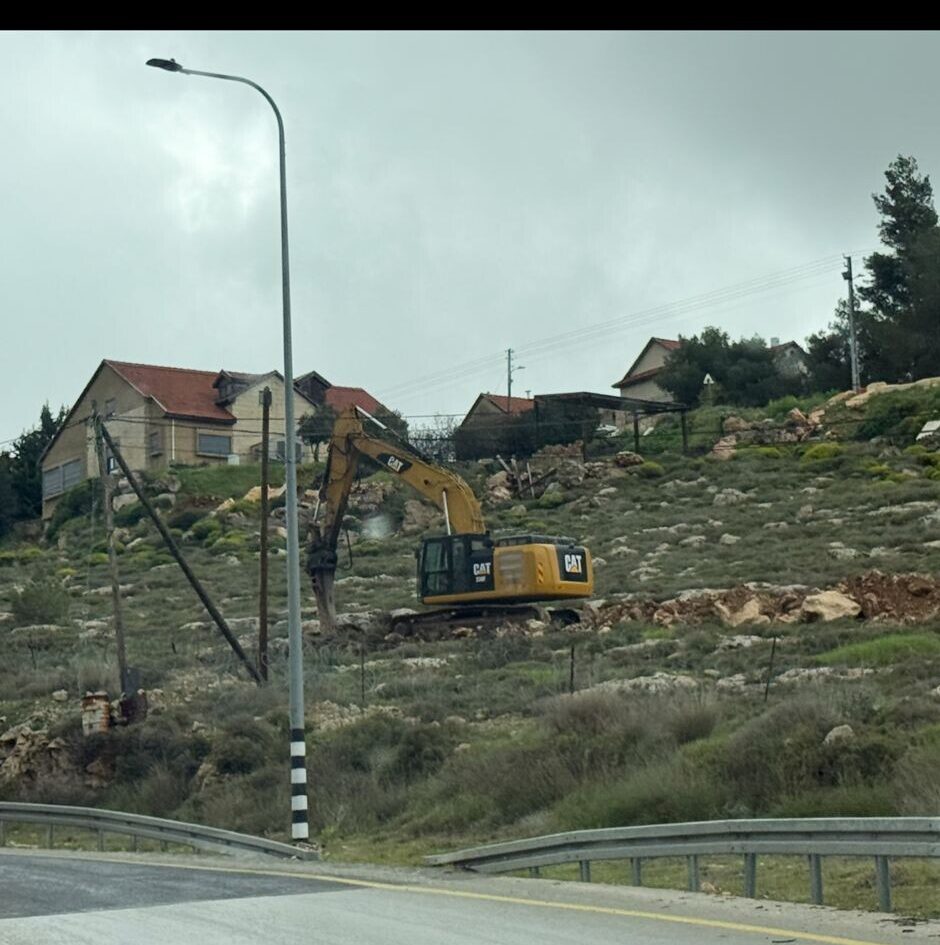 MuhammadFeb-24-2026South Hebron Hill, Beit Hagai: Paving an internal security road
-