
Hebron, Sansana (Meitar Crossing), South Hebron Hills, Tue 20.3.12, Morning
Meitar Sansana Checkpoint
the last workers are crossing and a Red Cross bus awaits the families of prisoners who will cross after 7:00 a.m.
Route 60
As usual, one army hummer thunders its way in the direction of Beersheva.
7:45 Hebron slumbers in its usual paralysis. At the Pharmacy Checkpoint two friendly Border Policement welcome us with smiles, there are no passers by and only one man crosses without obstruction. We head for the Tarpat checkpoint and here too all is quiet. We plan a stroll up the worshippers alley (now open only to those authorised) but our plan is foiled by the sight of an enormous garbage truck stranded like a beached whale, and just as smelly, at the top of the steep rise where the road splits left (!) to Jewish Tel Romeida and right to the Palestinian side and H1. The picture is worth a thousand words  .
.
Gathered at this site of action are a group of TIPH observers who are actually friendly (one of them recognizes us from our presentation last week) and fills us in on the incident. Two soldiers stand at the crossroads and my coleagues have asked me to say that they were very nice. And indeed they had the shiny faces and polished boots of youngsters on their first day at school and were extremely forthcoming. However I would have found them nicer had they refused to serve in the occupied (annexed) territories altogther and particularly in Hebron.
Be that as it may, they told us that the truck had Palestinian licence plates and was therefore barred from travelling on that road, reserved for Jews. (TIPH asserted that the grabage trucks regularly travelled on that street). Not only that, they insisted that when the DCO finally gave them instructions as to how to proceed, that truck was not moving one centimetre up the street but would have to reverse itself all the way down, so there! The lads then asked us when Nakba day fell and if it was March 30. We explained to them about Land Day and they seemed a bit anxious about the possibility of demonstrations in Hebron in solidarity with Palestinians within Israel. One of them told us he came from Bat Yam and had a lot of Arab friends and certainly didn't want to be on duty in Hebron as he leapt with alacrity across the road to check the briefcase of a young man heading downhill. He also gave a through frisking to another man (this one had terminal five-o'clock shadow, at 8:30 am) and explained that although he was headed for the Palestinian side of the neighbourhood he might have been able to sneak into the settlement round the back of the houses. Indeed, this is so and anyone wishing to infiltrate the settlers' houses can do so with relative ease since everything is terribly close together and the paths and alley ways infinite. However, do not worry, the army, and the settlers, are alert and ever on the watch. The soldiers asserted with vigour that they were charged with arresting any law-breaker, Jewish, Palestinian or whoever no discrimination They even agreed to our pleas to permit the truck, when it was finally released, to do a horse-shoe turn at the crossroads rather than reversing down the dangerous hill.
As we all waited, the unfortunate sanitation workers crouched on the pavement, the telephones to the DCO never stopped ringing, the Hebron Municipality rang its workers and the soldiers and we too tried our sources: all to no avail.
Settlers emerged and drove down unchecked. The TIPH observes warned us against one Marianne who is allegedly super-agressive and even worse than Anat Cohen. AlgotherTIPH observers suffer from both the settlers and the Palestinians and their cars have plastic windows and screens on their headlights against stone-throwing. Brave people. A settler stops his car to speak to the soldiers and then stops again to photograph us. As usual we smile sweetly llke film stars or the Queen and even blow kisses.
Finally, redemption arrives and the truck is actually permitted to continue on its errand of salvation, or at least garbage disposal. We wait to see it depart in peace and then we too make our way back through the silent, tense city. On Shuhada Street we see a 'presence patrol' of soldiers but they are not threatening and look more like a school outing that has lost its way.
We head back across the Rubicon of normailty (?) Netanya to Jersualem and Irris, M and I to Beersheva.
Happy is the nation then sends its sons on such important missions. Really normal…
Hebron
See all reports for this place-
According to Wye Plantation Accords (1997), Hebron is divided in two: H1 is under Palestinian Authority control, H2 is under Israeli control. In Hebron there are 170,000 Palestinian citizens, 60,000 of them in H2. Between the two areas are permanent checkpoints, manned at all hours, preventing Palestinian movement between them and controlling passage of permit holders such as teachers and schoolchildren. Some 800 Jews live in Avraham Avinu Quarter and Tel Rumeida, on Givat HaAvot and in the wholesale market.
Checkpoints observed in H2:
- Bet Hameriva CP- manned with a pillbox
- Kapisha quarter CP (the northern side of Zion axis) - manned with a pillbox
- The 160 turn CP (the southern side of Zion axis) - manned with a pillbox
- Avraham Avinu quarter - watch station
- The pharmacy CP - checking inside a caravan with a magnometer
- Tarpat (1929) CP - checking inside a caravan with a magnometer
- Tel Rumeida CP - guarding station
- Beit Hadassah CP - guarding station
Three checkpoints around the Tomb of the Patriarchs
 Raya YeorDec-18-2025Hebron - Yusri Jaber and part of his family
-
Meitar checkpoint / Sansana
See all reports for this place-
Meitar Checkpoint / Sansana The checkpoint is located on the Green Line and serves as a border crossing between Israel and the West Bank. It is managed by the Border Crossing Authority of the Defense Ministry. It is comprised of sections for the transfer of goods as well as a vehicle checkpoint (intended for holders of blue identity cards, foreign nationals or diplomats and international organizations). Passing of Palestinians is prohibited, except for those with entry permits to Israel. Palestinians are permitted to cross on foot only. The crossing has a DCO / DCL / DCL / DCL (District Coordination Office), a customs unit, supervision, and a police unit. In the last year, a breach has been opened in the fence, not far from the crossing. This breach is known to all, including the army. There does not appear to be any interest in blocking it, probably as it permits needed Palestinian workers without the bureaucratic permits to get to work in Israel. Food stalls and a parking area economy have been created, but incidents of violent abuse by border police have also been recorded. Updated April 2022
-
South Hebron Hills
See all reports for this place-
South Hebron Hills
South Hebron Hills is a large area in the West Bank's southern part.
Yatta is a major city in this area: right in the border zone between the fertile region of Hebron and its surroundings and the desert of the Hebron Hills. Yatta has about 64,000 inhabitants.
The surrounding villages are called Masafer Yatta (Yatta's daughter villages). Their inhabitants subsist on livestock and agriculture. Agriculture is possible only in small plots, especially near streams. Most of the area consists of rocky terraces.Since the beginning of the 1980s, many settlements have been established on the agricultural land cultivated by the Palestinians in the South Hebron Hills region: Carmel, Maon, Susia, Masadot Yehuda, Othniel, and more. Since the settlements were established and Palestinians cultivation areas have been reduced; the residents of the South Hebron Hills have been suffering from harassment by the settlers. Attempts to evict and demolish houses have continued, along with withholding water and electricity. The military and police usually refrain from intervening in violent incidents between settlers and Palestinians do not enforce the law when it comes to the investigation of extensive violent Jewish settlers. The harassment in the South Hebron Hills includes attacking and attempting to burn residential tents, harassing dogs, harming herds, and preventing access to pastures.
There are several checkpoints in the South Hebron Hills, on Routes 317 and 60. In most of them, no military presence is apparent, but rather an array of pillboxes monitor the villages. Roadblocks are frequently set up according to the settlers and the army's needs. These are located at the Zif Junction, the Dura-al Fawwar crossing, and the Sheep Junction at the southern entrance to Hebron.
Updated April 2022
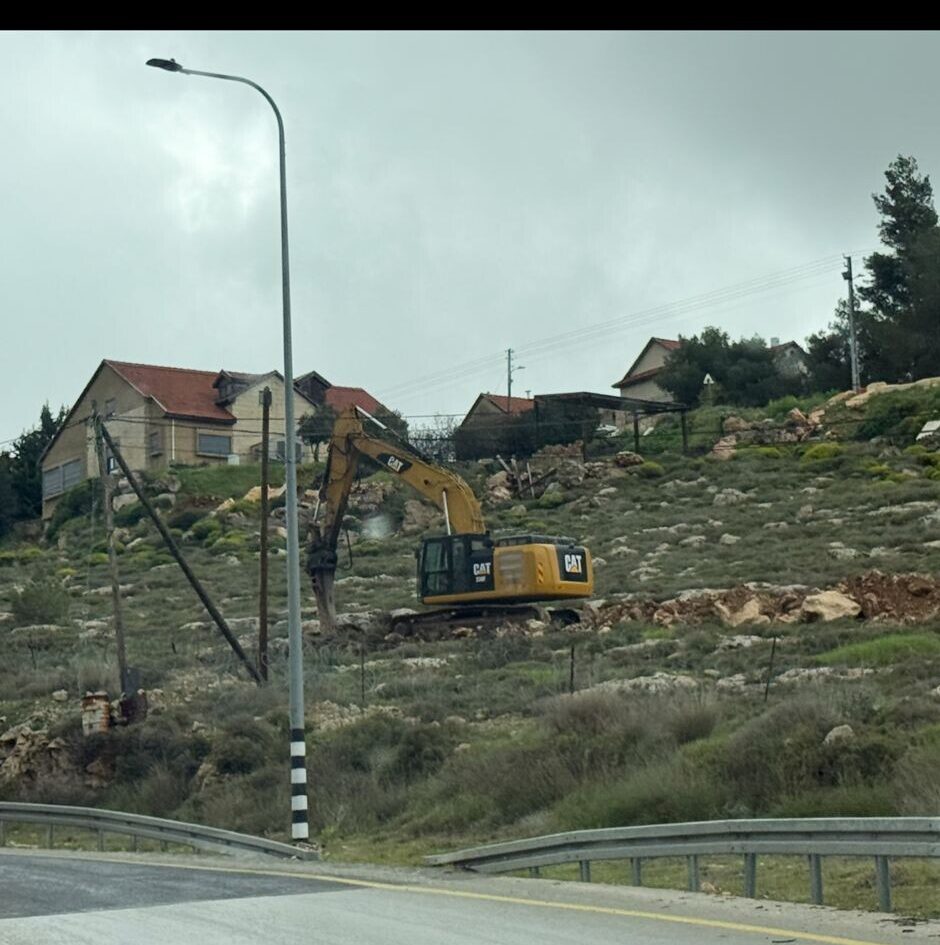 MuhammadFeb-24-2026South Hebron Hill, Beit Hagai: Paving an internal security road
-