
Hebron, Sansana, South Hebron Hills, Mon 17.5.10, Morning
Guests: Rita (photographing) and Rachel C.
Translator: Charles K. 06:30 – 10:00
- The “grass widow” routine
- Cave of the Patriarchs – Theatre of the absurd, Chapter 2.
Meitar crossing
By 6 AM the fenced corridor is already empty. There aren’t any relatives of prisoners in the shed. All the laborers are already on the Israeli side, waiting for their rides. The infrastructure works are proceeding apace. Hebron7 AM. We pick up Netanya, Rita and Rachel at the gas station at the entrance to Kiryat Arba. Soldiers at every corner of the city and at all the checkpoints. No detainees at the moment, but everyone – old and young – go through the metal detector.
Pharmacy checkpoint: CPT people continue to report that things are quieter everywhere. They say there are 15 manned checkpoints throughout the city (we usually observe eight of them, where there’s heavier traffic and they’re more sensitive). But they say there are some 94 roadblocks!!!! That’s an unbelievable number, but it’s probably accurate, since every lane that a car could go through is blocked off by concrete cubes, one of which is U-shaped so a person on foot or a small cart can get through. We never counted. It’s important to remember that some of the roadblocks are on streets in the H2 area, not between Arab Hebron and the mixed part of town.
Soldiers also man the roadblocks along Shouhada St., all the way to Tel Rumeida, but allow adults and children to go through. But up Shouhada Street, near the Jewish cemetery – the Chabad section – there’s a tall building, from whose roof you can see the whole city. In the past, the “grass widow” routine was carried out there – soldiers took over the roof or part of the building and turn it into an observation point. In the past we complained about this very often, and the routine ceased for a long time, or the soldiers would come for a few hours and then leave. Suddenly we again saw soldiers there. The residents told us that once again they come and go, but don’t stay long. It’s important to follow up on this, because we might have to intervene.
A young, an energetic female officer suddenly arrives. She’s buddy-buddy with the municipal employees and the firemen. They all showed up because of some fire that had been put out.
“See ya’, bro’,” she yells to one of them on her way back to her car.
I show her the soldiers on the room and ask her what’s going on.
“Where? Those aren’t soldiers. I don’t see anything.”
I insist that a group of men dressed in khaki are not residents of the building.
“Is a ‘grass widow’ routine underway?”, I ask.
She looks at me in amazement.
“Do you know what the ‘grass widow’ routine is”?, I ask.
“Sure! I’ve already been in Judea and Samaria for a year and seventh months.”
“OK, I don’t know,” answers the fire control officer who’s located in one of the world’s hot spots, and doesn’t even feel warm…
Rita wants to photograph everything but M., our driver, explains that there are places he doesn’t dare park, certainly not in the area of Beit Hadassah. We agree that I’ll wait with him near the Cave of the Patriarchs, because we don’t leave him alone there either.
Rita and Netanya walk the length of Shouhada Street, and we wait in Abed’s souvenir shop. He’s delighted.
Ofer left the luncheonette in Beit Gutnick, and Zvika and the owners are running it again. “He’s a prince, really; he even brought me food!,” he beams.“See?! That’s a neighbor! That’s what neighbors are like. He also agrees to open the luncheonette at 9:00, and most important: he doesn’t play his music loudly. Really, what a great guy Zvika is!”
Ofer now has an important job, shows up briefly on occasion and then leaves. I’m not exactly caught up in Abed’s glee; I remember the story about the rabbi and the goat…Twenty minutes passed, and my friends return excited and agitated. Even though they removed their ID tags, the settlers identified them and yelled “Machsom Watch…you must be having a great time…”, etc., etc. Now they’ve also felt how frightening it is to meet members of Hebron Jewish community.
Hebron
See all reports for this place-
According to Wye Plantation Accords (1997), Hebron is divided in two: H1 is under Palestinian Authority control, H2 is under Israeli control. In Hebron there are 170,000 Palestinian citizens, 60,000 of them in H2. Between the two areas are permanent checkpoints, manned at all hours, preventing Palestinian movement between them and controlling passage of permit holders such as teachers and schoolchildren. Some 800 Jews live in Avraham Avinu Quarter and Tel Rumeida, on Givat HaAvot and in the wholesale market.
Checkpoints observed in H2:
- Bet Hameriva CP- manned with a pillbox
- Kapisha quarter CP (the northern side of Zion axis) - manned with a pillbox
- The 160 turn CP (the southern side of Zion axis) - manned with a pillbox
- Avraham Avinu quarter - watch station
- The pharmacy CP - checking inside a caravan with a magnometer
- Tarpat (1929) CP - checking inside a caravan with a magnometer
- Tel Rumeida CP - guarding station
- Beit Hadassah CP - guarding station
Three checkpoints around the Tomb of the Patriarchs
 Raya YeorDec-18-2025Hebron - Yusri Jaber and part of his family
-
Meitar checkpoint / Sansana
See all reports for this place-
Meitar Checkpoint / Sansana The checkpoint is located on the Green Line and serves as a border crossing between Israel and the West Bank. It is managed by the Border Crossing Authority of the Defense Ministry. It is comprised of sections for the transfer of goods as well as a vehicle checkpoint (intended for holders of blue identity cards, foreign nationals or diplomats and international organizations). Passing of Palestinians is prohibited, except for those with entry permits to Israel. Palestinians are permitted to cross on foot only. The crossing has a DCO / DCL / DCL / DCL (District Coordination Office), a customs unit, supervision, and a police unit. In the last year, a breach has been opened in the fence, not far from the crossing. This breach is known to all, including the army. There does not appear to be any interest in blocking it, probably as it permits needed Palestinian workers without the bureaucratic permits to get to work in Israel. Food stalls and a parking area economy have been created, but incidents of violent abuse by border police have also been recorded. Updated April 2022
-
South Hebron Hills
See all reports for this place-
South Hebron Hills
South Hebron Hills is a large area in the West Bank's southern part.
Yatta is a major city in this area: right in the border zone between the fertile region of Hebron and its surroundings and the desert of the Hebron Hills. Yatta has about 64,000 inhabitants.
The surrounding villages are called Masafer Yatta (Yatta's daughter villages). Their inhabitants subsist on livestock and agriculture. Agriculture is possible only in small plots, especially near streams. Most of the area consists of rocky terraces.Since the beginning of the 1980s, many settlements have been established on the agricultural land cultivated by the Palestinians in the South Hebron Hills region: Carmel, Maon, Susia, Masadot Yehuda, Othniel, and more. Since the settlements were established and Palestinians cultivation areas have been reduced; the residents of the South Hebron Hills have been suffering from harassment by the settlers. Attempts to evict and demolish houses have continued, along with withholding water and electricity. The military and police usually refrain from intervening in violent incidents between settlers and Palestinians do not enforce the law when it comes to the investigation of extensive violent Jewish settlers. The harassment in the South Hebron Hills includes attacking and attempting to burn residential tents, harassing dogs, harming herds, and preventing access to pastures.
There are several checkpoints in the South Hebron Hills, on Routes 317 and 60. In most of them, no military presence is apparent, but rather an array of pillboxes monitor the villages. Roadblocks are frequently set up according to the settlers and the army's needs. These are located at the Zif Junction, the Dura-al Fawwar crossing, and the Sheep Junction at the southern entrance to Hebron.
Updated April 2022
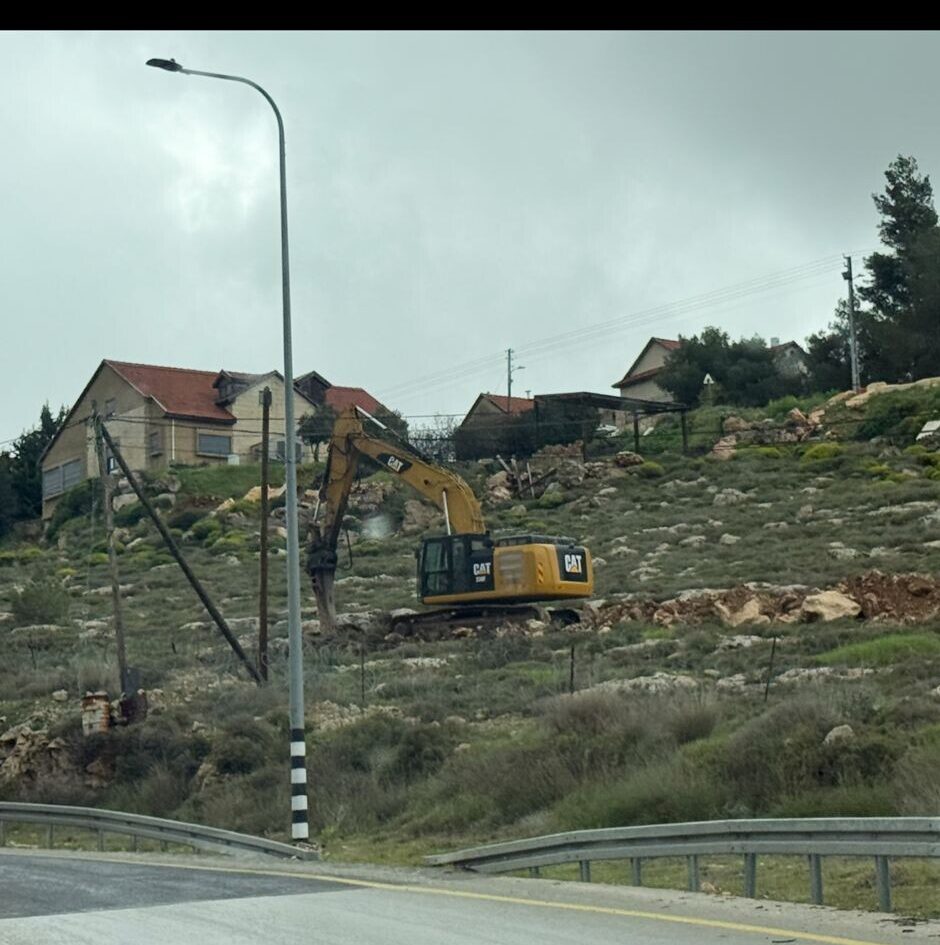 MuhammadFeb-24-2026South Hebron Hill, Beit Hagai: Paving an internal security road
-