
Hebron, Sansana, South Hebron Hills, Sun 14.2.10, Morning
Translated by Charles K.
Sansana
Very many laborers still waiting on line when we are there at 6:45, but there’s no confusion. Anat and Tamar were there since early morning (five-thirty). On Sunday mornings an additional crossing should be opened, perhaps the way we once saw that S., who’s in charge of the crossing, had done – using the vehicle crossing. In any case, on Sunday morning, even though all four screening stations are open, they’re not enough.
Route 60
The almond trees are in bloom. The sign we saw last week near Simiya, welcoming the released prisoner, has been removed, the children are walking to school along the roadside.
Kadura Alfawwar: The soldiers came down from the pillbox, and three stand near the concrete barriers, but don’t stop traffic or inspect anyone – maybe they just got bored up there.
The road junction: the pillbox is manned, traffic flows.
Hebron-Shiyuch Beit Anun: taxi and pedestrian traffic still handled “back to back”, but there’s no army presence.
Hebron
No detainees at any of the checkpoints. Staff at the al Ibrahamiyya Boys School are reluctant to tell us what happened Friday in the casbah. Soldiers killed a Palestinian, claiming he tried to stab them. For anyone who doesn’t know – the entire casbah is in H1, an area under Palestinian control. What were the soldiers doing there?! The dead Palestinian is apparently from the Ja’abari family – which suffered most from rioting settlers near Beit HaMeriva.
Pharmacy checkpoint: A nice, really nice soldier inspects all the children going through – at least 50 while we’re there. They let us stand on the Palestinian side of the checkpoint. Each child takes his satchel and passes it to the soldier who opens it and looks inside the pencil case. The children – some of them are really tiny, six or seven years old. Those older children wearing belts remove them. The crossing is quick and smooth – but there hasn’t been a study yet of the motivation to strike back and of anxiety among children who are suspect from birth. The 16 year old lad with his 2 year old brother who live next to the checkpoint cross back and forth on their way to the grocery store – they smile at us and say good morning… but the despair…God only knows…
We don’t see the peace activists at the checkpoint, nor at any of the other checkpoints. The TIF police pass on the road and the gate opens for them, but they also don’t release any information about the Palestinian killed on Friday.
The checkpoint opposite the Avraham Avinu neighborhood has moved, and is now located on Shouhadeh Street, not in the alley.
Curve 160 checkpoint: Soldiers sit in their position and children run around outside.
Tzion route: After investigation, we discovered that 21 Palestinian cars have permission to drive from the Curve 160 checkpoint to Giv’at Ha’avot, where an electric gate has been installed which is controlled by a soldier sitting at the entrance to the neighborhood. Drivers show him their authorization and go through. A forward police post has been established in the first house of the Avot neighborhood. The soldier manning the entrance to Giv’at Ha’avot is from the Shimshon battalion. The entrance to the Hebron police station is through the entrance to this neighborhood – Palestinians enter the police station through the rear entrance.
Beit Ha’meriva [House of Dispute] Checkpoint: Soldiers on the roof and in the pillbox. The barbed wire protecting the Ja’abari’s house looks like it has been moved by someone. (I hope there’s no connection to what happened Friday – but no Palestinian is around to ask). The municipality is restoring the cemetery, and paving a road. We run into Bassam – he didn’t seek permission to drive his car on the Tzion route, and parks farther up, next to Beit Ha’meriva, and rides from there to town. He says that it’s a little easier to make a living…if only that were true.
Route 356
In the grocery at the junction we hear about demolition orders for houses, issued by the Civil Administration – houses near Otniel…We referred them to Arik Asherman, who might be able to be of more help.
The occupation is becoming less burdensome. But the despair is the same, and the racism hasn’t changed.
Hebron
See all reports for this place-
According to Wye Plantation Accords (1997), Hebron is divided in two: H1 is under Palestinian Authority control, H2 is under Israeli control. In Hebron there are 170,000 Palestinian citizens, 60,000 of them in H2. Between the two areas are permanent checkpoints, manned at all hours, preventing Palestinian movement between them and controlling passage of permit holders such as teachers and schoolchildren. Some 800 Jews live in Avraham Avinu Quarter and Tel Rumeida, on Givat HaAvot and in the wholesale market.
Checkpoints observed in H2:
- Bet Hameriva CP- manned with a pillbox
- Kapisha quarter CP (the northern side of Zion axis) - manned with a pillbox
- The 160 turn CP (the southern side of Zion axis) - manned with a pillbox
- Avraham Avinu quarter - watch station
- The pharmacy CP - checking inside a caravan with a magnometer
- Tarpat (1929) CP - checking inside a caravan with a magnometer
- Tel Rumeida CP - guarding station
- Beit Hadassah CP - guarding station
Three checkpoints around the Tomb of the Patriarchs
 Raya YeorDec-18-2025Hebron - Yusri Jaber and part of his family
-
Meitar checkpoint / Sansana
See all reports for this place-
Meitar Checkpoint / Sansana The checkpoint is located on the Green Line and serves as a border crossing between Israel and the West Bank. It is managed by the Border Crossing Authority of the Defense Ministry. It is comprised of sections for the transfer of goods as well as a vehicle checkpoint (intended for holders of blue identity cards, foreign nationals or diplomats and international organizations). Passing of Palestinians is prohibited, except for those with entry permits to Israel. Palestinians are permitted to cross on foot only. The crossing has a DCO / DCL / DCL / DCL (District Coordination Office), a customs unit, supervision, and a police unit. In the last year, a breach has been opened in the fence, not far from the crossing. This breach is known to all, including the army. There does not appear to be any interest in blocking it, probably as it permits needed Palestinian workers without the bureaucratic permits to get to work in Israel. Food stalls and a parking area economy have been created, but incidents of violent abuse by border police have also been recorded. Updated April 2022
-
South Hebron Hills
See all reports for this place-
South Hebron Hills
South Hebron Hills is a large area in the West Bank's southern part.
Yatta is a major city in this area: right in the border zone between the fertile region of Hebron and its surroundings and the desert of the Hebron Hills. Yatta has about 64,000 inhabitants.
The surrounding villages are called Masafer Yatta (Yatta's daughter villages). Their inhabitants subsist on livestock and agriculture. Agriculture is possible only in small plots, especially near streams. Most of the area consists of rocky terraces.Since the beginning of the 1980s, many settlements have been established on the agricultural land cultivated by the Palestinians in the South Hebron Hills region: Carmel, Maon, Susia, Masadot Yehuda, Othniel, and more. Since the settlements were established and Palestinians cultivation areas have been reduced; the residents of the South Hebron Hills have been suffering from harassment by the settlers. Attempts to evict and demolish houses have continued, along with withholding water and electricity. The military and police usually refrain from intervening in violent incidents between settlers and Palestinians do not enforce the law when it comes to the investigation of extensive violent Jewish settlers. The harassment in the South Hebron Hills includes attacking and attempting to burn residential tents, harassing dogs, harming herds, and preventing access to pastures.
There are several checkpoints in the South Hebron Hills, on Routes 317 and 60. In most of them, no military presence is apparent, but rather an array of pillboxes monitor the villages. Roadblocks are frequently set up according to the settlers and the army's needs. These are located at the Zif Junction, the Dura-al Fawwar crossing, and the Sheep Junction at the southern entrance to Hebron.
Updated April 2022
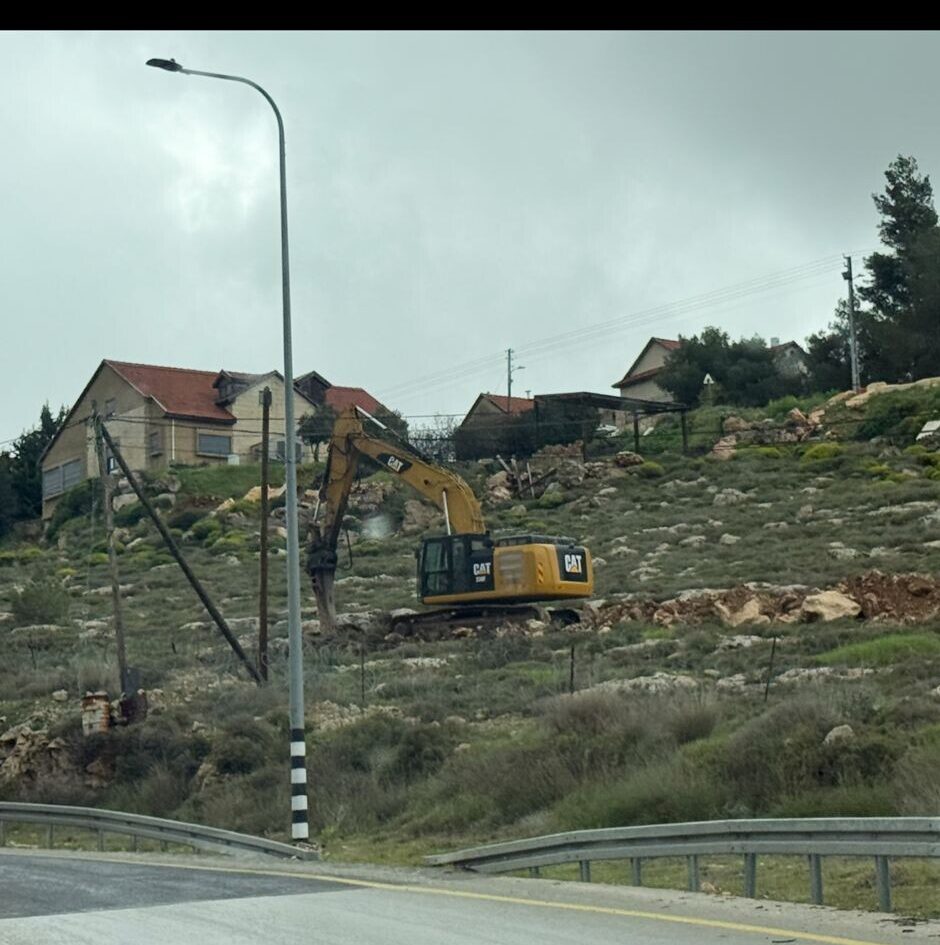 MuhammadFeb-24-2026South Hebron Hill, Beit Hagai: Paving an internal security road
-