
Hebron, Sansana, South Hebron Hills, Sun 27.1.08, Morning
6:30 – 10:30
Guests: Talia & Gali (Leah’s Students from the preparation course at Sde Boker)
On our way to Sansana, we stop to photograph the bus stop at the edge of Metar. The drawings on the bus stop are identical to those on the bus stop at South Mount Hebron. Leah explains that the Bnei Akiva youth movement in Metar identifies with the Bnei Akiva in South Mount Hebron.
Metar Crossing (Sansana)
6:45 – A new shelter was constructed on the Israeli side (near the car park area). The workers are standing around a small fire trying to find some warmth on this chilly day.
We arrive at the Palestinian side of the checkpoint. Several dozen workers are waiting outside the carousel. As soon as we approach, the carousel opens and the line begins to shorten. The workers say everything is okay today.
One of the workers (who asks that we not mention his name), asks us to check why he is not permitted to cross to the Israeli side on Saturday, despite his request for family reunification and the permit he holds. He has a permit from the Civilian Authority and the District Coordination Office in Bethlehem, but the soldiers refuse to let him through and he has to travel from Rahat to Tarqumiya in order to reach Dahariya.
Several workers ask us to verify when the checkpoint closes on Fridays. They assert that it closes at 13:00 and they can’t get there in time to go through, so they have to go to Tarqumiya.
We wait a few minutes, see that the line is progressing, and go to the Israeli side of the checkpoint. The female guard at the crossing asks for Ibrahim’s papers. We all take out our papers as a sign of identification and she nods her head and mumbles ‘Machsom Watch.’
The parking lot is almost empty. A few workers are still going through the checkpoint despite the time.
Muhammad Alharigi asks us to check into a problem he has. The army caused damages of NIS 5000 to his car. He made a claim in the small claims court. He is not certain he did the right thing and asks us to check into this.
We look at the vehicle checkpoint area. A dog attached to its owner is sniffing at the cars and equipment. Three vehicles are waiting for the dog to make his decision.
Road No. 60
It’s very foggy today and almost impossible to see anything. The barricades along the road seem to protrude less after the rains. It’s likely that someone will renew them soon.
Dora El Faavor – open to vehicle traffic.
Hebron
An army jeep that had a minor accident stands at the entrance to Hebron. It is blocking one of the lanes and a tow truck stands next to it.
The Pharmacy Checkpoint – Quiet. A thin stream of people passing through. The soldiers are cold. They tell us about an incident that occurred a week ago – there were gunshots on Bet-Hadassa. We are surprised this event did not reach the media.
Tel Rumeida Checkpoint – Lea discusses with the soldiers the event from last week – on 7.1.08. A woman gave birth at the Tarpat Checkpoint. The soldier says he was in command of the checkpoint that night. His version is different than the one that appeared in Gideon Levy’s article in Haaretz newspaper, but the facts remain the same – a woman gave birth at a checkpoint.
The soldier has trouble understanding that the problem stems from the fact that the ambulance couldn’t reach the woman’s home.
After a conversation that lasts about 15 minutes, the soldiers refuse to allow us to enter. ‘You don’t have a permit’ they assert. We try to explain that we don’t need a permit and our identity cards are our permits, but no one understands. We ask them to check. We overhear someone saying over the phone that we don’t have permission (Yaron from the Border Police).
We explain that we don’t accept the refusal to let us enter, but decide not to argue this time, since we have two young women guests (under draft age). We hearing gunshots somewhere far away. We stay calm, as do the soldiers. This is nothing out of the ordinary.
We walk down the road in the direction of the Tarpat Checkpoint. As we walk we look at the view. The city is fairly quiet and empty. Depressed and sad.
Tarpat Checkpoint – There’s no mistaking who’s in charge in this area. A huge sign for devision 92 greets us. It’s so brash, so out of place. We speak briefly with the soldiers and continue on our way.
Alongside Bet Hadassah, Leah gives us a history lesson on the Jewish settlement in Hebron. A vehicle from TIPH stops next to us.
We continue walking down the deserted road. Alongside the mural, a local police car stops next to us. We speak with Ilan who says that the next time we are prevented from going up to Tel Romeda, we should contact him. He offers to talk with the soldiers if we want to try again, but we refuse.
Leah shows us 4 murals decorating the walls of the houses. She names them: “No Arabs" One, “No Arabs" Two, three and four.
There is a mural on the wall of the army camp, too. On the camp’s water container is the slogan “Hebron Forever.”
We walk to the Cave of the Patriarch’s Checkpoint where we meet Ibrahim.
Only one store is open, but we’re not sure if it’s because of new sanctions or the cold. There are no delays. Everyone passes through without being checked. It’s too cold even for the soldiers. We get into the car and leave.
The tour seems to have made an impression on our two guests. They are very curious, ask a lot of questions, and fail to understand how this is possible. We, too, are still trying to understand.
Hebron
See all reports for this place-
According to Wye Plantation Accords (1997), Hebron is divided in two: H1 is under Palestinian Authority control, H2 is under Israeli control. In Hebron there are 170,000 Palestinian citizens, 60,000 of them in H2. Between the two areas are permanent checkpoints, manned at all hours, preventing Palestinian movement between them and controlling passage of permit holders such as teachers and schoolchildren. Some 800 Jews live in Avraham Avinu Quarter and Tel Rumeida, on Givat HaAvot and in the wholesale market.
Checkpoints observed in H2:
- Bet Hameriva CP- manned with a pillbox
- Kapisha quarter CP (the northern side of Zion axis) - manned with a pillbox
- The 160 turn CP (the southern side of Zion axis) - manned with a pillbox
- Avraham Avinu quarter - watch station
- The pharmacy CP - checking inside a caravan with a magnometer
- Tarpat (1929) CP - checking inside a caravan with a magnometer
- Tel Rumeida CP - guarding station
- Beit Hadassah CP - guarding station
Three checkpoints around the Tomb of the Patriarchs
 Raya YeorDec-18-2025Hebron - Yusri Jaber and part of his family
-
Meitar checkpoint / Sansana
See all reports for this place-
Meitar Checkpoint / Sansana The checkpoint is located on the Green Line and serves as a border crossing between Israel and the West Bank. It is managed by the Border Crossing Authority of the Defense Ministry. It is comprised of sections for the transfer of goods as well as a vehicle checkpoint (intended for holders of blue identity cards, foreign nationals or diplomats and international organizations). Passing of Palestinians is prohibited, except for those with entry permits to Israel. Palestinians are permitted to cross on foot only. The crossing has a DCO / DCL / DCL / DCL (District Coordination Office), a customs unit, supervision, and a police unit. In the last year, a breach has been opened in the fence, not far from the crossing. This breach is known to all, including the army. There does not appear to be any interest in blocking it, probably as it permits needed Palestinian workers without the bureaucratic permits to get to work in Israel. Food stalls and a parking area economy have been created, but incidents of violent abuse by border police have also been recorded. Updated April 2022
-
South Hebron Hills
See all reports for this place-
South Hebron Hills
South Hebron Hills is a large area in the West Bank's southern part.
Yatta is a major city in this area: right in the border zone between the fertile region of Hebron and its surroundings and the desert of the Hebron Hills. Yatta has about 64,000 inhabitants.
The surrounding villages are called Masafer Yatta (Yatta's daughter villages). Their inhabitants subsist on livestock and agriculture. Agriculture is possible only in small plots, especially near streams. Most of the area consists of rocky terraces.Since the beginning of the 1980s, many settlements have been established on the agricultural land cultivated by the Palestinians in the South Hebron Hills region: Carmel, Maon, Susia, Masadot Yehuda, Othniel, and more. Since the settlements were established and Palestinians cultivation areas have been reduced; the residents of the South Hebron Hills have been suffering from harassment by the settlers. Attempts to evict and demolish houses have continued, along with withholding water and electricity. The military and police usually refrain from intervening in violent incidents between settlers and Palestinians do not enforce the law when it comes to the investigation of extensive violent Jewish settlers. The harassment in the South Hebron Hills includes attacking and attempting to burn residential tents, harassing dogs, harming herds, and preventing access to pastures.
There are several checkpoints in the South Hebron Hills, on Routes 317 and 60. In most of them, no military presence is apparent, but rather an array of pillboxes monitor the villages. Roadblocks are frequently set up according to the settlers and the army's needs. These are located at the Zif Junction, the Dura-al Fawwar crossing, and the Sheep Junction at the southern entrance to Hebron.
Updated April 2022
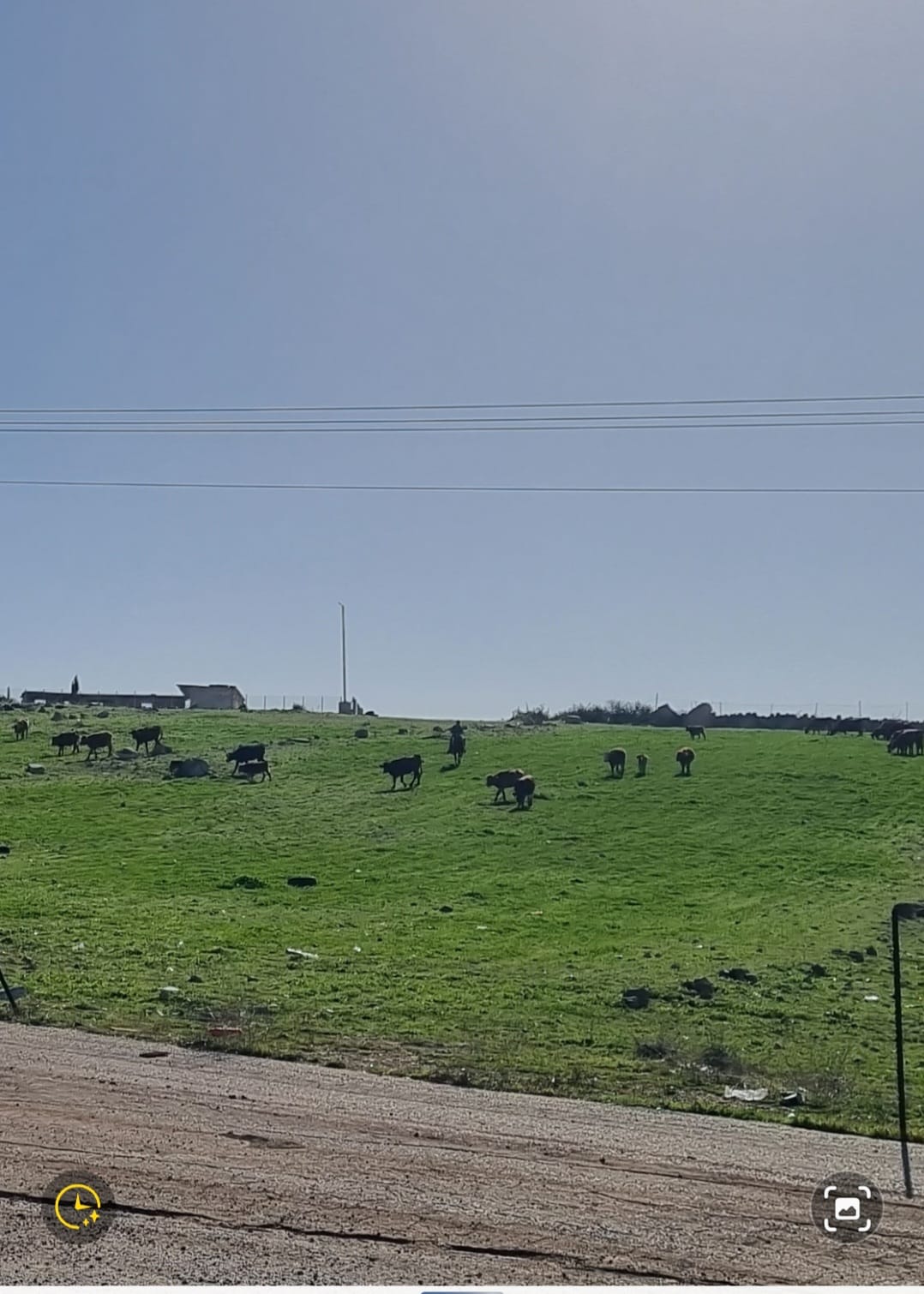 Smadar BeckerJan-12-2026A herd of cows in the area of Zanuta, from which its residents were expelled, accompanied by a settler on horseback
-