
Hebron, Sansana, South Hebron Hills, Tarqumiya, Tue 27.10.09, Morning
Trans. by Naomi S.
The Tarqumiya and Sansana checkpoints are located on the green line (1948 cease fire). When there will be a Palestinian state, they may indeed be called border-passageways. Today, however, the state of Israel has control on both sides of those CPs.
Some plain facts:
Sansana CP (Meytar): between 1500-2000 workers pass daily hee. The CP opens at 4:30am and by 7:15am all workers are through. Making a simple calculation, this means that every workers goes through within a few seconds (discounting waiting-time). But this is not how the Palestinian worker experiences the story as he goes to earn his living in Israel. After having receiving the magnetic card, and finding an Israeli employer, he still has to go through this Via Delarosa daily on his way to work.
At the checkpoint, they build up "sleeves" (lanes) which fit the checking points, but for financial reasons, only four of these have been opened and even they are not always manner or work properly. The workers say that when Shlomi, the CP manager is there, passage is more properly handled and that, when they are followed by prisoners' families, it is smoother. This morning there was havoc there and Shlomi asked the army in, to put some order in the line – he even came himself, to ensure that workers pass through peacefully. And the only solution to that is that all positioned will operate and that order will be kept by Palestinian attendants. Maybe numbers should be handed? By our calculation, for people not to waste a working day, passage should be at a rate of seven people per minute.
It should also be checked if it can't be helped, that workers do not all arrive at the same time – perhaps there should be some method by which they can ordered relative to the distance of their subsequent destination?
Tarquomiya: every morning, between 3550 and 4500 workers pass through here. The CP opens at 4am and by 7:30am all are through. Again, simple calculation shows that each worker passes through in a matter of only a few seconds and this is quick by any standard, but one should also take into account waiting time preceding the check-up, and there are workers who arrive before the CP opens. In any case, this is not the workers' own experience of the place. It is important to note that the same workers pass through every day, and that the right to earn one's living with dignity is a basic human right.
Following some phone calls we received from some workers who pass through there, we went to talk with Tz., the CP manager.
Points raised in discussion:
1. The CP opens on time and eight checking points are operated simultaneously.
2. The CP is partly manned by women and this can create a problem due to differences of culture, when a women has to approach a Muslim man. Also the women's tone of voice is often unbearable.
Tz. Says that few men are interested in this kind of work, so he must take on more women.
3. The cage-like appearance – the inner fences inside the CP: Tz claims that this is to protect the Palestinians and that if the fences were dismantled, people would have been pushed onto each other and there would have been more cases of broken ribs. When we suggest that in place of the fences, they might use portable band-poles (like those used in e.g. banks and airports), the response was that the Palestinians would still them. When we asked why, then, don't they move to the other side, the response was that they were not allowed, as they wouldn't be sufficiently well protected on the Palestinian side of the CP.
4. "Fighting" between groups of workers from different places over the right to enter first: on the Palestinian side of the Eyal passageway there are Palestinian attendants because on the other side of the CP it is zone A, i.e., Palestinian control territory. Right now the IDF does not allow PA policemen – or any other PA officials – to be positioned at Tarquimiya. The reason being that here, both sides are under Israeli control. Thus, the army is called in to restore order, not infrequently.
TZ. the CP manager, officially appealed to ask for permission to employ Palestinian attendants and thereby perhaps solve the problem of disorder while queuing. On the other hand, Tz. says that if security check-ups were handled by him, and not any other authorities, passage would have been smoother.
We were impressed that, under the circumstances, they do whatever they can to improve the service given at the CP. They recognize also the importance of personal treatment.
He says that Brig. Amos Harel, coordinator of Israel's operations in the territories, will be coming for a visit today, and he will be asking him for the following: 1. Palestinian attendants. 2. expanding the shade. 3. setting up toilets and a shade in the trucks' parking lot. 4. transporting the workers in Palestinian busses rather than East-Jerusalem transit owners who provoke the workers and that it should be the Israeli employers, rather than those transit drivers who pick up the workers to their working places in Israel.
By Tz.'s account, the shade in the waiting area, as well as the toilets, and whatever else there is there for the workers' benefit are all being regularly maintained – and then ruined anew.
Both CPs are planned in a way that reminds one of a military camp or a prison – if this is Israel's official gateway, then it is a pity they look they way. They pre-demonize those who pass through them – designating them enemies in advance.
Hebron
Feels as deserted as ever. There are no detainees at any CP and the children who pass through the CP at Curve 160 and the Pharmacy CP have long gotten used to the opening of their school bags. Peace activists watch over them, too, at these CPs.
They tell us that yesterday a Palestinian boy of about 13.5 was forcefully struck in the hand by a Border Police soldier at the Aba'ad CP – Aba'ad is the CP close to the CPs next to the Patriarchs' Cave, and that's how the Palestinians calls is, after Aba'ad, the owner of the local souvenir shop.
We go to meet the boy at "El Ibrahmiya" school. He shows us his bruised hand and says that on his way home, at around 1:30pm, Border Police soldiers instructed him and a friend to open their school bags, at that same time, pressing against his hand with great force. One of the fingers was swollen. No, he didn't go to hospital, so we can't do anything and because a soldier's word against his… well, the rest of the story is all too familiar…
Un Tuba-Hirbat Tiwwani – during our shift, I receive a call from a friend at Hirbat Tiwwani – it appears that the military escort for the children who walk under the Ma'on Farm on their way to school was late once more and the children were attacked by the settlers.
No one picked up the phone at the IDF… and again, we are helpless.
Hebron
See all reports for this place-
According to Wye Plantation Accords (1997), Hebron is divided in two: H1 is under Palestinian Authority control, H2 is under Israeli control. In Hebron there are 170,000 Palestinian citizens, 60,000 of them in H2. Between the two areas are permanent checkpoints, manned at all hours, preventing Palestinian movement between them and controlling passage of permit holders such as teachers and schoolchildren. Some 800 Jews live in Avraham Avinu Quarter and Tel Rumeida, on Givat HaAvot and in the wholesale market.
Checkpoints observed in H2:
- Bet Hameriva CP- manned with a pillbox
- Kapisha quarter CP (the northern side of Zion axis) - manned with a pillbox
- The 160 turn CP (the southern side of Zion axis) - manned with a pillbox
- Avraham Avinu quarter - watch station
- The pharmacy CP - checking inside a caravan with a magnometer
- Tarpat (1929) CP - checking inside a caravan with a magnometer
- Tel Rumeida CP - guarding station
- Beit Hadassah CP - guarding station
Three checkpoints around the Tomb of the Patriarchs
 Raya YeorDec-18-2025Hebron - Yusri Jaber and part of his family
-
Meitar checkpoint / Sansana
See all reports for this place-
Meitar Checkpoint / Sansana The checkpoint is located on the Green Line and serves as a border crossing between Israel and the West Bank. It is managed by the Border Crossing Authority of the Defense Ministry. It is comprised of sections for the transfer of goods as well as a vehicle checkpoint (intended for holders of blue identity cards, foreign nationals or diplomats and international organizations). Passing of Palestinians is prohibited, except for those with entry permits to Israel. Palestinians are permitted to cross on foot only. The crossing has a DCO / DCL / DCL / DCL (District Coordination Office), a customs unit, supervision, and a police unit. In the last year, a breach has been opened in the fence, not far from the crossing. This breach is known to all, including the army. There does not appear to be any interest in blocking it, probably as it permits needed Palestinian workers without the bureaucratic permits to get to work in Israel. Food stalls and a parking area economy have been created, but incidents of violent abuse by border police have also been recorded. Updated April 2022
-
South Hebron Hills
See all reports for this place-
South Hebron Hills
South Hebron Hills is a large area in the West Bank's southern part.
Yatta is a major city in this area: right in the border zone between the fertile region of Hebron and its surroundings and the desert of the Hebron Hills. Yatta has about 64,000 inhabitants.
The surrounding villages are called Masafer Yatta (Yatta's daughter villages). Their inhabitants subsist on livestock and agriculture. Agriculture is possible only in small plots, especially near streams. Most of the area consists of rocky terraces.Since the beginning of the 1980s, many settlements have been established on the agricultural land cultivated by the Palestinians in the South Hebron Hills region: Carmel, Maon, Susia, Masadot Yehuda, Othniel, and more. Since the settlements were established and Palestinians cultivation areas have been reduced; the residents of the South Hebron Hills have been suffering from harassment by the settlers. Attempts to evict and demolish houses have continued, along with withholding water and electricity. The military and police usually refrain from intervening in violent incidents between settlers and Palestinians do not enforce the law when it comes to the investigation of extensive violent Jewish settlers. The harassment in the South Hebron Hills includes attacking and attempting to burn residential tents, harassing dogs, harming herds, and preventing access to pastures.
There are several checkpoints in the South Hebron Hills, on Routes 317 and 60. In most of them, no military presence is apparent, but rather an array of pillboxes monitor the villages. Roadblocks are frequently set up according to the settlers and the army's needs. These are located at the Zif Junction, the Dura-al Fawwar crossing, and the Sheep Junction at the southern entrance to Hebron.
Updated April 2022
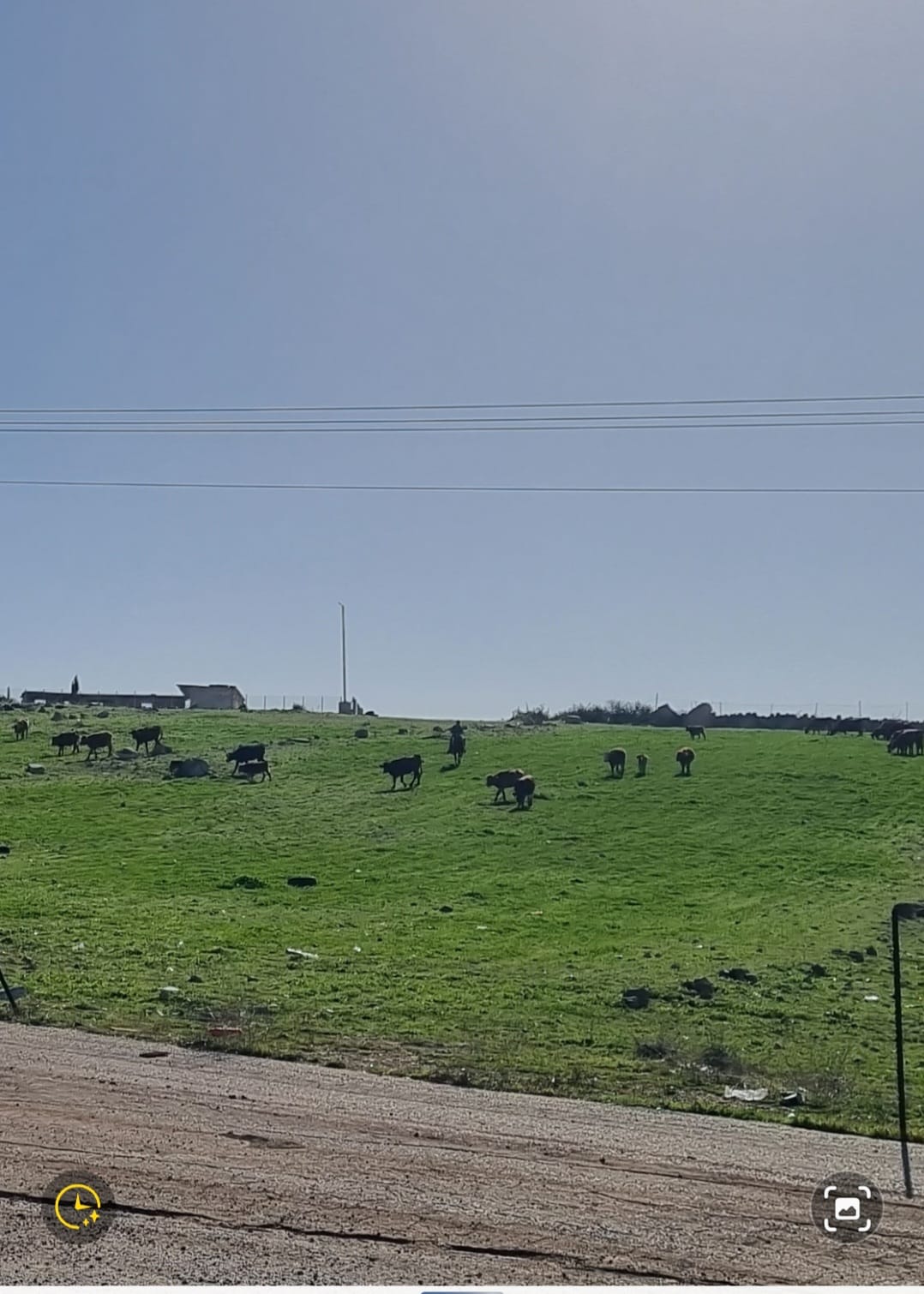 Smadar BeckerJan-12-2026A herd of cows in the area of Zanuta, from which its residents were expelled, accompanied by a settler on horseback
-
Tarqumiya CP
See all reports for this place-
The Tarqumiya Checkpoint is one of the largest and busiest checkpoints where people and goods cross into Israel. It is located on the Separation Barrier close to the Green Line, on Road 35 (connecting Beer Sheva and Hebron). It is run by the Israel Defense Ministry’s Crossings Administration with civilian secuirty companies running the day to day operations. The checkpoint is indeed open to vehicles in both directions 24/7, but Palestinians are prevented from crossing in vehicles, except in special cases. MachsomWatch activists visit the checkpoint as it opens at 3:45 am, in order to observe the daily passage of nearly 10,000 Palestinian workers. The workers arrive from throughout the Southern West Bank. Our activists report on the tremendous overcrowding at this checkpoint; they have observed young men climbing and scrambling on the fences and roofs of the ‘access cages’. This is how the work day begins for those who ‘build the land of Israel’. updated November 2019
-