
Hebron, Sansana, South Hebron Hills, Tarqumiya, Tue 4.11.08, Morning
10:00-14:00
Summary:
The main entrance from Road 60 to Samo'ah has been opened, with no pillbox next to it. We rubbed our eyes, as we saw taxies drive into town and on its roads. (All other exits to this road from the surrounding area have been blocked with stones and piles of rubble.)
Sansana-Meytar CP:
At this time of time (10am), there are no pedestrians at the CP. On the Palestinian side of the parking lot, 5 busses are waiting for the prisoners' families to return from their visits to the Israeli prisons. In front of the "back-to-back" sand-loading gate, 6 Israeli trucks are waiting.
Road 60:
Daharia – blocked as usual. Samo'ah – as said above, its main entrance was opened.
Dura el Fawar – pillbox is manned and traffic flows. Sheep's crossroad – pillbox manned, traffic flows. There is not much traffic on the road, but more Palestinian cars than normally. Just before Shiyoch Hebron – a military vehicle and another, of the Israel electric co., together with people from the Palestinian electric co. are busy taking measurements, preparing for the setting up of new electricity lines. Girls School, Shiuyuch –Hebron – we cross the road, blockages are all in place.
Road 35
Humanitarian CP – pillbox is manned; apart from that, the place is deserted. The olive passage – open. Halhul-Hebron Bridge – traffic flows, pillbox is manned. Next to the pillbox right above Beit Kachil, a huge antenna is being put up – more Palestinian cars on the road.
Idna-Tarqumiya – pillbox is manned, traffic flows. At the grocery, we equip ourselves, as usual, with the best Labaneh in the Middle-East. Representatives of the Halimi family still complain that they did not yet receive the long-awaited permit to harvest their olives, located on the Tarqumiya CP's other end. They own a lease rather than the grove itself and so, the permit is denied them on this ground – mere harassment. Arik from "Rabbis for Human Rights" will try to help them: hopefully, he will make it.
Tarqumiya
Three busloads of prisoners' families have passed there this morning. Their drivers, whom we met at the grocery, say they've passed through with no problems and anyway – the CP works as it should. On our way back we meet two Israeli Arabs who go through the car-check at Tarqumiya CP. They are grateful that dogs are no longer part of the check as they are observant Muslims and, religiously speaking, a dog cannot smell a Muslim's belongings. We were quickly allowed to proceed.
Hebron
On our way from Kiryat Arba to Hebron, just before the Give'at Harsina Base, on the hill, we see a large number of border-police cars and photographers, overlooking the events on the Federman Farm. The farm is located below the northern crest of Kiryat Arba, next to Give'at Harsina. From our car, we can see the settlers roaming around there.
We reached Hebron at 11am. This is the time set by the Committee for the restoration of Hebron, holding a week devoted to raising awareness to the occupation of Hebron. We parked in the large parking lot, next to the pharmacy CP. When we arrived there, we were alone. So we went to chat with a few of our acquaintances. M., the boys' school's janitor, complains that the children's morning check is slow. I walk with him to the CP and we talk to the soldiers – they promise him that checks will be quicker. Apart from us, there are very few passers by. Ofra and Yaniv proceed a bit further, and the policemen in the Jeep that's already positioned there show them a closed military area edict. We return to the parking lot, when a somewhat higher ranking police officer presents us with the new edict, up-to-date. A large photo is attached to this edict, and it applies to the entire Hebron-Kiryat Arba area. All this, in order to prevent the solidarity events, organized by the Committee for the restoration of Hebron. In front of us, stand representatives of all of the Palestinian media and so, the policemen are in no haste to impose the edict, allowing us some more time. Meanwhile, the Committee's members arrive – a large group of twenty Palestinians who are very happy to see us (representatives of Peace Now, Bnei Abraham [sons of Abraham], Fighters for Peace, Breaking the Silence, and us). We talk to them a bit and Hagit from Peace Now is interviewed by the Palestinian media.
A minute later, a group of about fifty people, tourists or activists from the US, arrives from the H1 area. With them, arrives also Bob Simon, of CBS's 60 minutes interview program. At the same time, arrive also Baruch Marzel and Ofer Ohana, with all his cameras and the usual talk of "you must visit the grave of the holy Baruch Goldstein and ask for mercy because you are such traitors…" We talk very briefly to Bob Simon and managed to get his visiting card. Bob mumbles to Michael – Hebron is a dangerous place. All this while, the policemen start imposing the closed military area edict and make us leave, giving Baruch Marzel a golden opportunity to flood Bob Simon with his poisonous words.
We drove away from there, and stopped by Basem's grocery, going up to the Disputed House [Beit HaMeriva]. Again, the same aggravating sights of the soldiers playing with the settlers there. Ofra takes photos of the desecrated graves next to the disputed house.
We're back, and back to the grocery – and the police already awaits us there. A fierce argument evolves between us and the illustrious policeman Ephraim Kremshnitt, concerning "how the public order is to be maintained in Hebron" – violence against us, and a blind-eye towards the settlers' deeds. Basem tells us that yesterday, between 5:30pm and 4:00am, the Disputed House settlers, together with others were busy throwing stones and even shooting – while neither soldiers nor policemen did a thing. The Palestinians have already despaired of the police and didn't even turn to them.
We left Hebron – desperation is horrible – but we cannot allow ourselves to succumb to it.
Hebron
See all reports for this place-
According to Wye Plantation Accords (1997), Hebron is divided in two: H1 is under Palestinian Authority control, H2 is under Israeli control. In Hebron there are 170,000 Palestinian citizens, 60,000 of them in H2. Between the two areas are permanent checkpoints, manned at all hours, preventing Palestinian movement between them and controlling passage of permit holders such as teachers and schoolchildren. Some 800 Jews live in Avraham Avinu Quarter and Tel Rumeida, on Givat HaAvot and in the wholesale market.
Checkpoints observed in H2:
- Bet Hameriva CP- manned with a pillbox
- Kapisha quarter CP (the northern side of Zion axis) - manned with a pillbox
- The 160 turn CP (the southern side of Zion axis) - manned with a pillbox
- Avraham Avinu quarter - watch station
- The pharmacy CP - checking inside a caravan with a magnometer
- Tarpat (1929) CP - checking inside a caravan with a magnometer
- Tel Rumeida CP - guarding station
- Beit Hadassah CP - guarding station
Three checkpoints around the Tomb of the Patriarchs
 Raya YeorDec-18-2025Hebron - Yusri Jaber and part of his family
-
Meitar checkpoint / Sansana
See all reports for this place-
Meitar Checkpoint / Sansana The checkpoint is located on the Green Line and serves as a border crossing between Israel and the West Bank. It is managed by the Border Crossing Authority of the Defense Ministry. It is comprised of sections for the transfer of goods as well as a vehicle checkpoint (intended for holders of blue identity cards, foreign nationals or diplomats and international organizations). Passing of Palestinians is prohibited, except for those with entry permits to Israel. Palestinians are permitted to cross on foot only. The crossing has a DCO / DCL / DCL / DCL (District Coordination Office), a customs unit, supervision, and a police unit. In the last year, a breach has been opened in the fence, not far from the crossing. This breach is known to all, including the army. There does not appear to be any interest in blocking it, probably as it permits needed Palestinian workers without the bureaucratic permits to get to work in Israel. Food stalls and a parking area economy have been created, but incidents of violent abuse by border police have also been recorded. Updated April 2022
-
South Hebron Hills
See all reports for this place-
South Hebron Hills
South Hebron Hills is a large area in the West Bank's southern part.
Yatta is a major city in this area: right in the border zone between the fertile region of Hebron and its surroundings and the desert of the Hebron Hills. Yatta has about 64,000 inhabitants.
The surrounding villages are called Masafer Yatta (Yatta's daughter villages). Their inhabitants subsist on livestock and agriculture. Agriculture is possible only in small plots, especially near streams. Most of the area consists of rocky terraces.Since the beginning of the 1980s, many settlements have been established on the agricultural land cultivated by the Palestinians in the South Hebron Hills region: Carmel, Maon, Susia, Masadot Yehuda, Othniel, and more. Since the settlements were established and Palestinians cultivation areas have been reduced; the residents of the South Hebron Hills have been suffering from harassment by the settlers. Attempts to evict and demolish houses have continued, along with withholding water and electricity. The military and police usually refrain from intervening in violent incidents between settlers and Palestinians do not enforce the law when it comes to the investigation of extensive violent Jewish settlers. The harassment in the South Hebron Hills includes attacking and attempting to burn residential tents, harassing dogs, harming herds, and preventing access to pastures.
There are several checkpoints in the South Hebron Hills, on Routes 317 and 60. In most of them, no military presence is apparent, but rather an array of pillboxes monitor the villages. Roadblocks are frequently set up according to the settlers and the army's needs. These are located at the Zif Junction, the Dura-al Fawwar crossing, and the Sheep Junction at the southern entrance to Hebron.
Updated April 2022
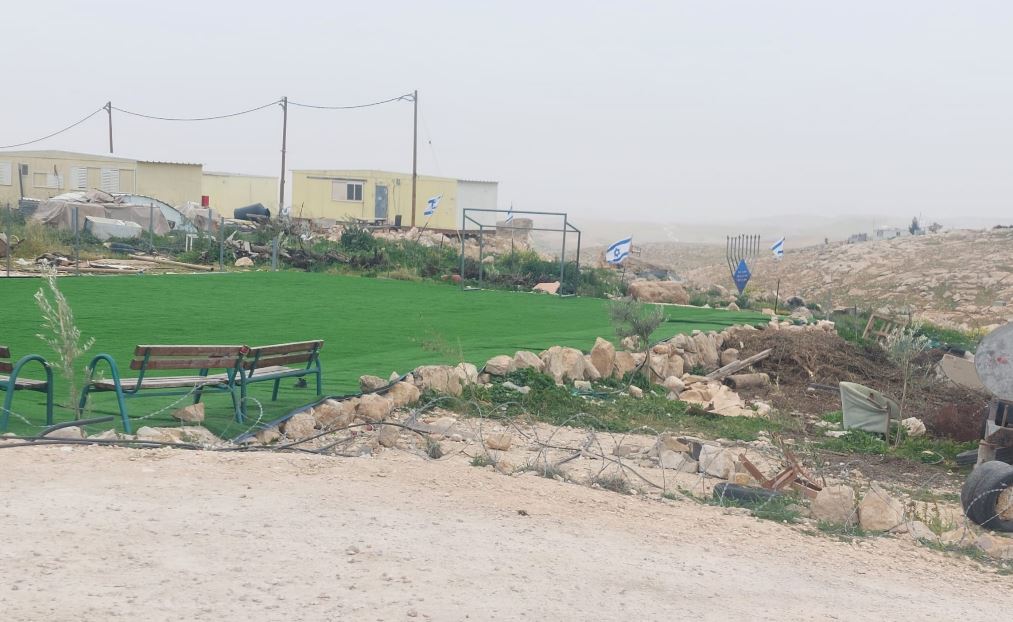 Michal TsadikFeb-17-2026Umm al-Khair: The soccer field for Palestinian children is surrounded by new trailers and lots of Israeli flags
-
Tarqumiya CP
See all reports for this place-
The Tarqumiya Checkpoint is one of the largest and busiest checkpoints where people and goods cross into Israel. It is located on the Separation Barrier close to the Green Line, on Road 35 (connecting Beer Sheva and Hebron). It is run by the Israel Defense Ministry’s Crossings Administration with civilian secuirty companies running the day to day operations. The checkpoint is indeed open to vehicles in both directions 24/7, but Palestinians are prevented from crossing in vehicles, except in special cases. MachsomWatch activists visit the checkpoint as it opens at 3:45 am, in order to observe the daily passage of nearly 10,000 Palestinian workers. The workers arrive from throughout the Southern West Bank. Our activists report on the tremendous overcrowding at this checkpoint; they have observed young men climbing and scrambling on the fences and roofs of the ‘access cages’. This is how the work day begins for those who ‘build the land of Israel’. updated November 2019
-