
Hebron, Sansana, South Hebron Hills, Tarqumiya, Tue 5.5.09, Morning
Sansana: 6:40am, the CP seems empty and workers appear to be passing through as soon as they arrive.
Tarquomiya: 09:00am – as we arrive, five buses of prisoners' families' visits arrive. The workers passed through uninterrupted, and there is no line at the local Laison and Coordination admin. offices, although there are still long lines at the Hebron L&C offices (this is based on information given us by Palestinians, not first-hand impression). It is worth recommending to them that they should go to the CP at Tarquomiya – the same services are given in both places.
At the old CP, there is a horde of trucks, awaiting phone-notification, inviting them over to the CP – still, there are no toilets at all even as the drivers might wait here for four hours and more.
Two weeks ago, a Palestinian was shot dead here. We heard the details from one of the Palestinians present there now: the 65yrs old Palestinian from Halhul went to the CP in order to be shot at. His family sold his sheep and he was left with no living – his despair was so bad, that he wished to die. Committing suicide is religiously prohibited and so, he approached the CP, acting in a manner which he knew would make the soldiers shoot him. To his great chagrin, he was shot only in the foot. We thought to ourselves how horrible it is that people become so desperate as to head for the CP, to be shot dead. And how horrible it is that in the Palestinian consciousness, CPs are where one can be killed: shot dead.
Road 60
Next to Samo'a-Simiya: the rubble hills and road-blocks have been reset. One way leading to Simiya is open – the other, seriously blocked. Maybe the army left one way open in order to harass the locals still more. The turn to Samo'ah is open, and Palestinian taxis can pass through – the grey gate has not been shut – in fact, it was discarded altogether.
The road is packed, plenty of army vehicles.
Next to Beit Hagai, on the southern hill, a new military base has been set up. In the other direction, next to the grey gate at the entry to Hebron, a group of women-soldiers (one of them wearing a red Palestinian Kafia) is getting organized for some military drill – they carry cardboards resembling stone-protective shields. Next to the gateway to Beit Hagai a military bulldozer stands, along with two police vans and a horde of military vehicles.
On our way back we talk to the soldiers and find out that there was a large military training there, apparently a training aimed at practicing the evacuation of a settlers stronghold (illegal settlement). The megaphones are still on there and a certain demonstration takes place in front of about 200 soldiers, but we didn't catch whatever was said there.
Sheep's junction: the soldiers descend from the pillbox to secure the car of three settlers who got stranded with their car.
Shuyukh-Hebron: girls' school: a civil track escorted by the brigade's engineering corps' soldiers collect the concrete blocks – now it is only beautiful Hebron stones that are used for roadblocks – thereby contributing, perhaps, to the aesthetic presentation of the occupation. Over all junctions, flags of Israel are set – as it to intentionally annoy – as well as the settlers' publicity-slogan: "Judea and Samaria: the story of every Jew's".
Road 35
Ukafim Junction: the pillbox is manned, and traffic flows.
Olive pathway: open
Idna-Tarquomiya: pillbox, manned – traffic, flows.
Hebron:
There's a very strong feeling that the army, conjointly with the Border Police, is increasing the levels of harassment and petrol – the atmosphere is very tense and harsh.
The House of Dispute: preparation for the opening of the Border Police's base there are finalizing: on the roof, a structure with some more water tanks was set up; the concrete blocks and pillbox have been painted white and great – Border Police bases' identification mark – the entry to the house was surrounded by still more concrete blocks.
Along the way to the House of Dispute, many children walk every morning to school. The Hebron children's routine, which is already full of the military anyway, is about to become still more so.
Below the House of Dispute, a Border Police Jeep detains some people. Just as we are there, someone's ID is handed back.
The prayers' route: the gate is open, and there is no military presence.
Curve 160 (what was previously "Schorr CP"): a new, small pillbox, the yellow gate is open but Border Police soldiers detain almost everyone who passes through, which seems odd given that they all walk in the other direction from the Jewish Quarter. It seems to be harassment for its own sake, because no one is detained for more than ten minutes, and all this is while so many children walk through to school there.
CP at Patriarchs' Tombs' Cave's entry: here, too, Border Police soldiers check every youngster walking to school and go through their school bags – it seems odd because no one is normally checked here.
Patriarchs' Tombs' Cave CPs: no detainees. Shops are shut and the loudspeaker, too, does not work.
Pharmacy CP: outside of the CP, a new patrol position was set up, but the children run through and there are no special check-ups.
Tarpat CP; Tel Rumeidah CP; Avraham Avinu Neighborhood CP: there are no detainees, but also very few people walking through. No peace activists can be seen around.
Shouhada St.: the paratroopers' patrol walks through, and they all stand by to guard the Jewish settlers' children who await their transport. Along the Shouhada Rd. and next to all CPs, there are flag of Israel – Hebron always leaves one with a bad feeling.
Hebron
See all reports for this place-
According to Wye Plantation Accords (1997), Hebron is divided in two: H1 is under Palestinian Authority control, H2 is under Israeli control. In Hebron there are 170,000 Palestinian citizens, 60,000 of them in H2. Between the two areas are permanent checkpoints, manned at all hours, preventing Palestinian movement between them and controlling passage of permit holders such as teachers and schoolchildren. Some 800 Jews live in Avraham Avinu Quarter and Tel Rumeida, on Givat HaAvot and in the wholesale market.
Checkpoints observed in H2:
- Bet Hameriva CP- manned with a pillbox
- Kapisha quarter CP (the northern side of Zion axis) - manned with a pillbox
- The 160 turn CP (the southern side of Zion axis) - manned with a pillbox
- Avraham Avinu quarter - watch station
- The pharmacy CP - checking inside a caravan with a magnometer
- Tarpat (1929) CP - checking inside a caravan with a magnometer
- Tel Rumeida CP - guarding station
- Beit Hadassah CP - guarding station
Three checkpoints around the Tomb of the Patriarchs
 Raya YeorDec-18-2025Hebron - Yusri Jaber and part of his family
-
Meitar checkpoint / Sansana
See all reports for this place-
Meitar Checkpoint / Sansana The checkpoint is located on the Green Line and serves as a border crossing between Israel and the West Bank. It is managed by the Border Crossing Authority of the Defense Ministry. It is comprised of sections for the transfer of goods as well as a vehicle checkpoint (intended for holders of blue identity cards, foreign nationals or diplomats and international organizations). Passing of Palestinians is prohibited, except for those with entry permits to Israel. Palestinians are permitted to cross on foot only. The crossing has a DCO / DCL / DCL / DCL (District Coordination Office), a customs unit, supervision, and a police unit. In the last year, a breach has been opened in the fence, not far from the crossing. This breach is known to all, including the army. There does not appear to be any interest in blocking it, probably as it permits needed Palestinian workers without the bureaucratic permits to get to work in Israel. Food stalls and a parking area economy have been created, but incidents of violent abuse by border police have also been recorded. Updated April 2022
-
South Hebron Hills
See all reports for this place-
South Hebron Hills
South Hebron Hills is a large area in the West Bank's southern part.
Yatta is a major city in this area: right in the border zone between the fertile region of Hebron and its surroundings and the desert of the Hebron Hills. Yatta has about 64,000 inhabitants.
The surrounding villages are called Masafer Yatta (Yatta's daughter villages). Their inhabitants subsist on livestock and agriculture. Agriculture is possible only in small plots, especially near streams. Most of the area consists of rocky terraces.Since the beginning of the 1980s, many settlements have been established on the agricultural land cultivated by the Palestinians in the South Hebron Hills region: Carmel, Maon, Susia, Masadot Yehuda, Othniel, and more. Since the settlements were established and Palestinians cultivation areas have been reduced; the residents of the South Hebron Hills have been suffering from harassment by the settlers. Attempts to evict and demolish houses have continued, along with withholding water and electricity. The military and police usually refrain from intervening in violent incidents between settlers and Palestinians do not enforce the law when it comes to the investigation of extensive violent Jewish settlers. The harassment in the South Hebron Hills includes attacking and attempting to burn residential tents, harassing dogs, harming herds, and preventing access to pastures.
There are several checkpoints in the South Hebron Hills, on Routes 317 and 60. In most of them, no military presence is apparent, but rather an array of pillboxes monitor the villages. Roadblocks are frequently set up according to the settlers and the army's needs. These are located at the Zif Junction, the Dura-al Fawwar crossing, and the Sheep Junction at the southern entrance to Hebron.
Updated April 2022
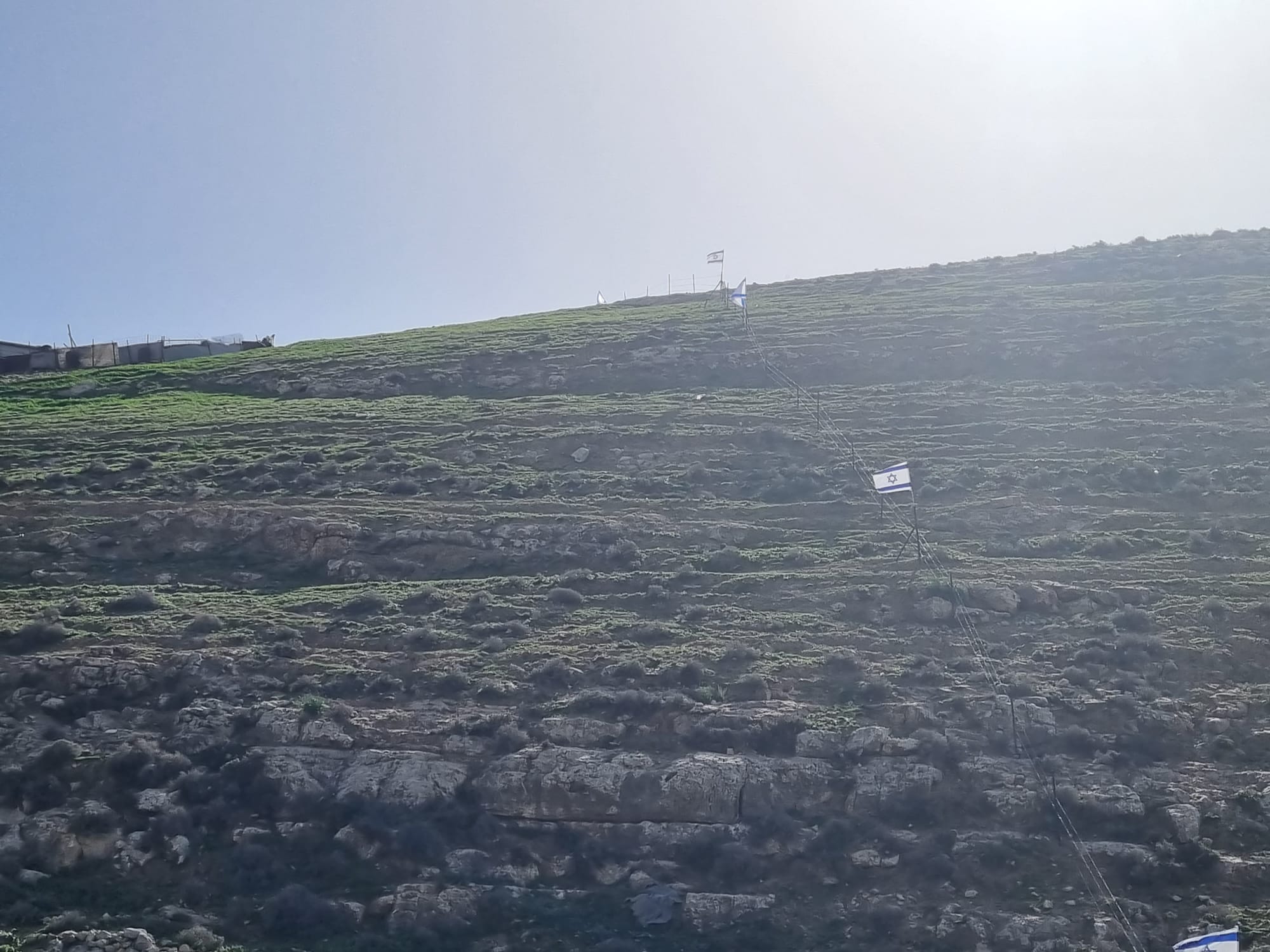 Smadar BeckerFeb-2-2026The fence and flags erected adjacent to the Abu Sharakh family's territory in Rahwa, southern Hebron Hills
-
Tarqumiya CP
See all reports for this place-
The Tarqumiya Checkpoint is one of the largest and busiest checkpoints where people and goods cross into Israel. It is located on the Separation Barrier close to the Green Line, on Road 35 (connecting Beer Sheva and Hebron). It is run by the Israel Defense Ministry’s Crossings Administration with civilian secuirty companies running the day to day operations. The checkpoint is indeed open to vehicles in both directions 24/7, but Palestinians are prevented from crossing in vehicles, except in special cases. MachsomWatch activists visit the checkpoint as it opens at 3:45 am, in order to observe the daily passage of nearly 10,000 Palestinian workers. The workers arrive from throughout the Southern West Bank. Our activists report on the tremendous overcrowding at this checkpoint; they have observed young men climbing and scrambling on the fences and roofs of the ‘access cages’. This is how the work day begins for those who ‘build the land of Israel’. updated November 2019
-