
Hebron, Sansana, South Hebron Hills, Tarqumiya, Wed 27.8.08, Morning
Metar-Sansana Checkpoint
06:10am. On the Israeli side, many workers waiting for their transport vehicles. On the Palestinian side, there are workers in the checking lane and a few workers waiting ahead of the carousel, before checking lane. Measured passage time: 10 minutes per worker, more or less. Workers keep arriving, no complaints – "all's well at the checkpoint" they say. In the parking lot, one busload of prisoners’ families is already waiting – it is still early, and their inspection will not begin before 7am, when all workers are gone. On our way, we see three more buses. In all, four buses will pass today.
Road 60
No military vehicles on the road. No vehicles at all. Children walking to school along the side lane. Part of the blockages we had believed were removed – are now back.
Dura el Faur: Pillbox is manned. Traffic flows.
The Sheep Junction: Pedestrian pathway was blocked with barbed wire and a grey gate – pillbox is manned and the traffic flows.
From Bnei Naim: Heavy flow of children toward schools.
Hebron-affiliated: No army; we arrived after school opening time, and there are no pedestrians, very few taxis.
Road 35:
Humanitarian pathway: pillbox is manned – traffic flows.
Halhul-Hebron Bridge: pillbox manned; traffic flows. A novelty, and much for the better: another entrance to Hebron has opened!! Where previously there was a grey gate, just in front of the pillbox, a bit after the Beit Khachil Bridge. Soldiers from the Duchifat Brigade guard the entry. This pathway is for lorries only – according to the drivers, this is a great relief. And indeed, many lorries pass there without stopping at all. This opening is now two-weeks old.
Tarqumiya-Idna: pillbox is manned – traffic flows.
Tarqumiya: in order to relieve pressure on the Hebron Coordination and Communication Admin. [CCA], a new office was set up here a month ago, providing the same services as the Hebron CCA, serving the west Hebron Hill area populace: Tarqumiya, Idna, Beit Abba. It’s a pity that the Palestinians still don't take full advantage of it. People on the Palestinian side say that all's well at the crossing and workers pass quickly and efficiently. No complaints.
Hebron:
Immediately as we pass through the yellow gate of Kiryat Arba – under the Giveat Ha'avot neighbourhood – what was previously an illegal settlement (ma'achaz) is now the "Hazon David" synagogue, with a full minyan. We are walking to Give'at Harsina, where we arrive at 7:10am – Hebron seems more deserted than usual. Only the early risers – groups of children walking to school. Little sweeties, from whom the morning's odor still flows, having a very long walk to school. The soldiers guarding the Mishmar Hagvul (Border Police) base "Ashmoret Yitzhak" don't harass the children. On the base's wall, a new graffiti: "Welcome to Mishmar Hagvul Hevron."
Me’arat Hamakhpela checkpoints: No detainees and still quiet.
Tarpat Checkpoint: Golani soldiers have really cleaned up, the "Death to the Arabs" graffiti as well, and a worker walks around, cleaning. The Kordoba school teachers and children pass through with no trouble, school bags are hardly checked.
Tel Rumeida checkpoint: No detainees, and the soldiers there haven’t given anyone a hard time nor harassment. David, a peace-activist, tells us that yesterday they had indeed delayed the children there. We ask the TIF policemen to make sure they are always there at 07:30 – this might help to prevent the Mishmar Hagvul policemen from harassing the Kordoba school children. Later, we are told that Rim, the school's headmistress had requested the same. We'll see about tomorrow – today, there were no problems.
The Pharmacy checkpoint: Children pass through with no problems but we notice a very large military convoy. Turns out that Udi – the Hebron Brigadier – is visiting, and we await the end of his visit in order to talk to him. Two events unfold as we wait: 1. Ofer Ohana is on holiday, but he has a replacement – a settler arrives at the checkpoint in his car and starts talking to us – he doesn't get out of the car, nor does he attack. We pursue our normal policy of ignoring – he is not as offensive and irritating as Ofer is, so that this attack is easier, he tires of our irresponsiveness and leaves. 2. The soldiers awaiting the brigadier talk to a first grade child, headed to school. They are kind to him – but his body language discloses terrible fear. We remark on this to the soldiers; they laugh at me, but get the point.
Talk with brigadier:
- Settlers’ violence: soldiers received orders to respond immediately to any disturbance on the settlers' part – and not to await the arrival of policemen. Soldiers often do not follow these orders because of the inevitable affinity between them and the settlers. A stray soldier or two may find it difficult to respond.
- The violence of settlers in the South Hebron Hill area: a troop of the Lavi Brigade moved into a second camp in order to try to prevent the violence there. He believes that when the extensive school holiday is over, violence will subside.
- Palestinian Presence on Shuohada St.: no comment
- Patrols and presence in Hebron: regarding our own presence – soldiers will protect us from the settlers; other excursions must be pre-coordinated with the police.
- Ramadan: they are in direct contact with the Palestinian Waqf. the Palestinians will have more days, because Ramadan does not coincide with the Jewish holidays.
- Hebron CCA: (Brigadier) talks of consistent attempts to relieve pressure on CCA, and of coordination with the Palestinian CAA. The Palestinians prefer the Israeli CAA as it is free of charge, while the Palestinian CAA charges a fee. A branch of the Hebron CAA is being set up at Tarkumiah.
- Direct contact with brigadier: Via his spokeswoman who sits in the room adjacent to his and is constantly by his side.
- Accompanying the Children from Umm Tuba to Hirbat Tawanni: accompaniment will continue.
Unrelated to any question, the Brigadier complains of the incitement of peace activists and tells us that today's visit is an attempt to improve the image of inner-Hebron blockages. As of next week, works improving their appearance will commence (God forbid: he never thought of removing those blockages).Within Hebron, a new neighborhood was "established" – the "Hebron Heroes" neighborhood – in the territory in-between Kiryat Arba and the prayers route. Between 40-50 settlers from the "noar hagevaot" sleep there every night. They run around, moving between "Beit Hameriva" and the area below, and throwing stones – last night, they smashed glasses onto the house neighboring that of Basem's, from the local grocery store – he takes us around to see the sights. We arrive at the family house – TIF policemen are already there, filing the complaint and the landlord has already filed a complaint with the Hebron Police. Issah from Betzelem has already taken photos… everyone knows, everyone does nothing. At the "Meriva House" – soldiers protect these outlaws as usual and the lives of the Palestinians are unwarranted for.
Hebron
See all reports for this place-
According to Wye Plantation Accords (1997), Hebron is divided in two: H1 is under Palestinian Authority control, H2 is under Israeli control. In Hebron there are 170,000 Palestinian citizens, 60,000 of them in H2. Between the two areas are permanent checkpoints, manned at all hours, preventing Palestinian movement between them and controlling passage of permit holders such as teachers and schoolchildren. Some 800 Jews live in Avraham Avinu Quarter and Tel Rumeida, on Givat HaAvot and in the wholesale market.
Checkpoints observed in H2:
- Bet Hameriva CP- manned with a pillbox
- Kapisha quarter CP (the northern side of Zion axis) - manned with a pillbox
- The 160 turn CP (the southern side of Zion axis) - manned with a pillbox
- Avraham Avinu quarter - watch station
- The pharmacy CP - checking inside a caravan with a magnometer
- Tarpat (1929) CP - checking inside a caravan with a magnometer
- Tel Rumeida CP - guarding station
- Beit Hadassah CP - guarding station
Three checkpoints around the Tomb of the Patriarchs
 Raya YeorDec-18-2025Hebron - Yusri Jaber and part of his family
-
Meitar checkpoint / Sansana
See all reports for this place-
Meitar Checkpoint / Sansana The checkpoint is located on the Green Line and serves as a border crossing between Israel and the West Bank. It is managed by the Border Crossing Authority of the Defense Ministry. It is comprised of sections for the transfer of goods as well as a vehicle checkpoint (intended for holders of blue identity cards, foreign nationals or diplomats and international organizations). Passing of Palestinians is prohibited, except for those with entry permits to Israel. Palestinians are permitted to cross on foot only. The crossing has a DCO / DCL / DCL / DCL (District Coordination Office), a customs unit, supervision, and a police unit. In the last year, a breach has been opened in the fence, not far from the crossing. This breach is known to all, including the army. There does not appear to be any interest in blocking it, probably as it permits needed Palestinian workers without the bureaucratic permits to get to work in Israel. Food stalls and a parking area economy have been created, but incidents of violent abuse by border police have also been recorded. Updated April 2022
-
South Hebron Hills
See all reports for this place-
South Hebron Hills
South Hebron Hills is a large area in the West Bank's southern part.
Yatta is a major city in this area: right in the border zone between the fertile region of Hebron and its surroundings and the desert of the Hebron Hills. Yatta has about 64,000 inhabitants.
The surrounding villages are called Masafer Yatta (Yatta's daughter villages). Their inhabitants subsist on livestock and agriculture. Agriculture is possible only in small plots, especially near streams. Most of the area consists of rocky terraces.Since the beginning of the 1980s, many settlements have been established on the agricultural land cultivated by the Palestinians in the South Hebron Hills region: Carmel, Maon, Susia, Masadot Yehuda, Othniel, and more. Since the settlements were established and Palestinians cultivation areas have been reduced; the residents of the South Hebron Hills have been suffering from harassment by the settlers. Attempts to evict and demolish houses have continued, along with withholding water and electricity. The military and police usually refrain from intervening in violent incidents between settlers and Palestinians do not enforce the law when it comes to the investigation of extensive violent Jewish settlers. The harassment in the South Hebron Hills includes attacking and attempting to burn residential tents, harassing dogs, harming herds, and preventing access to pastures.
There are several checkpoints in the South Hebron Hills, on Routes 317 and 60. In most of them, no military presence is apparent, but rather an array of pillboxes monitor the villages. Roadblocks are frequently set up according to the settlers and the army's needs. These are located at the Zif Junction, the Dura-al Fawwar crossing, and the Sheep Junction at the southern entrance to Hebron.
Updated April 2022
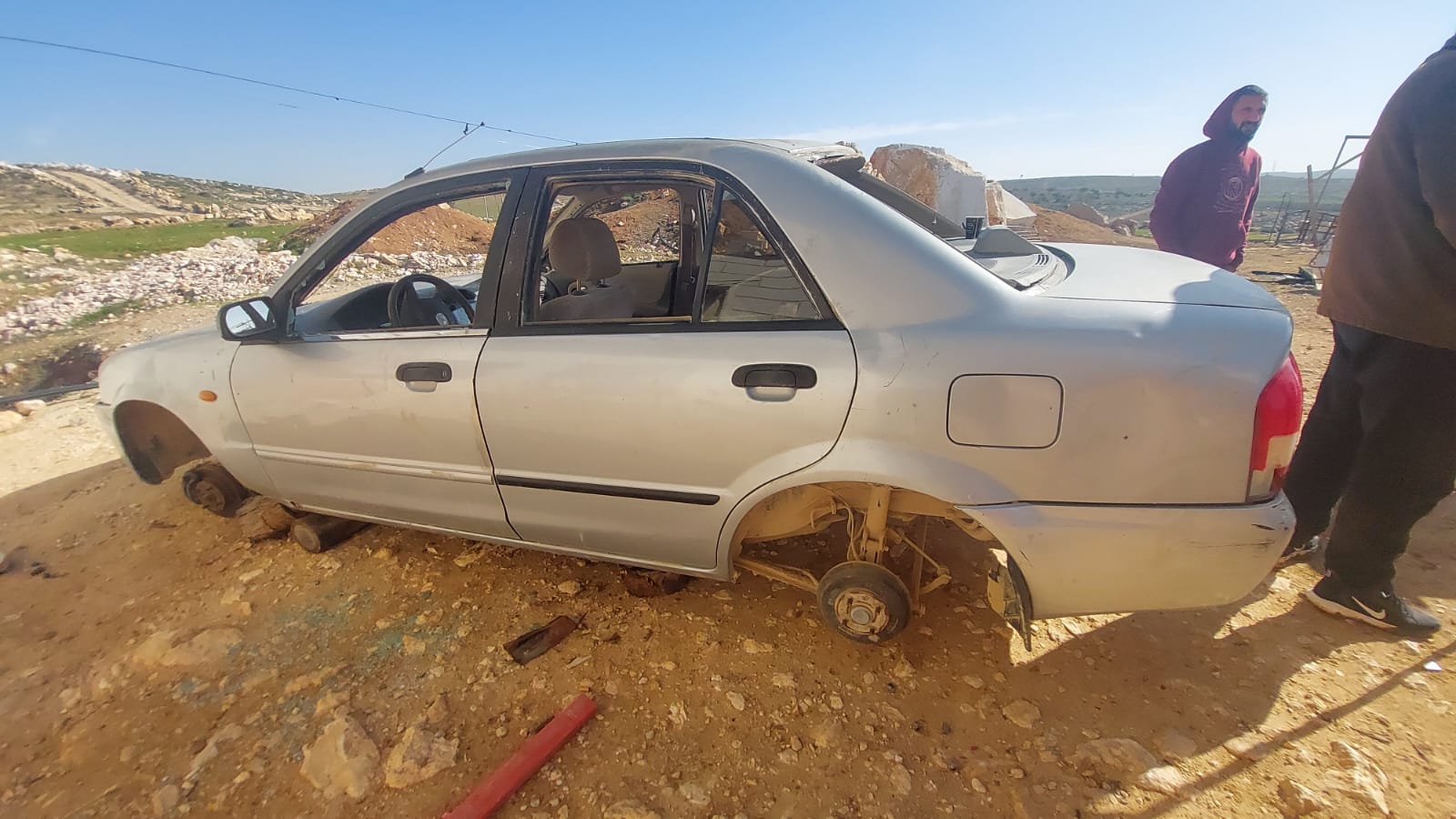 Michal TsadikDec-23-2025Wadi Shahish - The family car vandalized by settlers
-
Tarqumiya CP
See all reports for this place-
The Tarqumiya Checkpoint is one of the largest and busiest checkpoints where people and goods cross into Israel. It is located on the Separation Barrier close to the Green Line, on Road 35 (connecting Beer Sheva and Hebron). It is run by the Israel Defense Ministry’s Crossings Administration with civilian secuirty companies running the day to day operations. The checkpoint is indeed open to vehicles in both directions 24/7, but Palestinians are prevented from crossing in vehicles, except in special cases. MachsomWatch activists visit the checkpoint as it opens at 3:45 am, in order to observe the daily passage of nearly 10,000 Palestinian workers. The workers arrive from throughout the Southern West Bank. Our activists report on the tremendous overcrowding at this checkpoint; they have observed young men climbing and scrambling on the fences and roofs of the ‘access cages’. This is how the work day begins for those who ‘build the land of Israel’. updated November 2019
-