
Hebron, Sansana, South Hebron Hills, Thu 14.1.10, Morning
Translated by Charles K.
Sansana-Meitar
At 6:45am the checking lane is empty and many Palestinians are waiting for rides on the Israeli side. Vans transporting laborers are inspected on entering Israel – the line isn’t long.
On our way back all we see is one bus with relatives of prisoners.
Route 60
We’re almost the only vehicle on the road. All we see is an army jeep. On our way back, the gate to Hebron below the settlement of Beit Haggai is open – Electric Company personnel are working there.
As in “The acacia was blossoming…” by Bialik – the almond tree was blossoming, pillboxes are manned and traffic flows. At Dura al Fawwar and also at the Sheeps' junction. Life goes on and the occupation continues.
Shayukh Hebron: the girls’ school – the pupils cross the road without interference, expect for the most important fact that this is the usual place for the roadblocks and back-to-back transfers between taxis.
Hebron
(The time is 7:30-7:45am) TIF police – we run into and speak to them at the Pharmacy checkpoint and also at those near the Cave of the Patriarchs – the attitude toward them hasn’t changed. Apparently Danny Ayalon wanted only another good headline for himself, and no serious action was taken against them – one, a Norwegian, agrees with me that they’re not doing anything (cf. the report from Tuesday, 12 January). There’s now a break for exams, and pupils walk to school without schoolbags, just notebooks and pencil, no backpacks, and they’re not delayed anywhere.
At the Beit Ha’meriva checkpoint the soldiers didn’t want to talk to us. The dirt path has been paved (by the Palestinian Authority), and the gravestones at the cemetery (vandalized by the settlers living in Beit Ha’meriva some time ago) are now being repaired.
We couldn’t get any details from Bassam because the grocery store was closed.
The checkpoint down the Worshippers’ route has moved – two bored Border Policemen man it. The worshippers’ route neighborhood is being renovated, and apparently a new sewer pipe is being laid. The cameras are still operating – and the sight of the abandoned neighborhood is as annoying and depressing as usual.
The Patriarch’s Cave checkpoints – The pillbox and the yellow gate have been removed because of renovations at the Moslem’s entrance to the Cave of the Patriarchs.
‘Abed tells us that there’s no more loud music from Beit Gutnick.
A Border Policeman talks to us, and from him we understand that we’re seen mainly as naïve people who understand nothing about what our enemies want to do to us. A second soldier is busy getting angry at two little children walking along the dividing wall trying to keep their balance. We tell him they’re only playing, but he sees it as a provocation. Later on this same, pleasant soldier tries to tell M., our driver, that he has to remain in the car…we ignored him, and everything remained peaceful. There were no detainees.
Pharmacy checkpoint – Manned by Border Police, not soldiers from the Shimshon battalion, but the occupation routine doesn’t change – the settlers continue to speed along the roads on which the children are running – very dangerous.
Tel Rumeida checkpoint – The soldiers sit on the curb. Two large armored vehicles for transporting soldiers are parked on the side and don’t detain anyone.
Tarpa't checkpoint – A Palestinian youth with two sledgehammers is detained even though he’s on his way to area H1, but only for 5 minutes. A new Norwegian peace activist is happy to see us and tells us that she heard Hana Barg orienting the group in Jerusalem. Her hands are freezing.
While we were there Baruch Marzel and his short little assistant stop their vehicle and curse us as usual – Israel haters, traitors, interfering with the soldiers, ugly, fat and his other verbal pearls. Shula wants to reply and I follow Gandhi’s policy – don’t answer.
Curve 160 checkpoint – Manned; no detainees.
Kafisha neighborhood – We stop at the “office,” drink coffee, and they tell us that about 50 dunums belonging to one of the family members, between Giv’at Ha’harsina and the base, keep being taken from him and declared a closed military area. We put him in contact with M., from Yesh Din.
Next to the Ashmoret Yitzhak Border Police base, our “escape route,” a large yellow gate is being constructed.
M., our driver, saw Anat Cohen’s car in the distance – next to Beit Hadassah – and we drove slowly away to avoid her. We succeeded and didn’t see her any more.
No unusual incidents.
Hebron
See all reports for this place-
According to Wye Plantation Accords (1997), Hebron is divided in two: H1 is under Palestinian Authority control, H2 is under Israeli control. In Hebron there are 170,000 Palestinian citizens, 60,000 of them in H2. Between the two areas are permanent checkpoints, manned at all hours, preventing Palestinian movement between them and controlling passage of permit holders such as teachers and schoolchildren. Some 800 Jews live in Avraham Avinu Quarter and Tel Rumeida, on Givat HaAvot and in the wholesale market.
Checkpoints observed in H2:
- Bet Hameriva CP- manned with a pillbox
- Kapisha quarter CP (the northern side of Zion axis) - manned with a pillbox
- The 160 turn CP (the southern side of Zion axis) - manned with a pillbox
- Avraham Avinu quarter - watch station
- The pharmacy CP - checking inside a caravan with a magnometer
- Tarpat (1929) CP - checking inside a caravan with a magnometer
- Tel Rumeida CP - guarding station
- Beit Hadassah CP - guarding station
Three checkpoints around the Tomb of the Patriarchs
 Raya YeorDec-18-2025Hebron - Yusri Jaber and part of his family
-
Meitar checkpoint / Sansana
See all reports for this place-
Meitar Checkpoint / Sansana The checkpoint is located on the Green Line and serves as a border crossing between Israel and the West Bank. It is managed by the Border Crossing Authority of the Defense Ministry. It is comprised of sections for the transfer of goods as well as a vehicle checkpoint (intended for holders of blue identity cards, foreign nationals or diplomats and international organizations). Passing of Palestinians is prohibited, except for those with entry permits to Israel. Palestinians are permitted to cross on foot only. The crossing has a DCO / DCL / DCL / DCL (District Coordination Office), a customs unit, supervision, and a police unit. In the last year, a breach has been opened in the fence, not far from the crossing. This breach is known to all, including the army. There does not appear to be any interest in blocking it, probably as it permits needed Palestinian workers without the bureaucratic permits to get to work in Israel. Food stalls and a parking area economy have been created, but incidents of violent abuse by border police have also been recorded. Updated April 2022
-
South Hebron Hills
See all reports for this place-
South Hebron Hills
South Hebron Hills is a large area in the West Bank's southern part.
Yatta is a major city in this area: right in the border zone between the fertile region of Hebron and its surroundings and the desert of the Hebron Hills. Yatta has about 64,000 inhabitants.
The surrounding villages are called Masafer Yatta (Yatta's daughter villages). Their inhabitants subsist on livestock and agriculture. Agriculture is possible only in small plots, especially near streams. Most of the area consists of rocky terraces.Since the beginning of the 1980s, many settlements have been established on the agricultural land cultivated by the Palestinians in the South Hebron Hills region: Carmel, Maon, Susia, Masadot Yehuda, Othniel, and more. Since the settlements were established and Palestinians cultivation areas have been reduced; the residents of the South Hebron Hills have been suffering from harassment by the settlers. Attempts to evict and demolish houses have continued, along with withholding water and electricity. The military and police usually refrain from intervening in violent incidents between settlers and Palestinians do not enforce the law when it comes to the investigation of extensive violent Jewish settlers. The harassment in the South Hebron Hills includes attacking and attempting to burn residential tents, harassing dogs, harming herds, and preventing access to pastures.
There are several checkpoints in the South Hebron Hills, on Routes 317 and 60. In most of them, no military presence is apparent, but rather an array of pillboxes monitor the villages. Roadblocks are frequently set up according to the settlers and the army's needs. These are located at the Zif Junction, the Dura-al Fawwar crossing, and the Sheep Junction at the southern entrance to Hebron.
Updated April 2022
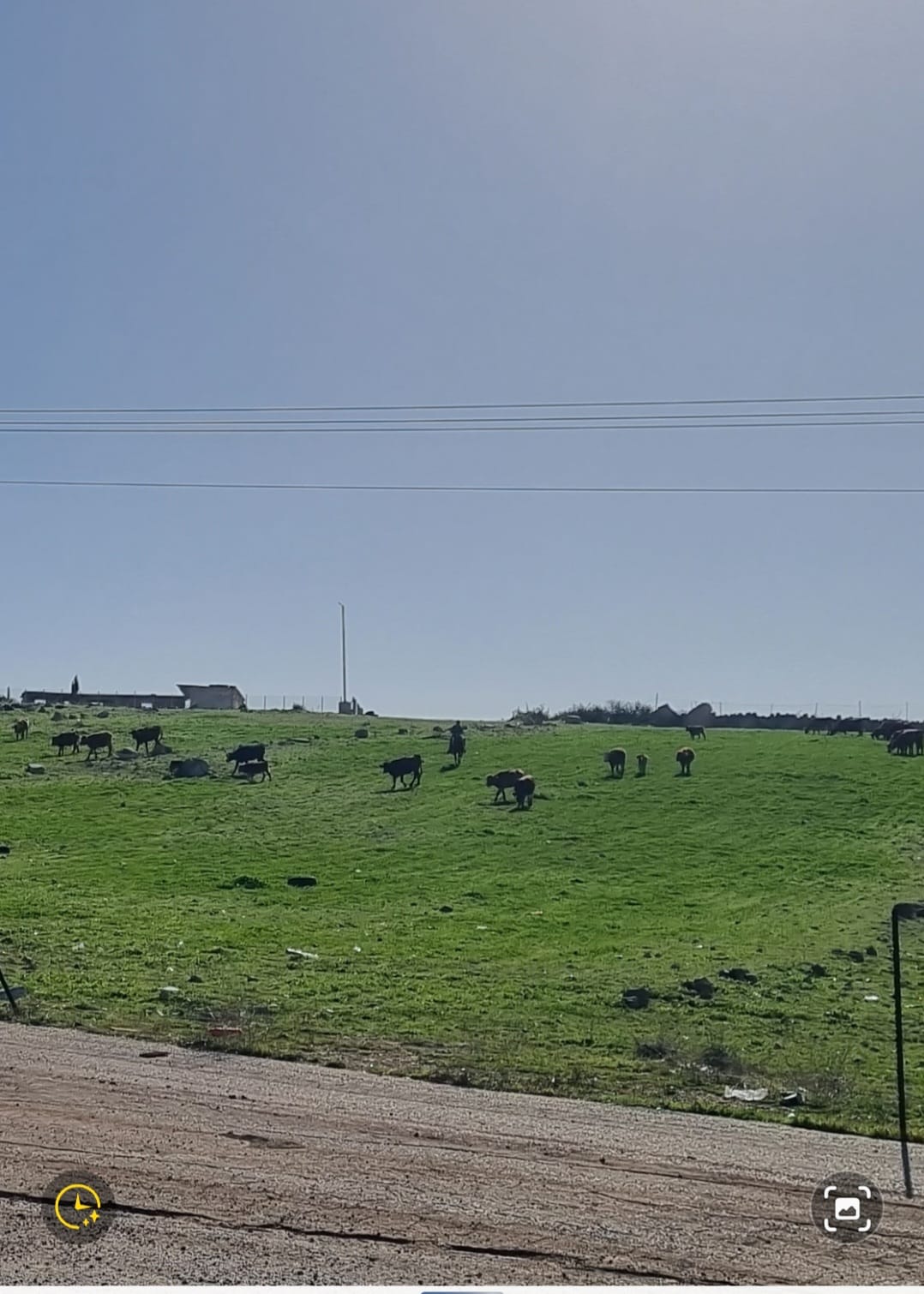 Smadar BeckerJan-12-2026A herd of cows in the area of Zanuta, from which its residents were expelled, accompanied by a settler on horseback
-