
Hebron, Sansana, South Hebron Hills, Thu 2.9.10, Morning
Sansana-Meitar crossing
7:15am, no one waiting to cross.
Samoa’a junction
7:30 Four soldiers checking IDs of three Palestinians who then went on their way.
Military jeeps were stationed at the roads to Adba and Negohot.
Dura Alfawwar
7:45 We were pulled over by the army and Mohamad’s ID was checked. We were asked where we were going. The northbound road was closed to Palestinians from that point onwards.
Sheep Junction
There were soldiers on both sides of the road. Again we were pulled aside for identification.
Route 60
At the junction, we began seeing signposts put up by the settlers and announcing "release terrorists=terrorist attack"
Bani Na’im: Three army jeeps and two police vans stationed on the road leading to the village. Another entry to the village was also blocked by an army jeep.
Entry gate to Kiryat Arba, 7:50: We were pulled over by a Modiin Ezrachi (civil company) security guard who looked like a typical hilltop youth, not the usual guard. When he realized that we were with MachshomWatch, he told us to pull to the side of the road. He was obviously angry (but throughout remained polite) about who we are and asked where we were headed. He also seemed to realize, after Mira spoke to him about our rights, that he couldn’t prevent us from continuing on to Hebron. After fifteen minutes, he unwillingly opened the gate for us when we started talking about contacting the army. Active building construction was taking place on the south side of the road just above the check post.
We had arranged to meet Hamed, a resident of Hebron and a member of the Village Group, on the road in front of Patriarchs' Caves Tomb but Muhamad, for good reason, suggested that we do not go into Hebron at this time in order to avoid confrontations with the settlers (such as Anat Cohen) given the recent shootings at the Bani Na’im junction and near Nablus.
We therefore called Hamed and asked to meet with him at Bassem’s store on the road into Hebron. Bassem, a shoemaker by trade, used to work at the central bus station in Tel Aviv some 15 years ago. Recently, the army confiscated his magnetic ID because he did some filming for B’Tselem (he was given a camera and filmed events at Beit Hameriva until it was evacuated). He had been making shoes in his Hebron shop and selling them to stores in Tel Aviv and Ashdod for many years, but recently has not had many orders because his Israeli clients are now getting Chinese-made goods and he has also had a problem with bad checks. He now relies on selling snack food and various small household items. Is there anything MachshomWatch can do to help Bassem get is magnetic ID back? Hamed said he would see if the Village Group could do anything.
8:40 Meeting with Hamed: the purpose of our meeting was to discuss how we can assist the preschool at Khashem-Al-Daraj and the possibilities of some form of cooperation between the southern branch of MachshomWatch and the Village Group in this matter. The Village Group, particularly Hamed, is involved in establishing a preschool at Um-Al-Hir (near Carmel) with funds from UNRWA and an Australian donor. The engineer working with them agreed to visit the Khashem-al-Daraj preschool and give us a list of the quantity of materials needed to renovate the preschool and an estimate of the cost. We discussed possible sources of funding and described our two meetings with Huda (see our MachshomWatch reports 18/8/10 and 26/8/10). Hamed described the various activities of the Village Group: a group of only 5 people! We discussed the advantages and disadvantages of small groups. He emphasized that because they are a small group they cannot assist Huda’s preschool and she is quite isolated.
At about 9:15, toward the end of our meeting, a car of Hebron settlers (we didn’t have time to identify them) stopped in front of the store and started shouting invectives at us. Bassem was clearly uncomfortable with the MachshomWatch van parked in front of his store for such a long time. He didn’t want to incur the wrath of the settlers. The meeting ended at 9:25.
As was true on the trip to Hebron, there were many military and police vehicles on the road and at the junctions. On our way back, there seemed to be an increased presence of army and police on the Hebron side of Sheep junction.
Hebron
See all reports for this place-
According to Wye Plantation Accords (1997), Hebron is divided in two: H1 is under Palestinian Authority control, H2 is under Israeli control. In Hebron there are 170,000 Palestinian citizens, 60,000 of them in H2. Between the two areas are permanent checkpoints, manned at all hours, preventing Palestinian movement between them and controlling passage of permit holders such as teachers and schoolchildren. Some 800 Jews live in Avraham Avinu Quarter and Tel Rumeida, on Givat HaAvot and in the wholesale market.
Checkpoints observed in H2:
- Bet Hameriva CP- manned with a pillbox
- Kapisha quarter CP (the northern side of Zion axis) - manned with a pillbox
- The 160 turn CP (the southern side of Zion axis) - manned with a pillbox
- Avraham Avinu quarter - watch station
- The pharmacy CP - checking inside a caravan with a magnometer
- Tarpat (1929) CP - checking inside a caravan with a magnometer
- Tel Rumeida CP - guarding station
- Beit Hadassah CP - guarding station
Three checkpoints around the Tomb of the Patriarchs
 Raya YeorDec-18-2025Hebron - Yusri Jaber and part of his family
-
Meitar checkpoint / Sansana
See all reports for this place-
Meitar Checkpoint / Sansana The checkpoint is located on the Green Line and serves as a border crossing between Israel and the West Bank. It is managed by the Border Crossing Authority of the Defense Ministry. It is comprised of sections for the transfer of goods as well as a vehicle checkpoint (intended for holders of blue identity cards, foreign nationals or diplomats and international organizations). Passing of Palestinians is prohibited, except for those with entry permits to Israel. Palestinians are permitted to cross on foot only. The crossing has a DCO / DCL / DCL / DCL (District Coordination Office), a customs unit, supervision, and a police unit. In the last year, a breach has been opened in the fence, not far from the crossing. This breach is known to all, including the army. There does not appear to be any interest in blocking it, probably as it permits needed Palestinian workers without the bureaucratic permits to get to work in Israel. Food stalls and a parking area economy have been created, but incidents of violent abuse by border police have also been recorded. Updated April 2022
-
South Hebron Hills
See all reports for this place-
South Hebron Hills
South Hebron Hills is a large area in the West Bank's southern part.
Yatta is a major city in this area: right in the border zone between the fertile region of Hebron and its surroundings and the desert of the Hebron Hills. Yatta has about 64,000 inhabitants.
The surrounding villages are called Masafer Yatta (Yatta's daughter villages). Their inhabitants subsist on livestock and agriculture. Agriculture is possible only in small plots, especially near streams. Most of the area consists of rocky terraces.Since the beginning of the 1980s, many settlements have been established on the agricultural land cultivated by the Palestinians in the South Hebron Hills region: Carmel, Maon, Susia, Masadot Yehuda, Othniel, and more. Since the settlements were established and Palestinians cultivation areas have been reduced; the residents of the South Hebron Hills have been suffering from harassment by the settlers. Attempts to evict and demolish houses have continued, along with withholding water and electricity. The military and police usually refrain from intervening in violent incidents between settlers and Palestinians do not enforce the law when it comes to the investigation of extensive violent Jewish settlers. The harassment in the South Hebron Hills includes attacking and attempting to burn residential tents, harassing dogs, harming herds, and preventing access to pastures.
There are several checkpoints in the South Hebron Hills, on Routes 317 and 60. In most of them, no military presence is apparent, but rather an array of pillboxes monitor the villages. Roadblocks are frequently set up according to the settlers and the army's needs. These are located at the Zif Junction, the Dura-al Fawwar crossing, and the Sheep Junction at the southern entrance to Hebron.
Updated April 2022
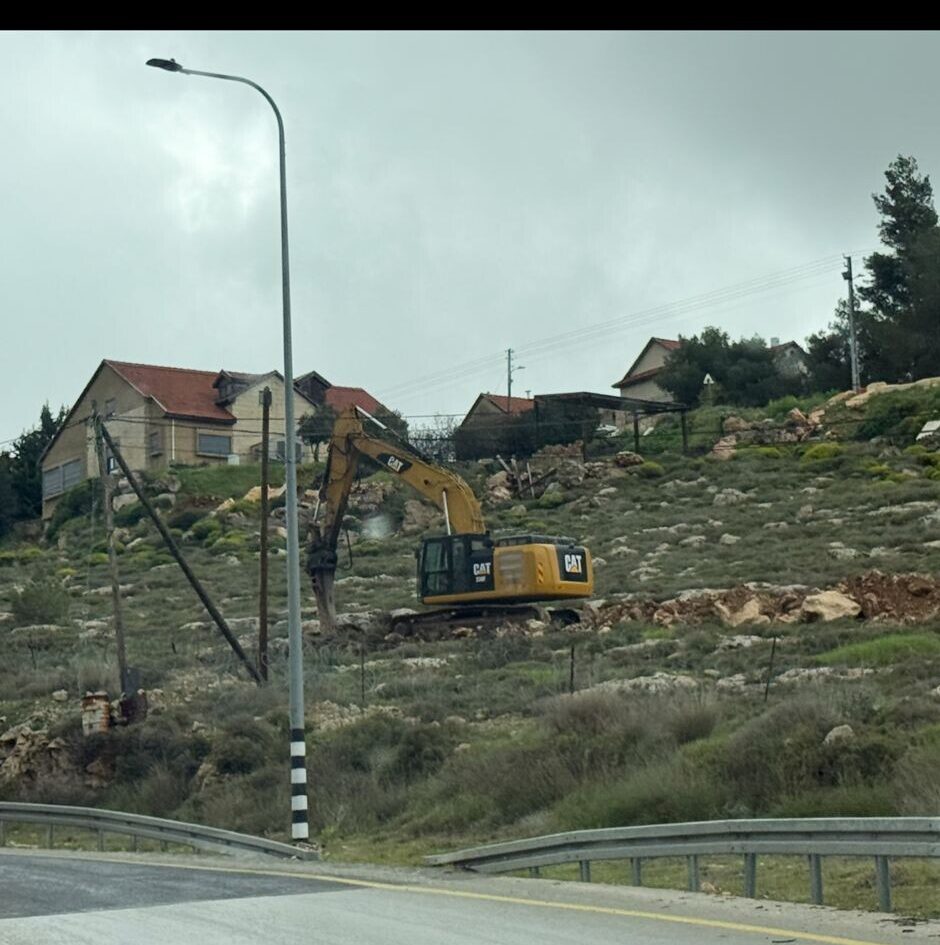 MuhammadFeb-24-2026South Hebron Hill, Beit Hagai: Paving an internal security road
-