
Hebron, Sansana, South Hebron Hills, Thu 31.1.08, Morning
6:30 – 9:30
Sansana Checkpoint
No one was waiting on the Palestinian side at 6:50 A.M. A transit arrived and let off passengers, who immediately crossed through the checkpoint. On the Israeli side a few workers were waiting for their Israeli employers.
Road No. 60
It was very cold. The road is still under construction. This terrific road will be used for only a few vehicles – look where the public's money is going. There are army jeeps at all the crossroads: Samua, Dahriya, Dora El Pavar, the Sheep Crossing. The soldiers are sitting inside the jeeps, partly because of the cold, and because there are almost no passersby – in any case there are no delays. All the pillboxes are manned and the barriers are in place. School vacation is over and young children are walking to school on the edge of the roads – one little girl is wearing a pink coat…maybe there is still room for optimism.
Hebron
We arrive in Hebron at 7:30 – it's cold. The Samson Battalion now serving in Hebron has a very militaristic attitude – the soldiers have "forgotten" that this is a civilian city and that people like themselves live here. They may be Palestinians – which means enemies – but still people who have hopes and dreams, who may want to travel to Goa after the liberation, except that their liberation doesn't come. The Samson Battalion will leave and then the Nachal will come and after them Givati and after them the Paratroopers….and things go round and only despair continues to grow. Our presence there, firstly that of the settlers and then the soldiers, is a blot on humanity. On this freezing day – the inhuman wind strikes us in the face. The militarism of the Samson Battalion expresses itself in the presence of soldiers in all kinds of places next to barricades that weren't manned previously, such as the barricade on the way to the Tomb of the Patriarchs, under the Disputed House, and Tel Romeda – a single soldier standing on top.
The Disputed House (Bet Hameriva)
A soldier is standing next to the Egged bus stop for Line 161 which carries the settlers' children to their schools (the Palestinian children walk to school – the Committee for Children's Rights must have decided that "the country's rulers" deserve better) – He gets off the roof of Bet HaMeriva and stands there from 7:00.
Bassam from the grocery store tells us that this is a daily occurrence – but the soldier isn't just standing there. He stops every Palestinian that looks suspicious to him. And who looks suspicious? The person looking at the children, for example. The person looking at the children? He works with Bassam and goes to work everyday, and everyday the soldier stops him and asks him to open his coat. From Bassam's store we watch another man opening his coat. The soldier has forgotten that this is the birthplace of this Palestinian man. Bassam makes a joke that the man wasn't looking at the children but rather at an attractive settler woman. When we talk to the soldier he says 'you're interfering with military activities'. He yells to his friend up above "Didn't I get enough of them at Hawara?"
The crawling occupation looks like this: last year before March when the House was "purchased" there was no soldier or checkpoint or barbed wire to protect the entrance gate of the Palestinian house opposite the Disputed house. The Border Guard station is deserted because of the cold – the border policemen are in the jeep – and a Palestinian woman carrying a boy of about two is struggling up the steps. She has trouble carrying him and gives him her hand and tells him to hurry up…as they cross the settlers' parking lot. They have no other way to get to the city, to District H1. Before the settlers occupied Bet HaMeriva, the area was open to Palestinian taxis and the boy didn't have to walk so fast and with such fear – he could simply take a taxi. And what will this cute two-year-old learn from this?
Because we are interfering with army activities, we merit a military escort – two army jeeps follow in our footsteps. I speak to the officer – a captain – and tell him how things were before the purchase of Bet HaMeriva and about the tension between the settlers' behavior and the soldiers' behavior and the basic quality of life of the Palestinians. He replies that everyone does what he is supposed to do…there is no one to talk to – despair.
The Pharmacy Checkpoint
When we arrive it is 7:30. We meet old acquaintances from the peace organizations – their third or fourth visit to Hebron. They are a bit surprised that I am still coming here, and the feeling is mutual – what are they doing here once again?
The children begin to pass through the checkpoint on their way to school. The friendly janitor of the El Ibrahima School – a boys' school – comes out to tell us that the soldiers are frightening the children – Givati were better. And why? Because the soldiers have an order to check the school bags of every little kid whose bag registers on the megnometer. And all the zippers make noise… So children from the first and second grade are stopped and asked to open their bags. The children who are stopped shiver from fear and cold, open their bags on the road and the soldiers bend down to check. The janitor asks that the children not be made to bend down. Officer 'D' hears this and promises that the soldiers will be nicer during inspection. We talk and he agrees that every little kid who has an experience like this can grow up to become a…terrorist.
It's the old question of the chicken or the egg – here it is clear: the chicken, i.e. the settlers, began and they are the ones throwing the eggs. In a letter that Limor of the Society for Citizens' Rights received from the Judah Brigade and the legal advisor of the Judah and Samaria Division, there were clear orders not to open their bags or detain small children at the checkpoint. But who listens to orders from above when every new commander is king? The peace activists keep a copy of this letter and show it to the soldiers – but to no avail.
Tel Romeda Checkpoint – deserted. Very few people.
Tarpat Checkpoint – very few people crossing. The graffiti on the posts near the checkpoint is still there: "Death to the Arabs."
End of report, but not the end of despair.
Hebron
See all reports for this place-
According to Wye Plantation Accords (1997), Hebron is divided in two: H1 is under Palestinian Authority control, H2 is under Israeli control. In Hebron there are 170,000 Palestinian citizens, 60,000 of them in H2. Between the two areas are permanent checkpoints, manned at all hours, preventing Palestinian movement between them and controlling passage of permit holders such as teachers and schoolchildren. Some 800 Jews live in Avraham Avinu Quarter and Tel Rumeida, on Givat HaAvot and in the wholesale market.
Checkpoints observed in H2:
- Bet Hameriva CP- manned with a pillbox
- Kapisha quarter CP (the northern side of Zion axis) - manned with a pillbox
- The 160 turn CP (the southern side of Zion axis) - manned with a pillbox
- Avraham Avinu quarter - watch station
- The pharmacy CP - checking inside a caravan with a magnometer
- Tarpat (1929) CP - checking inside a caravan with a magnometer
- Tel Rumeida CP - guarding station
- Beit Hadassah CP - guarding station
Three checkpoints around the Tomb of the Patriarchs
 Raya YeorDec-18-2025Hebron - Yusri Jaber and part of his family
-
Meitar checkpoint / Sansana
See all reports for this place-
Meitar Checkpoint / Sansana The checkpoint is located on the Green Line and serves as a border crossing between Israel and the West Bank. It is managed by the Border Crossing Authority of the Defense Ministry. It is comprised of sections for the transfer of goods as well as a vehicle checkpoint (intended for holders of blue identity cards, foreign nationals or diplomats and international organizations). Passing of Palestinians is prohibited, except for those with entry permits to Israel. Palestinians are permitted to cross on foot only. The crossing has a DCO / DCL / DCL / DCL (District Coordination Office), a customs unit, supervision, and a police unit. In the last year, a breach has been opened in the fence, not far from the crossing. This breach is known to all, including the army. There does not appear to be any interest in blocking it, probably as it permits needed Palestinian workers without the bureaucratic permits to get to work in Israel. Food stalls and a parking area economy have been created, but incidents of violent abuse by border police have also been recorded. Updated April 2022
-
South Hebron Hills
See all reports for this place-
South Hebron Hills
South Hebron Hills is a large area in the West Bank's southern part.
Yatta is a major city in this area: right in the border zone between the fertile region of Hebron and its surroundings and the desert of the Hebron Hills. Yatta has about 64,000 inhabitants.
The surrounding villages are called Masafer Yatta (Yatta's daughter villages). Their inhabitants subsist on livestock and agriculture. Agriculture is possible only in small plots, especially near streams. Most of the area consists of rocky terraces.Since the beginning of the 1980s, many settlements have been established on the agricultural land cultivated by the Palestinians in the South Hebron Hills region: Carmel, Maon, Susia, Masadot Yehuda, Othniel, and more. Since the settlements were established and Palestinians cultivation areas have been reduced; the residents of the South Hebron Hills have been suffering from harassment by the settlers. Attempts to evict and demolish houses have continued, along with withholding water and electricity. The military and police usually refrain from intervening in violent incidents between settlers and Palestinians do not enforce the law when it comes to the investigation of extensive violent Jewish settlers. The harassment in the South Hebron Hills includes attacking and attempting to burn residential tents, harassing dogs, harming herds, and preventing access to pastures.
There are several checkpoints in the South Hebron Hills, on Routes 317 and 60. In most of them, no military presence is apparent, but rather an array of pillboxes monitor the villages. Roadblocks are frequently set up according to the settlers and the army's needs. These are located at the Zif Junction, the Dura-al Fawwar crossing, and the Sheep Junction at the southern entrance to Hebron.
Updated April 2022
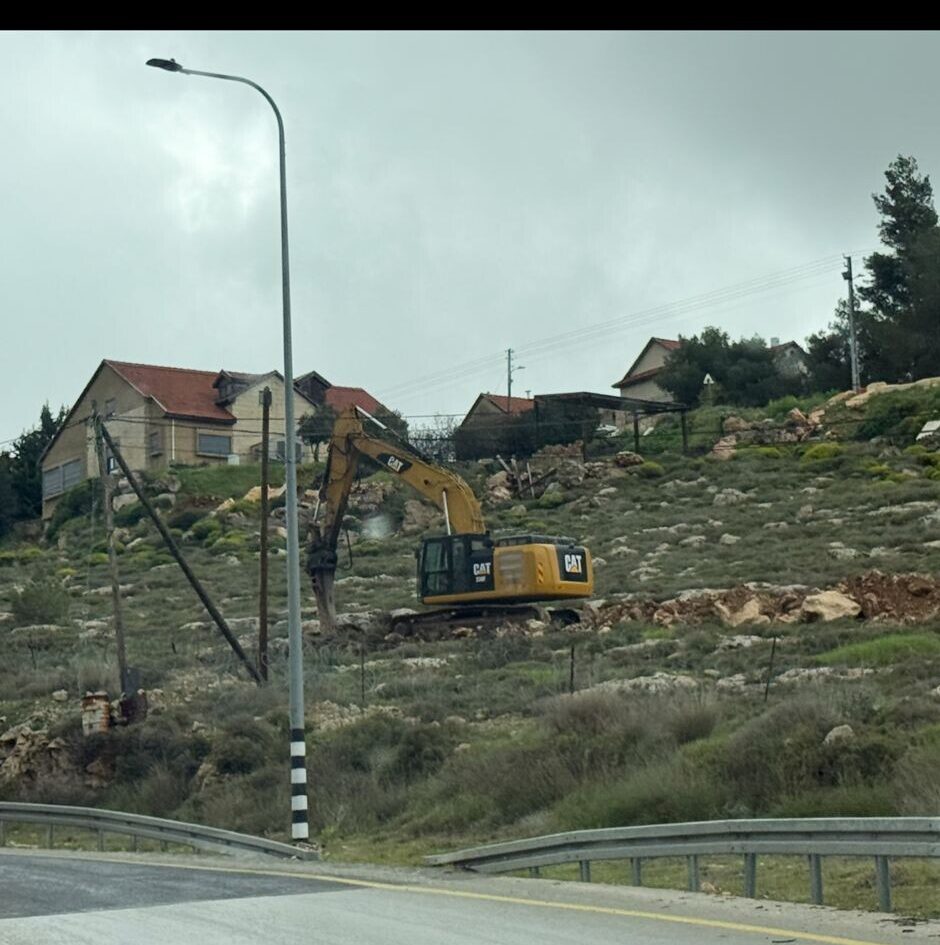 MuhammadFeb-24-2026South Hebron Hill, Beit Hagai: Paving an internal security road
-