
Hebron, Sansana, South Hebron Hills, Thu 7.8.08, Morning
Translating to English- Revital S.
06:00 – Sansana – Meitar
There are a few people at the checkpoint and the crossing is reasonably quick. Workers are still coming and cross as soon as they arrive. The Palestinians talk of an X-ray room through which all workers must pass on Fridays. They say they'd heard it's an unhealthy procedure. Close to our departure time the first bus with visiting families arrives on its way to the prisons.
At about 08:45, on our way back via the checkpoint, the buses on the Israeli side would have already left.
Highway 60
There are no significant changes in the roadblocks. Some are open but generally nothing new.
Near Durah Al Fawar people are filling up water bottles and packing them on the donkey's back.
A cab driver is washing his vehicle near a water hole. Some children are helping him – pouring water over the cab and scrubbing off the dust with a broom.
The Sheep Junction
The little grey gate at the pedestrian checkpoint is shut and made to with barbed wire. The pedestrians also have to go all the way around. An elderly man is riding a donkey.
07:00 – Hebron
In the agricultural plot between Kiryat Arbah and Hebron, where a few weeks ago some youngsters put up a tent, a new tent now stands. In the Shack between Kiryat Arbah and Hebron by The Neighbourhood of the Patriarchs, Men are praying the early morning prayer.
At the makeshift bus stop by The Disputed House three 6-7 year olds are hitching a hike on their own.
At Landmark 408 stands a military jeep. The soldiers are in the vehicle.
At the entrance to Tel Rumeida the soldiers stop us saying we are forbidden to go up. A police car arrives then. After some argument with the police and once they've checked our ID cards they allow us to proceed. Then the soldier remembers again that we're not permitted to go up. The soldiers refuse to submit their details. Unfortunately at this crucial point my camera decided to call it a day and I have no documentation of what happened from this point on.
Their behaviour, towards us and the Palestinians, is extremely aggressive and unpleasant. They don't tell the people at the checkpoint to stop and come to them to show their documents, but make all sorts of noises instead – whistling and buzzing, and minimal gestures with their hands.
We allow them a few minutes to check about us but when it looks like they're not making any inquiries on their wireless we start making our way up the hill. The Golani soldiers at the bottom of the hill look cross and shout to the Border Police soldiers to stop us. At the Border Police post they check again if leftists are allowed up. After a few minutes' conversation with the soldiers we are confirmed.
As a matter of principle we go as far as the military base by the grey gate. We then mean to descend, I just ask to see the commander before we leave. I wait. A soldier at the entrance post to the base demands that I stand here and not there, there and not here. As I wait an egg is hurled at me from one of the upper stories of the building. It hits me but shatters on the floor. A lieutenant comes out and approaches me. I introduce myself and ask him to tell his soldiers that we're allowed to come up once we present our blue ID cards. From our short conversation I gather that he is not aware what is and what isn't allowed. I ask him to introduce himself. He is extremely surprised and then says his name hesitatingly. A sergeant tells him to belt up and he does. Something to the effect of – what, are you a sucker to go telling your name.
I ask him to accompany me up the stairs to see who threw the egg at me, pointing at his soldier who was witness to the event. He refuses. He is not allowed to enter houses without a warrant, he claims. I explain that it is his duty to uphold order and it has just been disrupted. But he is adamant. Must be afraid. We leave the place (I have the officer's name).
At the exit from Hebron we stop at Bassam's cobbler workshop. He tells us that the settlers started to throw their garbage by the door of the Mosque next to The Disputed House.
For lack of time we didn't stop to see for ourselves but we shall next week.
Hebron
See all reports for this place-
According to Wye Plantation Accords (1997), Hebron is divided in two: H1 is under Palestinian Authority control, H2 is under Israeli control. In Hebron there are 170,000 Palestinian citizens, 60,000 of them in H2. Between the two areas are permanent checkpoints, manned at all hours, preventing Palestinian movement between them and controlling passage of permit holders such as teachers and schoolchildren. Some 800 Jews live in Avraham Avinu Quarter and Tel Rumeida, on Givat HaAvot and in the wholesale market.
Checkpoints observed in H2:
- Bet Hameriva CP- manned with a pillbox
- Kapisha quarter CP (the northern side of Zion axis) - manned with a pillbox
- The 160 turn CP (the southern side of Zion axis) - manned with a pillbox
- Avraham Avinu quarter - watch station
- The pharmacy CP - checking inside a caravan with a magnometer
- Tarpat (1929) CP - checking inside a caravan with a magnometer
- Tel Rumeida CP - guarding station
- Beit Hadassah CP - guarding station
Three checkpoints around the Tomb of the Patriarchs
 Raya YeorDec-18-2025Hebron - Yusri Jaber and part of his family
-
Meitar checkpoint / Sansana
See all reports for this place-
Meitar Checkpoint / Sansana The checkpoint is located on the Green Line and serves as a border crossing between Israel and the West Bank. It is managed by the Border Crossing Authority of the Defense Ministry. It is comprised of sections for the transfer of goods as well as a vehicle checkpoint (intended for holders of blue identity cards, foreign nationals or diplomats and international organizations). Passing of Palestinians is prohibited, except for those with entry permits to Israel. Palestinians are permitted to cross on foot only. The crossing has a DCO / DCL / DCL / DCL (District Coordination Office), a customs unit, supervision, and a police unit. In the last year, a breach has been opened in the fence, not far from the crossing. This breach is known to all, including the army. There does not appear to be any interest in blocking it, probably as it permits needed Palestinian workers without the bureaucratic permits to get to work in Israel. Food stalls and a parking area economy have been created, but incidents of violent abuse by border police have also been recorded. Updated April 2022
-
South Hebron Hills
See all reports for this place-
South Hebron Hills
South Hebron Hills is a large area in the West Bank's southern part.
Yatta is a major city in this area: right in the border zone between the fertile region of Hebron and its surroundings and the desert of the Hebron Hills. Yatta has about 64,000 inhabitants.
The surrounding villages are called Masafer Yatta (Yatta's daughter villages). Their inhabitants subsist on livestock and agriculture. Agriculture is possible only in small plots, especially near streams. Most of the area consists of rocky terraces.Since the beginning of the 1980s, many settlements have been established on the agricultural land cultivated by the Palestinians in the South Hebron Hills region: Carmel, Maon, Susia, Masadot Yehuda, Othniel, and more. Since the settlements were established and Palestinians cultivation areas have been reduced; the residents of the South Hebron Hills have been suffering from harassment by the settlers. Attempts to evict and demolish houses have continued, along with withholding water and electricity. The military and police usually refrain from intervening in violent incidents between settlers and Palestinians do not enforce the law when it comes to the investigation of extensive violent Jewish settlers. The harassment in the South Hebron Hills includes attacking and attempting to burn residential tents, harassing dogs, harming herds, and preventing access to pastures.
There are several checkpoints in the South Hebron Hills, on Routes 317 and 60. In most of them, no military presence is apparent, but rather an array of pillboxes monitor the villages. Roadblocks are frequently set up according to the settlers and the army's needs. These are located at the Zif Junction, the Dura-al Fawwar crossing, and the Sheep Junction at the southern entrance to Hebron.
Updated April 2022
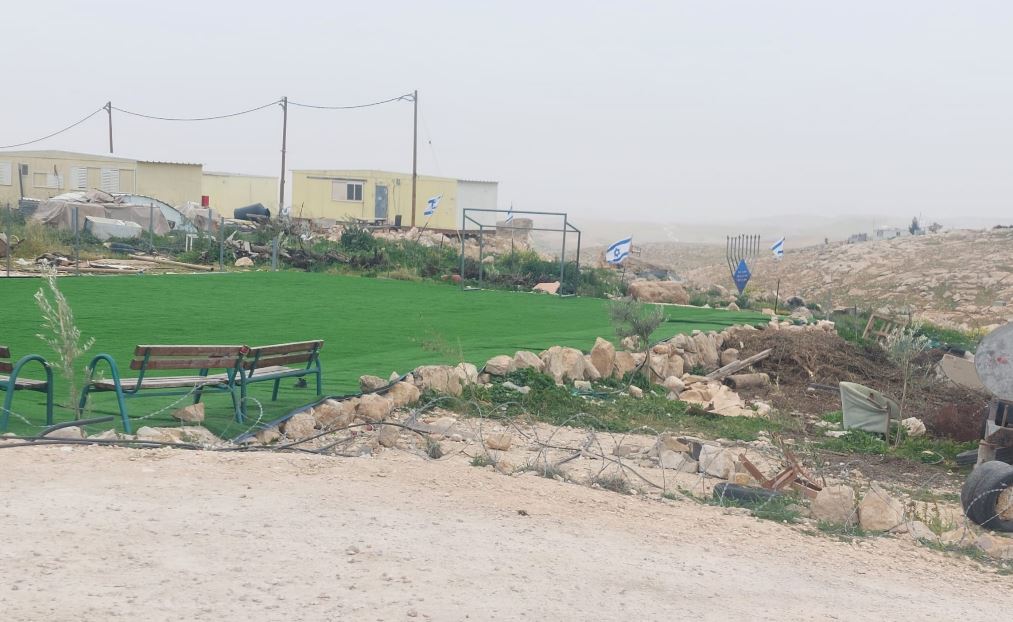 Michal TsadikFeb-17-2026Umm al-Khair: The soccer field for Palestinian children is surrounded by new trailers and lots of Israeli flags
-