
Hebron, Sansana, South Hebron Hills, Tue 17.11.09, Morning
Translation: Bracha B.A. 06:00 – 11:00Sansana
Today there was rain, drizzling, and then the rain stopped, but it was enough to cause a lot of agricultural workers to return home and to miss the work day.At the crossing there is no line at all, and whoever arrives goes through immediately. One busload of families going to visit prisoners is already here waiting for the Red Cross person to arrive at 07:00. They will then cross over. IN order to prevent crowding at the checkpoint they have begun to open it every day at 04:00 and if the inspection booths operate properly there is no lineup. S., the manager of the crossing, tells us that they are enlarging the parking lot and that on Friday there was a vegetable market there. R., the operations manager of the checkpoint, will be responsible for the crossing at Metzudot Yehudah – Beit Yatir that will be transferred to the Border Crossings Authority in another two weeks. Only merchandise and Palestinian workers who work at Har Amsha and in the settlements of Beit Yatir will cross here. Sand trucks that cross over “back to back” are working at top speed. Road 60There is heavy fog and children are walking to school on the side of the road. At the curve beneath Beit Hagai a huge truck with a trailer is stuck at the bend and a jeep with soldiers stops to see what happened. They are inside the jeep and the Palestinians are trying to move the truck. All the pillboxes are Dura al Fawar, and the Sheep Junction are manned. Big Brother above is sleeping.
HebronThe Pharmacy JunctionChildren’s school bags are still being checked – the boys’ school principal tells us that this year the checkpoints are much better. At least one class of boys has gone to the girls’ school to take boxes of food that went there by UNWRA since the food cannot be brought by car because of the checkpoints and a wagon will also not be permitted to go through. He also told us that Anat Cohen is no longer driving her car around the school attempting to frighten the children as we saw last week. Work is being done on the infrastructure on the road leading to the Moslem entrance to the Cave of the Patriarchs. The loudspeakers from Beit Gutnick is quiet today. בים.
Curve 160 – Four soldiers from the border patrol are leaning on their jeep-…and everyone continues on their way in this nightmarish city.At the opening to the Olive Crossing there are bright red warning signs telling people not to enter the Palestinian Authority and traffic is moving smoothly.Idna-Tarkomia – The guys in the grocery store tell us that every day of the week soldiers come down from the pillboxes and erect a checkpoint on the side of Idna and create large traffic jams – they block the road for a half hour and then leave.Tarkomia- When we went through there were no longer any people going through and about 12 trucks were waiting in line to enter. There were no trucks in the upper parking lot, showing that the waiting time was not long.Negohot– A beautiful new road has opened from the entrance junction to Lachish and Amatzia to the Shoket Junction. The road is on the western side of the separation barrier that runs here along the green line – except for several instances of Israel stealing land, for example, near the quarry belonging to Omri Sharon, or near the settlement of Negohot. The fence also is not completely finished and the section from Dahariyya to Ramadin and Lahav. Since it was reported on the news yesterday that illegal buildings were being demolished in Negohot (everything is illegal and unjust there) and soldiers from the Nachshon Brigade had protested against evacuation of Jewish settlements, we decided to go in and see what was going on.First of all there is a checkpoint, two reservists are guarding and not everyone can enter. We had to invent a story that we had come to visit a friend and we removed the “Machsom Watch” sign from the transit and hid our tags. After our ID cards were checked they moved the red bricks and let us enter. We drove for a while and reached the old Road 358 that connects Beit Awa to Siqa where the Beit Awa checkpoint used to be. The pillbox is still there and still manned but the yellow gates are open and Palestinians can drive on the road as far as Dahariyya. There are no signs that mark Area A. There are a few Palestinian families living on both sides of the road leading to Negohot, which is actually a Palestinian road leading to Dura. The Supreme Court has recently ruled that the checkpoint has to be removed. The Supreme Court has made a decision but the people at Negohot think otherwise.
On the right side of the road there is a sign pointing to the Negohot B neighborhood. They call it Givat Habustan, or “Garden Hill” and it was built in 2002. There are five buildings, two of which are wooden cabins that look like pretty vacation cabins. Further on at the top of the hill stands Negohot A, a fairly large settlement. Behind it is a green gate with a Palestinian village behind it, but that gate is closed!!! Remember that the Supreme Court ruled that it was to be opened? The gate is closed and locked, and we see a settler coming from the other side of the gate about to enter the settlement from the direction of the Palestinian village. HE opens the gate with a key. On the other side of the gate is the illegal settlement and only a settler has the key. We photographed what we could and left. We gave all the information to Hagit from Peace Now and we will see what will happen. The entire area looks very pastoral…and on the other hand we see the horrible occupation of the settlers.
Hebron
See all reports for this place-
According to Wye Plantation Accords (1997), Hebron is divided in two: H1 is under Palestinian Authority control, H2 is under Israeli control. In Hebron there are 170,000 Palestinian citizens, 60,000 of them in H2. Between the two areas are permanent checkpoints, manned at all hours, preventing Palestinian movement between them and controlling passage of permit holders such as teachers and schoolchildren. Some 800 Jews live in Avraham Avinu Quarter and Tel Rumeida, on Givat HaAvot and in the wholesale market.
Checkpoints observed in H2:
- Bet Hameriva CP- manned with a pillbox
- Kapisha quarter CP (the northern side of Zion axis) - manned with a pillbox
- The 160 turn CP (the southern side of Zion axis) - manned with a pillbox
- Avraham Avinu quarter - watch station
- The pharmacy CP - checking inside a caravan with a magnometer
- Tarpat (1929) CP - checking inside a caravan with a magnometer
- Tel Rumeida CP - guarding station
- Beit Hadassah CP - guarding station
Three checkpoints around the Tomb of the Patriarchs
 Raya YeorDec-18-2025Hebron - Yusri Jaber and part of his family
-
Meitar checkpoint / Sansana
See all reports for this place-
Meitar Checkpoint / Sansana The checkpoint is located on the Green Line and serves as a border crossing between Israel and the West Bank. It is managed by the Border Crossing Authority of the Defense Ministry. It is comprised of sections for the transfer of goods as well as a vehicle checkpoint (intended for holders of blue identity cards, foreign nationals or diplomats and international organizations). Passing of Palestinians is prohibited, except for those with entry permits to Israel. Palestinians are permitted to cross on foot only. The crossing has a DCO / DCL / DCL / DCL (District Coordination Office), a customs unit, supervision, and a police unit. In the last year, a breach has been opened in the fence, not far from the crossing. This breach is known to all, including the army. There does not appear to be any interest in blocking it, probably as it permits needed Palestinian workers without the bureaucratic permits to get to work in Israel. Food stalls and a parking area economy have been created, but incidents of violent abuse by border police have also been recorded. Updated April 2022
-
South Hebron Hills
See all reports for this place-
South Hebron Hills
South Hebron Hills is a large area in the West Bank's southern part.
Yatta is a major city in this area: right in the border zone between the fertile region of Hebron and its surroundings and the desert of the Hebron Hills. Yatta has about 64,000 inhabitants.
The surrounding villages are called Masafer Yatta (Yatta's daughter villages). Their inhabitants subsist on livestock and agriculture. Agriculture is possible only in small plots, especially near streams. Most of the area consists of rocky terraces.Since the beginning of the 1980s, many settlements have been established on the agricultural land cultivated by the Palestinians in the South Hebron Hills region: Carmel, Maon, Susia, Masadot Yehuda, Othniel, and more. Since the settlements were established and Palestinians cultivation areas have been reduced; the residents of the South Hebron Hills have been suffering from harassment by the settlers. Attempts to evict and demolish houses have continued, along with withholding water and electricity. The military and police usually refrain from intervening in violent incidents between settlers and Palestinians do not enforce the law when it comes to the investigation of extensive violent Jewish settlers. The harassment in the South Hebron Hills includes attacking and attempting to burn residential tents, harassing dogs, harming herds, and preventing access to pastures.
There are several checkpoints in the South Hebron Hills, on Routes 317 and 60. In most of them, no military presence is apparent, but rather an array of pillboxes monitor the villages. Roadblocks are frequently set up according to the settlers and the army's needs. These are located at the Zif Junction, the Dura-al Fawwar crossing, and the Sheep Junction at the southern entrance to Hebron.
Updated April 2022
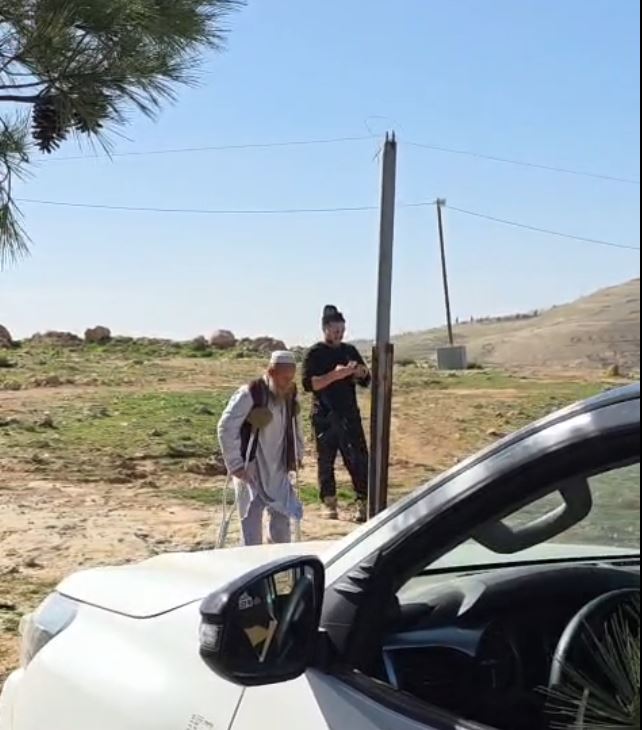 Feb-3-2026Security coordinator of the Abigail settlement, the one who injured Sheikh Saad (next to him)
-