
Hebron, Sansana, South Hebron Hills, Tue 31.3.09, Morning
06:30-10:30
Sansana-Maytar CP:
Many workers who have already gone through are waiting on the Israeli side for their rides. The checking lane is empty. There are no busses carrying families of prisoners and no sand trucks.
Road 60
The road is almost empty. There are only a few children on their way to Dura Alfawwar – the crossing is open, traffic is flowing. The same holds true for the intersection.
Bnei Naim: Children and adults are climbing the hills by foot; the more fortunate, ride on donkeys.
Hebron
The House of Dispute: The house is surrounded by barbed wire. The new road winds between the mosque and the house of contention, and there is a heavy presence of Border Police soldiers. At the feet of the House of Dispute, we saw them talking to Palestinians and so, we stopped. We were pleased to see that it was a normal conversation and we did not see the difficult sights of people being frisked with the shirts off and their arms raised against the wall like we saw in the movie that Bassam took last week. Along the way there were also an increased number of Border Police soldiers, and they were present at every corner and alleyway. They are standing next to the new concrete barriers in front of the Schorr Crossing.
We met M, the son of our friend S., opposite the army base on Hashuhada Street below the Palestinian cemetery. He has been living in Hebron for over two years now, doing some documentary work for “B’tzelem”. He confirms our feeling that there is unrest among the settlers because of the decision to open the Zion Route (referred to by the Palestinians as Jabari). Apparently this is also the reason for the increased presence of the Border Police and their strict behavior towards the Palestinians. He tells us that he heard that the army is about to move soldiers into the House of Dispute. We sing the Hebrew song about “The Nahal Base in Sinai”…
Tarpat CP: A police jeep emerges immediately and a police officer comes to ensure that we are only following our regular route. When we ask how he is he answers: “The situation here is always very, very sensitive. Yesterday someone threw rocks at the police car on the Erez Road” – which is the road used by people going to pray. We try to get more information out of him concerning the prospects of Palestinians being allowed to use the Zion Route, at which he expresses concern and does not believe that the plan will succeed: He feels this road cannot handle the large amount of traffic. All drivers – both Palestinians and settlers – drive badly and there will be many accidents. We did not see any detainees at this checkpoint or at the Tel Romeida CP, above.
All seems to be as usual and uneventful. The paratroopers, due to replace the Givati Brigade soldiers, have not yet arrived. Border Police soldiers are now manning all checkpoints.
Pharmacy CP: People pass through without being detained. Border Police soldiers enquire us about our activities and who we are, informing us that experienced policemen from Qalqilya have arrived and will reinforce them here.
Patriarchs' Tombs' Cave: deceptively quiet. The speakers have not yet been turned on and the stores are not yet open. Suddenly the Border Police soldiers shout and run towards children fighting at the entrance to the Avraham Avinu neighborhood. We go to see what's up when a soldier informs us that a settlers' child threw stones at some Palestinian children and a fight broke out between two Palestinian children and himself. The soldiers broke it up and… guess who were the children who were taken to the police? The Palestinians, of course. When we enquire about the Jewish boy, we receive no answer. Nevertheless, the soldier asked us very gently not to get into an argument with Ofer Ochna or Noam Federman. He makes Yoshafat Tor from Havat Maon leave. He is the disruptive settler who is held in disrespect – having parked his car next to a Palestinian souvenir shop. Ofer and Noam arrive from the direction of the Patriarchs' Tombs' Cave, immediately getting into their cars. The atmosphere is very tense, and we leave.
In addition to the regular customers in Bassam’s grocery, there's another person there. He tells us that he was a driver for the Haifa “Dagon” mills for many years, having driven wheat back and forth between Haifa and Hebron. He knows Jews and the roads very well. In his opinion the new arrangement for opening the Zion Route and allowing one car per family is bad: it should be all or nothing. He is angry, saying: “I, for instance, have two cars, so they won’t let me drive this one? or only the other? And if my daughter from Nablus comes to visit, they won’t let her in with her car? Don’t let them do us any favors – we don’t think they want to make things any easier for us.” Bassam also explains that in their opinion this is another way of supervising and controlling them, and will not make things easier. Bassam says that yesterday at midnight the settlers threw rocks at their houses (which sounds like the story we heard from the policeman, and apparently the rocks that were thrown at the patrol car were thrown by settlers). Bassam again says that Border Police soldiers keep detaining people under the House of Dispute, checking their clothes and cars. We understand that both sides in Hebron are not interested in any changes or in the way they are implemented. The Palestinians have absolutely no trust and do not believe that there will be any significant changes in their lives, while the settlers fear for their safety and welfare and respond with violence towards everyone.
We drive back via Road 356 317: the vegetables in the Zif Junction grocery are excellent. The people there ask about Ibrahim, our driver who passed away recently, and whom we still miss.
Hebron
See all reports for this place-
According to Wye Plantation Accords (1997), Hebron is divided in two: H1 is under Palestinian Authority control, H2 is under Israeli control. In Hebron there are 170,000 Palestinian citizens, 60,000 of them in H2. Between the two areas are permanent checkpoints, manned at all hours, preventing Palestinian movement between them and controlling passage of permit holders such as teachers and schoolchildren. Some 800 Jews live in Avraham Avinu Quarter and Tel Rumeida, on Givat HaAvot and in the wholesale market.
Checkpoints observed in H2:
- Bet Hameriva CP- manned with a pillbox
- Kapisha quarter CP (the northern side of Zion axis) - manned with a pillbox
- The 160 turn CP (the southern side of Zion axis) - manned with a pillbox
- Avraham Avinu quarter - watch station
- The pharmacy CP - checking inside a caravan with a magnometer
- Tarpat (1929) CP - checking inside a caravan with a magnometer
- Tel Rumeida CP - guarding station
- Beit Hadassah CP - guarding station
Three checkpoints around the Tomb of the Patriarchs
 Raya YeorDec-18-2025Hebron - Yusri Jaber and part of his family
-
Meitar checkpoint / Sansana
See all reports for this place-
Meitar Checkpoint / Sansana The checkpoint is located on the Green Line and serves as a border crossing between Israel and the West Bank. It is managed by the Border Crossing Authority of the Defense Ministry. It is comprised of sections for the transfer of goods as well as a vehicle checkpoint (intended for holders of blue identity cards, foreign nationals or diplomats and international organizations). Passing of Palestinians is prohibited, except for those with entry permits to Israel. Palestinians are permitted to cross on foot only. The crossing has a DCO / DCL / DCL / DCL (District Coordination Office), a customs unit, supervision, and a police unit. In the last year, a breach has been opened in the fence, not far from the crossing. This breach is known to all, including the army. There does not appear to be any interest in blocking it, probably as it permits needed Palestinian workers without the bureaucratic permits to get to work in Israel. Food stalls and a parking area economy have been created, but incidents of violent abuse by border police have also been recorded. Updated April 2022
-
South Hebron Hills
See all reports for this place-
South Hebron Hills
South Hebron Hills is a large area in the West Bank's southern part.
Yatta is a major city in this area: right in the border zone between the fertile region of Hebron and its surroundings and the desert of the Hebron Hills. Yatta has about 64,000 inhabitants.
The surrounding villages are called Masafer Yatta (Yatta's daughter villages). Their inhabitants subsist on livestock and agriculture. Agriculture is possible only in small plots, especially near streams. Most of the area consists of rocky terraces.Since the beginning of the 1980s, many settlements have been established on the agricultural land cultivated by the Palestinians in the South Hebron Hills region: Carmel, Maon, Susia, Masadot Yehuda, Othniel, and more. Since the settlements were established and Palestinians cultivation areas have been reduced; the residents of the South Hebron Hills have been suffering from harassment by the settlers. Attempts to evict and demolish houses have continued, along with withholding water and electricity. The military and police usually refrain from intervening in violent incidents between settlers and Palestinians do not enforce the law when it comes to the investigation of extensive violent Jewish settlers. The harassment in the South Hebron Hills includes attacking and attempting to burn residential tents, harassing dogs, harming herds, and preventing access to pastures.
There are several checkpoints in the South Hebron Hills, on Routes 317 and 60. In most of them, no military presence is apparent, but rather an array of pillboxes monitor the villages. Roadblocks are frequently set up according to the settlers and the army's needs. These are located at the Zif Junction, the Dura-al Fawwar crossing, and the Sheep Junction at the southern entrance to Hebron.
Updated April 2022
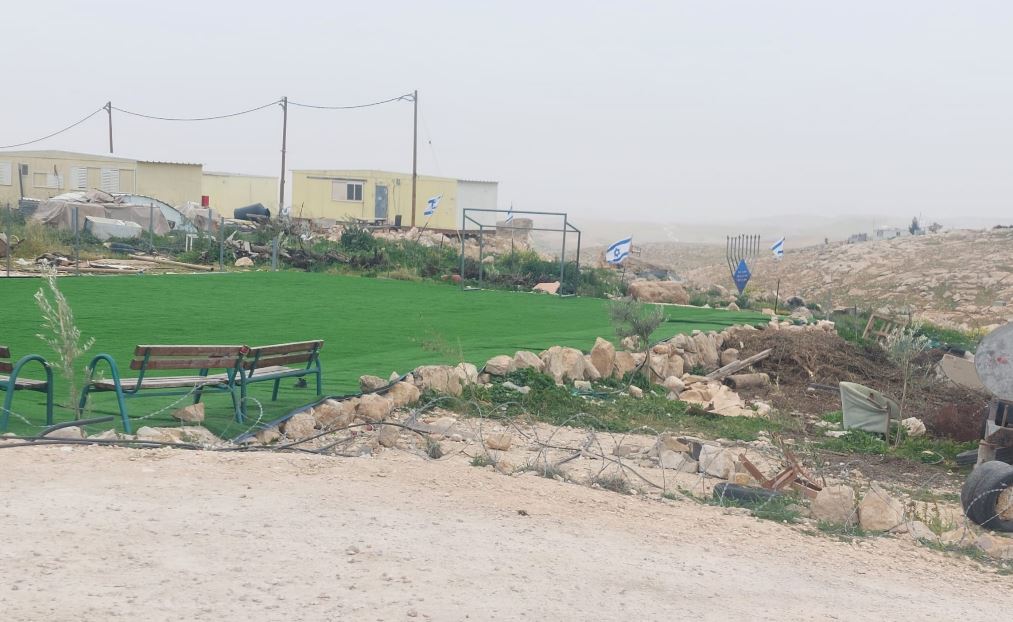 Michal TsadikFeb-17-2026Umm al-Khair: The soccer field for Palestinian children is surrounded by new trailers and lots of Israeli flags
-