
Hebron, Sansana, South Hebron Hills, Tue 6.7.10, Morning
Translator: Charles K.
- Hebron – Are IDF orders becoming stricter, or did we just happen to run into some “commander’s” individual initiative?
- An incident on Friday, 2.7.10, at the village of Deir Raza.
- Meitar crossing – meeting with Moti, the manager
Meytar crossing
All laborers have crossed by 7:00 and the passageway is empty. A few families of prisoners wait under the awning. Five buses were waiting when we returned.
Route 60
The roads are deserted all the way to Hebron, except at the Dura Elfawwar junction where we see military vehicles. The market at the Kvasim junction is less crowded. The IDF isn’t there today.
All the roadblocks are open!
Hebron
Are IDF orders becoming stricter, or did we just happen to run into an individual initiative by some “kodkod” (commander)?
The city is deserted. We drive along our usual route when suddenly, at the beginning of Shuohada Street, a soldier stops us and asks to see IDs.
Why? He checks and lets us drive on.
We go another kilometer, and another soldier, next to Kikar Gross, signals us to stop: “You can’t go through.”
Why?!
Because Arabs can’t ride on Shuhada Street, and you also came via H1 at the Pharmacy checkpoint.
“No we didn’t! We came the same way we always do, and passed the Pharmacy checkpoint on the side that we’re allowed to pass. Moreover, we’ve been here for years, riding on our shifts, Muhammad is an Israeli citizen, like us.”
”OK, just a minute, I have to talk to the kodkod.”
He whispers something again into the radio, already convinced we didn’t cross where its forbidden, but the kodkod is stubborn: “Arabs can’t drive on Shuhada. Sorry, it’s forbidden!”
Maybe they don’t want us to see them dancing…
We decided to go to the police to report the limitations imposed on civilians.
“Yes, yes,’ says the soldier, happy to get rid of us. “Talk to the police.”
So we went to the police station at the Cave of the Patriarchs. They know us very well. We tell our story, and express our surprise at the soldiers’ reaction.
The policeman tries to explain that there are new orders because of all the mess here. What mess?! What orders?! I ask.
“There’s an order from the Commanding General,” he says.
?????
Can we see the order? I ask.
Yes, he replies. Wait a minute.
We wait. After a while the policeman returns. “I don’t have an order from the Commanding General; get it from the army. But I spoke to the DCO, you’ve got a permit to move around. If you have any problems, tell the soldiers you’ve got a permit.”
The effort paid off. We return to Shuhada. The soldiers at all the roadblocks have already been updated and let us pass.
All along the road, and at Tel Rumeida, the soldiers haven’t detained anyone.
We went to B.’s grocery. We haven’t visited him for a long time. He says they stopped paving the road connecting to the worshippers’ route because the court ordered a 60-day wait. That’s also good. He tells us that every Friday and Saturday dozens of settlers come from Qiryat Arba and fill the road passing beneath Beit HaMeriva, and pray there. They’re not allowed to go inside, but to stand outside, make noise a pray is permitted.
And the Palestinians? They stay home.
An incident on Friday, 2.7.10, at the village of Deir Raza.
N., our friend, called and told us that settlers and soldiers showed up at his fields which are filled with ruins and caves. He had tools in one of them, jerrycans, spray cans, eating utensils, a mattress and other items he uses when working his fields. The settlers and soldiers entered this “storeroom,” broke and shattered everything, and took the pickaxes and pitchforks away with them. Afterwards they crossed his village from east to west (he said that everyone hid in their homes out of fear), to a vehicle that waited for them on Route 60 and picked them up.
He complained in Dura, at the Palestinian coordination office, where they promised to submit a complaint to the Israelis. He also said that Palestinian TV reported the incident on Saturday and on Sunday.
N, of course, is very shocked and hurt. Up to now, he said, his contacts with the settlers had been proper. He simply can’t understand the vandalism…
I contacted “Yesh Din,” who promised to act as soon as possible. Let’s hope they do.
Meitar crossing – meeting with Moti, the crossing manager
Moti awaits us, concerned and ready to listen.
He says that what’s been most important to him since taking the job has been to create conditions permitting people to cross quickly so that the laborers get to work on time. Now, when the equipment and staff at his disposal make this possible, he wants to upgrade the waiting shed and equip it so it’s more comfortable. In addition, it will be divided so that if it’s crowded men and women won’t be jammed together, and the women will feel more comfortable. He says the slalom design of the passage is necessary for safety, as is the fence surrounding the shed.
We again ask that all changes be carried out with maximum sensitivity to the needs and culture of the people passing through the checkpoint. Moti promises that he’ll do so.
On Fridays many fewer laborers show up, so the staff is smaller, but he assures us that he’s always able to open an additional inspection passage and add staff if necessary.
Bathrooms on the Palestinian side are now only open to women and children because the DCO is responsible for maintaining them and is still having difficulties. The laborers can use the bathrooms on the Israeli side. There are apparently problems keeping them clean as well.
To sum up, we got the impression that there’s a desire to solve problems fairly, but it’s important to remind ourselves that the Ministry of Defence Crossings Unit isn’t the only one making decisions about conditions and procedures. Other actors have a great influence on how the place operates.
That’s the situation as of now. We can only keep following up and hope that the location will actually serve as a transit point between countries and will look and operate like one.
Hebron
See all reports for this place-
According to Wye Plantation Accords (1997), Hebron is divided in two: H1 is under Palestinian Authority control, H2 is under Israeli control. In Hebron there are 170,000 Palestinian citizens, 60,000 of them in H2. Between the two areas are permanent checkpoints, manned at all hours, preventing Palestinian movement between them and controlling passage of permit holders such as teachers and schoolchildren. Some 800 Jews live in Avraham Avinu Quarter and Tel Rumeida, on Givat HaAvot and in the wholesale market.
Checkpoints observed in H2:
- Bet Hameriva CP- manned with a pillbox
- Kapisha quarter CP (the northern side of Zion axis) - manned with a pillbox
- The 160 turn CP (the southern side of Zion axis) - manned with a pillbox
- Avraham Avinu quarter - watch station
- The pharmacy CP - checking inside a caravan with a magnometer
- Tarpat (1929) CP - checking inside a caravan with a magnometer
- Tel Rumeida CP - guarding station
- Beit Hadassah CP - guarding station
Three checkpoints around the Tomb of the Patriarchs
 Raya YeorDec-18-2025Hebron - Yusri Jaber and part of his family
-
Meitar checkpoint / Sansana
See all reports for this place-
Meitar Checkpoint / Sansana The checkpoint is located on the Green Line and serves as a border crossing between Israel and the West Bank. It is managed by the Border Crossing Authority of the Defense Ministry. It is comprised of sections for the transfer of goods as well as a vehicle checkpoint (intended for holders of blue identity cards, foreign nationals or diplomats and international organizations). Passing of Palestinians is prohibited, except for those with entry permits to Israel. Palestinians are permitted to cross on foot only. The crossing has a DCO / DCL / DCL / DCL (District Coordination Office), a customs unit, supervision, and a police unit. In the last year, a breach has been opened in the fence, not far from the crossing. This breach is known to all, including the army. There does not appear to be any interest in blocking it, probably as it permits needed Palestinian workers without the bureaucratic permits to get to work in Israel. Food stalls and a parking area economy have been created, but incidents of violent abuse by border police have also been recorded. Updated April 2022
-
South Hebron Hills
See all reports for this place-
South Hebron Hills
South Hebron Hills is a large area in the West Bank's southern part.
Yatta is a major city in this area: right in the border zone between the fertile region of Hebron and its surroundings and the desert of the Hebron Hills. Yatta has about 64,000 inhabitants.
The surrounding villages are called Masafer Yatta (Yatta's daughter villages). Their inhabitants subsist on livestock and agriculture. Agriculture is possible only in small plots, especially near streams. Most of the area consists of rocky terraces.Since the beginning of the 1980s, many settlements have been established on the agricultural land cultivated by the Palestinians in the South Hebron Hills region: Carmel, Maon, Susia, Masadot Yehuda, Othniel, and more. Since the settlements were established and Palestinians cultivation areas have been reduced; the residents of the South Hebron Hills have been suffering from harassment by the settlers. Attempts to evict and demolish houses have continued, along with withholding water and electricity. The military and police usually refrain from intervening in violent incidents between settlers and Palestinians do not enforce the law when it comes to the investigation of extensive violent Jewish settlers. The harassment in the South Hebron Hills includes attacking and attempting to burn residential tents, harassing dogs, harming herds, and preventing access to pastures.
There are several checkpoints in the South Hebron Hills, on Routes 317 and 60. In most of them, no military presence is apparent, but rather an array of pillboxes monitor the villages. Roadblocks are frequently set up according to the settlers and the army's needs. These are located at the Zif Junction, the Dura-al Fawwar crossing, and the Sheep Junction at the southern entrance to Hebron.
Updated April 2022
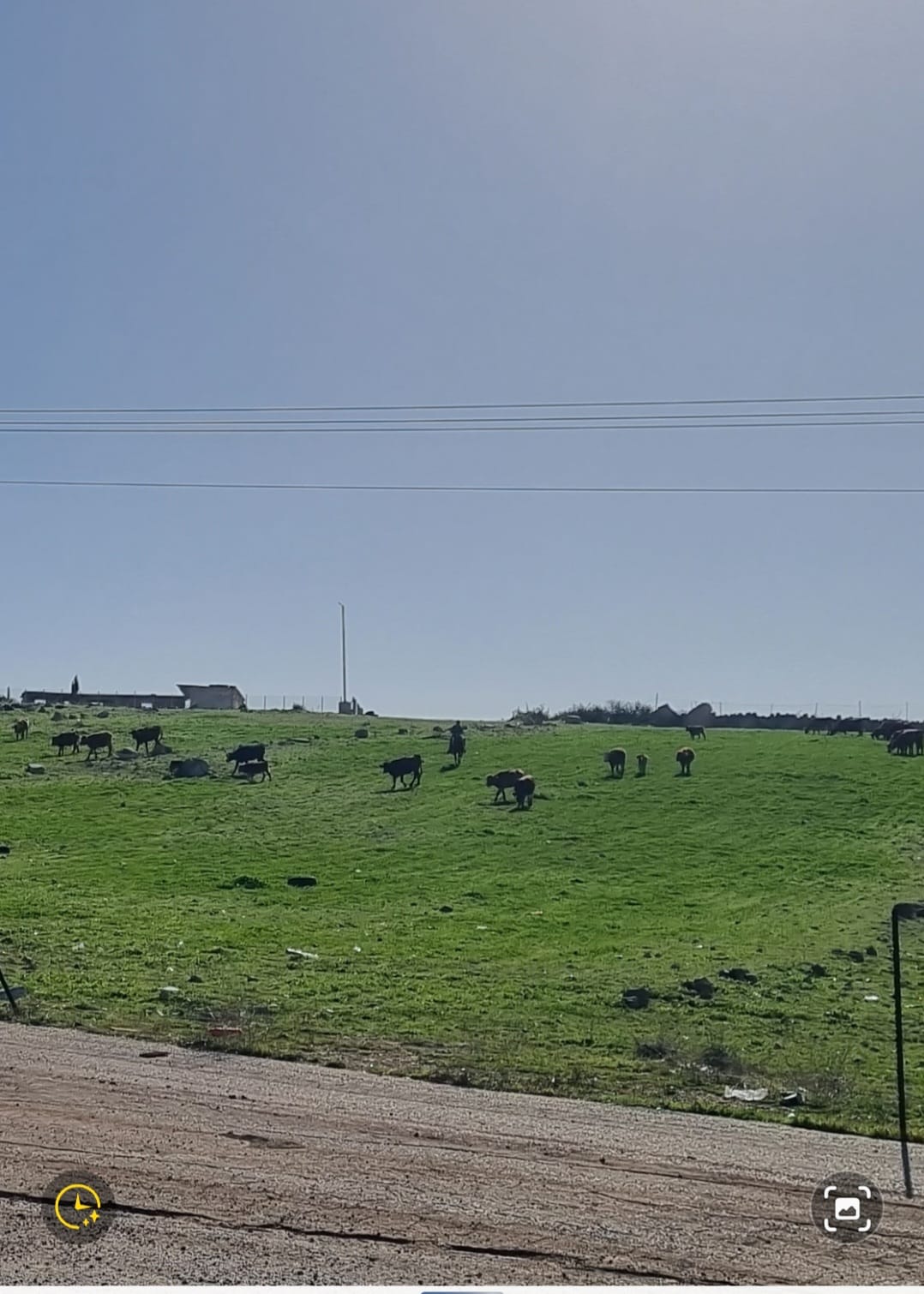 Smadar BeckerJan-12-2026A herd of cows in the area of Zanuta, from which its residents were expelled, accompanied by a settler on horseback
-