
Hebron, Sansana, South Hebron Hills, Tue 7.10.08, Morning
6:30-10:00am
Sansana-Meytar Checkpoint
On the right side of the CP (relative to Be'er Sheva), there is a back-to-back goods' transfer lot – three trucks on the Israeli side, three on the Palestinian side: Waiting time is merely loading time. The goods being transferred: sand. When we were at the CP, all workers had already passed through and checks commenced on the buses with families visiting prisoners. All booths are working and the check is quick – in all, six buses passed through. One worker angrily tells us of a certain member of the checking staff who always detains him, because his shoes beep. He's already talked to A., officer in charge of the shift, but his anger doesn't subside… on our way back, we check the details and A. promises us that he will take care of it – and that no personal harassment is involved.
Road 60:
Palestinian traffic very active; all are manned.
Dora el Faur—the sheep's crossing
No military vehicles were observed and traffic flows, all blockages are in place, and children walk along on the sides of the road on their way to school.
Road 35
Next to the humanitarian CP, a borders' control jeep is parked alongside a car. On our way back, it is no longer there.
The olive passage –The northern entry to Hebron – is open and there are no soldiers.
We drive to Halhul-east to see if the opening of this passage has really decreased the number of cars going to Hebron via Halhul and, indeed, it did – there are quite a few Palestinian vehicles going to Hebron directly via this passage – perhaps the end of apartheid on this part of the road. We buy some excellent grapes from a local farmer who tells us that his mother had an accident next to the Container CP – she passed by with a donkey and a settler's car hit her. Ma'ale Edomim police immediately evacuated her but since then, he's been unable to contact them. Through Yehudit Elkana we referred him to Yesh Din. His mother was hospitalized in Hebron and is a bit better now.
Idna – Tarqumiya: Traffic flows. Pillbox is manned.
The people in the local grocery store will not give us their telephone numbers, so that the Israeli Association for civil rights check what happened there exactly, when the military took the residents' details a few weeks ago. Their faces disclosed how fearful they were (small wonder… they must have good reasons). We agreed that they would give them to us next week, after thinking it over a bit more. We've also concluded the details of our olive-oil purchase.
Hebron:
Golani are completing their term here today. Following them, it is Give'ati soldiers – we already see their officers getting ready for their term in Hebron. First, officers are taken to see the Hebron Jewish Quarter’s Museum, and have a talk with Noam Arnon, the Jewish Hebron residents' spokesperson. We can already conjecture what their approach to the Palestinians will be. As we arrive, all the children are headed to school.
The Disputed House (Bet Hameriva):
A soldiers' patrol is just there – 12 soldiers, six on each side, gun-bearing. We didn't see the Jewish Children waiting at the station, they might have already gone. The overhead cameras keep photographing as usual. Basem's grocery is shut. At the turn to the Patriarchs' tomb cave, the military jeep that is always stationed there is absent. The children walk through the blockage.
The Pharmacy CP:
Peace activists stand there. The CP's appearance is altered: large concrete blocks on either side of the road. It is much cleaner and tidy now. Next to the concrete blocks, there are a military police soldier and a Golani soldier. After the children walk through the magnometer the soldiers go through each and every school-bag. At the CP, there's also a volunteer from the TIF and A, the Israeli policeman, who detains us and enquires as to where we're headed at – he knows us already and knows exactly where we're heading, so we have the feeling he just wants to show us who's in charge here. A few minutes later, he lets us we can go, adding "but don't make trouble and don't get into Tel Rumeida." We go over to greet a Palestinian woman who lives next to the CP and watches over us from her window – "tfadal" she says, "come on in". But we apologize and hurriedly proceed to Tel Rumeida.
The Shuhada St.:
Guarding positions on Gross Square are down to where they were before – soldiers don't guard the Jewish children's transport and don't stand on the cemetery walls with exposed guns.
Tarpat PC:
Checks as usual.
Tel Rumeida:
The soldiers – their heavy backpacks strewn on the local houses' stairways – meet us with cheering applauds “for the traitors”. "Do you have cameras on you? Write about us in the papers…" They're happy today because they're finishing their term here, in Hebron today – all their belongings are next to them and none of them are in armor. One soldier is praying. Quite a few children stand in line and the checks proceed rather lazily. As if the children need not haste for school. Having exchanged only a few words with the soldiers we realize there's no one to talk to here – it’s the State of Israel here, and Palestinian life seems worthless. "I protect only Jews," the officer tells us. In situ, some peace activists with TIC police. When a queue of Palestinian girls forms, the officer wakes up and gets them through – not before we've said to him something. One soldier says to me "don't interfere with me here. You're a woman and I need to wee here"[!!!] He couldn't be bothered by the fact that the fig tree he wees by belongs to a Palestinian family – "this is a public area" he asserts.
We leave the place feeling very bad – if this is how the officer speaks, what can we expect of his soldiers?
The Settler Anat Cohen – at the Pharmacy CP:
On our way back, we stop again at the pharmacy CP, to take photos of the changes made there – the CP is empty at this time of day. The soldiers are nice and attentive. Anat Cohen passes by and sees us. As is her habit whenever she sees us, she stops her car in the middle of the road, gets out of it, swears A. our driver first and then approaches us so: "what? Are you here again, coming to drill those soldiers' minds?" the rest of what she says will not be repeated here – it just shames the human heart to repeat such filth, the filth coming out of a woman dressed in the manner of a God-fearing, creator-loving person. We respond Ghandi-style: no answer or reaction. Having overcome our wish to respond and attack, we are impressed that the soldiers had this golden opportunity to see who they should really be protecting.
We went out of Hebron as quickly as we could, shaken to tears (me, for the first time).
The Jewish settlers in Hebron demonstrate yet again what shame and calamity they bring onto the state of Israel and the Jewish people at large.
Hebron
See all reports for this place-
According to Wye Plantation Accords (1997), Hebron is divided in two: H1 is under Palestinian Authority control, H2 is under Israeli control. In Hebron there are 170,000 Palestinian citizens, 60,000 of them in H2. Between the two areas are permanent checkpoints, manned at all hours, preventing Palestinian movement between them and controlling passage of permit holders such as teachers and schoolchildren. Some 800 Jews live in Avraham Avinu Quarter and Tel Rumeida, on Givat HaAvot and in the wholesale market.
Checkpoints observed in H2:
- Bet Hameriva CP- manned with a pillbox
- Kapisha quarter CP (the northern side of Zion axis) - manned with a pillbox
- The 160 turn CP (the southern side of Zion axis) - manned with a pillbox
- Avraham Avinu quarter - watch station
- The pharmacy CP - checking inside a caravan with a magnometer
- Tarpat (1929) CP - checking inside a caravan with a magnometer
- Tel Rumeida CP - guarding station
- Beit Hadassah CP - guarding station
Three checkpoints around the Tomb of the Patriarchs
 Raya YeorDec-18-2025Hebron - Yusri Jaber and part of his family
-
Meitar checkpoint / Sansana
See all reports for this place-
Meitar Checkpoint / Sansana The checkpoint is located on the Green Line and serves as a border crossing between Israel and the West Bank. It is managed by the Border Crossing Authority of the Defense Ministry. It is comprised of sections for the transfer of goods as well as a vehicle checkpoint (intended for holders of blue identity cards, foreign nationals or diplomats and international organizations). Passing of Palestinians is prohibited, except for those with entry permits to Israel. Palestinians are permitted to cross on foot only. The crossing has a DCO / DCL / DCL / DCL (District Coordination Office), a customs unit, supervision, and a police unit. In the last year, a breach has been opened in the fence, not far from the crossing. This breach is known to all, including the army. There does not appear to be any interest in blocking it, probably as it permits needed Palestinian workers without the bureaucratic permits to get to work in Israel. Food stalls and a parking area economy have been created, but incidents of violent abuse by border police have also been recorded. Updated April 2022
-
South Hebron Hills
See all reports for this place-
South Hebron Hills
South Hebron Hills is a large area in the West Bank's southern part.
Yatta is a major city in this area: right in the border zone between the fertile region of Hebron and its surroundings and the desert of the Hebron Hills. Yatta has about 64,000 inhabitants.
The surrounding villages are called Masafer Yatta (Yatta's daughter villages). Their inhabitants subsist on livestock and agriculture. Agriculture is possible only in small plots, especially near streams. Most of the area consists of rocky terraces.Since the beginning of the 1980s, many settlements have been established on the agricultural land cultivated by the Palestinians in the South Hebron Hills region: Carmel, Maon, Susia, Masadot Yehuda, Othniel, and more. Since the settlements were established and Palestinians cultivation areas have been reduced; the residents of the South Hebron Hills have been suffering from harassment by the settlers. Attempts to evict and demolish houses have continued, along with withholding water and electricity. The military and police usually refrain from intervening in violent incidents between settlers and Palestinians do not enforce the law when it comes to the investigation of extensive violent Jewish settlers. The harassment in the South Hebron Hills includes attacking and attempting to burn residential tents, harassing dogs, harming herds, and preventing access to pastures.
There are several checkpoints in the South Hebron Hills, on Routes 317 and 60. In most of them, no military presence is apparent, but rather an array of pillboxes monitor the villages. Roadblocks are frequently set up according to the settlers and the army's needs. These are located at the Zif Junction, the Dura-al Fawwar crossing, and the Sheep Junction at the southern entrance to Hebron.
Updated April 2022
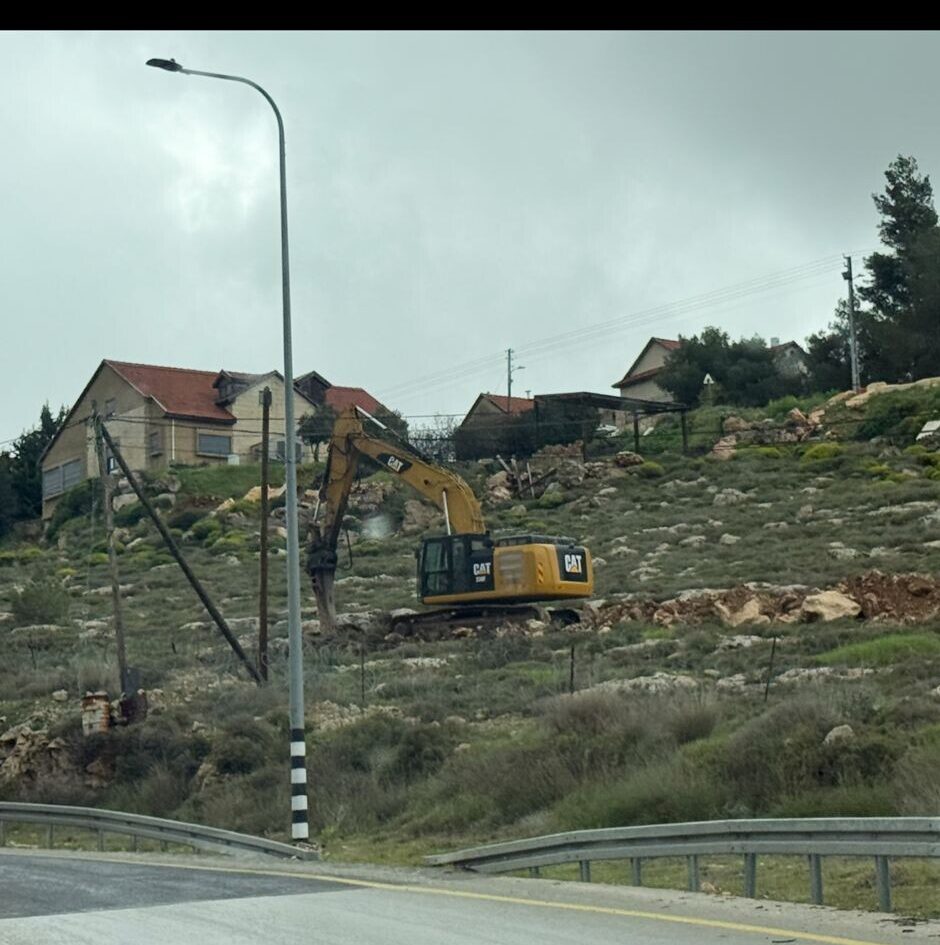 MuhammadFeb-24-2026South Hebron Hill, Beit Hagai: Paving an internal security road
-