
Hebron, Sansana, South Hebron Hills, Tue 7.7.09, Morning
Guest: Josh Briener, 'Walla' reporter
Sansana:
all workers have passed through already by the time we arrive and the last families going for prisoners' visits are being checked up (five busses). The sand tracks works endlessly in their back-to-back method. The parking lot on the Palestinian side is packed.
Road 60
Almost no cars. On the blocked entry-way to Dahariya – many people await taxies.Samo'a: taxies leave and the blockage seems open. The road, previously perfectly-good, is now entirely wrecked – but the taxies pass through anyway and who cares if they suffer any damages – this is only the Palestinians' livelihood.
All pillboxes are manned and gates are open, but big brother keeps watching over. Past Har Manoa'h, some road works have begun.
Hebron
Josh, the Walla reporter, joined us after he read our report of last week, where we mentioned the Palestinian mother's complaint, that Border Police soldiers show pornographic photos to Palestinian boys on their cell phones.
After hearing some more such stories, it turns out that, out of mutual boredom, the soldiers and the Palestinian kids developed a kind of game, whereby they exchange such photos between themselves. The soldiers are always the initiators.
The subject is rather hushed, and people didn't want to discuss it for their own reasons, not necessarily out of fear of the army.
Later on, we stopped at a mother-baby clinic and asked the women there whether the rumors to this effect are grounded – none was willing to comment. Bassem, the grocer, relates the following:
- Two days ago, a white settlers' Jeep stopped by a Palestinian who walked in the street around 9pm. They hit him and he was hospitalized at the Hebron Hospital with a broken rib and several bruises. No complaint was filed at the local police: "what ever for?" was the laconic response to our query.
- A month and a half ago, the soldiers positioned at the House of Dispute harassed a Palestinian girl – the Palestinians complained to Border Police officers and the matter was handled.
- A New brigade of Border Police soldiers has just replaced the old one and the children tell us the new ones are better.
- Water shortage: the pipe leading water to the neighborhood has been shut down very often by the Hebron Municipality – on such occasions, every Palestinian family purchased a water tank, placed next to their house. Those water tanks are supplied by a Palestinian merchant and another, from Kiryat Arba. The Hebron water is cheaper, but the CPs make it difficult for to reach it, and people are forced to purchase water from the Kiryat Arba supplier (much dearer). The neighborhood's representative at the Hebron municipal council can't make them turn the pipe off less often. Opening the CP next to the House of Dispute should help to facilitate those water-tanks way in and out –it is entirely redundant.
- Computer games – next to the grocery, there are four PCs the children play at – "Hero Palestinian policemen "chasing "thieves" in neighborhoods which look like the settlers' and shooting non-stop – the game was designed and is manufactured in Hebron – this is their summer camp.
- Kaphisha Neighborhood CP: the problem with the steel factory's tractor had been resolved – they are now allowed to use it out of their premises as well (perhaps to our credit?)
Curve 60 CP: no detainees to be seen. Border Police soldiers appear bored. Lots children with empty jags and all sort of plastic containers roam the streets, going to buy the special noon-soup.
Pharmacy CP: an old man is disputing something with a soldier there, saying he can't walk through the CP because he has a heart-pacer. We tells the soldier he gets there daily and the soldier, apparently new to the place, believes him and lets him on with no further ado. The soldier tell Josh, the reporter, that he respects every person at the CP, paying no attention to color, race, gender, etc (this is in response to Josh's question, about how he perceives MW).
At the house where the Civilian Admin. has made an opening for the handicapped child to pass through, we meet the owner, who tells us that, during the summer holidays the door is shut, and the keys are with the soldiers at the CP. The fact that the opening is now shut makes it necessary for him to walk for about 2km in order to reach Hebron center. Almost all the shops in the vicinity are shut since 2001, and people can't make their living. Why aren't the transportation routes open? Obama, please: intervene!
This man has heard the rumors about the porn photos cell-phone games – but he will not discuss it. Next to the CP, a police van stops, asking us where we're heading next.The CP under the stairwell to the Cordoba School: the police detained three boys there – as we arrive, all are released. The soldiers at the CP detain a Palestinian man, but we go on and don't take pause, thinking this might hasten his release.
Tarpat CP: no detainees. The children walk around.
Tel Rumeida CP: shifts change. No detainees. Uphill, in the neighborhood next the HABAD cemetery, we stop the transit and approach some Palestinian families, to talk to them. We also visit the roof top held by IDF soldiers at nights – there are sleeping bags, graffiti on the walls, and the Palestinians tell us that the soldiers go up there every night, making quite a noise. On top of that house, a camera is set. A 15yrs old girl tells us that each passage at the CP entails the soldiers' comments, but that she doesn't pay attention anymore. While we are there, talking to the locals, a group of soldiers – five in all – arrives with the Palestinian who was detained earlier, next to the Cordoba school, leading them to several places. The other Palestinians tell us he must be an informer, but they don't know him. We're afraid for him, and later see him with the soldiers a bit further below. It turns out he's not from Hebron, but Yatta and the soldiers asked him to show them how he reached the H2 area – have we mentioned freedom of movement lately? In any case, an informer he's not.
The soldiers are very hostile towards us and ask for M., our driver's ID. Josh talked to them at length.
Patriarchs' Tombs' Cave CPs: Border Police soldiers positioned there have detained two Palestinians and requested, in addition to their routine ID check, also their cigarette boxes and the nylon bags they had. In response to our query, we were told that they were searching for drugs and, being Border Police soldiers they're also policemen and hence, allowed to carry out such searches.
We've met an agent from Beit Sahuor accompanied by a Japanese tourist, who arrived from England and he told us the following story about Shadma, in southern Gush Etzion – formerly a military base, currently evacuated and recognized as zone B. The Palestinians, together with the EU, would like to build there an orthopedic hospital and are awaiting some kind of permit to that purpose. The settlers object, and so, organize some happenings there every Friday in order to claim possession of the territory, backed by the army. Therefore, there are weekly hostilities between settlers and Palestinians there.
That's it about Hebron for today.
Road 356
Much heavier Palestinian traffic. On the military stronghold positioned there, most of the buildings were demolished/removed – only a single pillbox has remains, and the cameras, too, have been dismantled. The Palestinians pave a new way to one of the villages in the vicinity. Finally, they can do so, because the blockage was removed.
At the Ziff grocery, we're told that everything is relatively quiet.
Road 317
A new fence is being built or extended around (the settlement) Carmel, next to the new neighborhood.
Hebron
See all reports for this place-
According to Wye Plantation Accords (1997), Hebron is divided in two: H1 is under Palestinian Authority control, H2 is under Israeli control. In Hebron there are 170,000 Palestinian citizens, 60,000 of them in H2. Between the two areas are permanent checkpoints, manned at all hours, preventing Palestinian movement between them and controlling passage of permit holders such as teachers and schoolchildren. Some 800 Jews live in Avraham Avinu Quarter and Tel Rumeida, on Givat HaAvot and in the wholesale market.
Checkpoints observed in H2:
- Bet Hameriva CP- manned with a pillbox
- Kapisha quarter CP (the northern side of Zion axis) - manned with a pillbox
- The 160 turn CP (the southern side of Zion axis) - manned with a pillbox
- Avraham Avinu quarter - watch station
- The pharmacy CP - checking inside a caravan with a magnometer
- Tarpat (1929) CP - checking inside a caravan with a magnometer
- Tel Rumeida CP - guarding station
- Beit Hadassah CP - guarding station
Three checkpoints around the Tomb of the Patriarchs
 Raya YeorDec-18-2025Hebron - Yusri Jaber and part of his family
-
Meitar checkpoint / Sansana
See all reports for this place-
Meitar Checkpoint / Sansana The checkpoint is located on the Green Line and serves as a border crossing between Israel and the West Bank. It is managed by the Border Crossing Authority of the Defense Ministry. It is comprised of sections for the transfer of goods as well as a vehicle checkpoint (intended for holders of blue identity cards, foreign nationals or diplomats and international organizations). Passing of Palestinians is prohibited, except for those with entry permits to Israel. Palestinians are permitted to cross on foot only. The crossing has a DCO / DCL / DCL / DCL (District Coordination Office), a customs unit, supervision, and a police unit. In the last year, a breach has been opened in the fence, not far from the crossing. This breach is known to all, including the army. There does not appear to be any interest in blocking it, probably as it permits needed Palestinian workers without the bureaucratic permits to get to work in Israel. Food stalls and a parking area economy have been created, but incidents of violent abuse by border police have also been recorded. Updated April 2022
-
South Hebron Hills
See all reports for this place-
South Hebron Hills
South Hebron Hills is a large area in the West Bank's southern part.
Yatta is a major city in this area: right in the border zone between the fertile region of Hebron and its surroundings and the desert of the Hebron Hills. Yatta has about 64,000 inhabitants.
The surrounding villages are called Masafer Yatta (Yatta's daughter villages). Their inhabitants subsist on livestock and agriculture. Agriculture is possible only in small plots, especially near streams. Most of the area consists of rocky terraces.Since the beginning of the 1980s, many settlements have been established on the agricultural land cultivated by the Palestinians in the South Hebron Hills region: Carmel, Maon, Susia, Masadot Yehuda, Othniel, and more. Since the settlements were established and Palestinians cultivation areas have been reduced; the residents of the South Hebron Hills have been suffering from harassment by the settlers. Attempts to evict and demolish houses have continued, along with withholding water and electricity. The military and police usually refrain from intervening in violent incidents between settlers and Palestinians do not enforce the law when it comes to the investigation of extensive violent Jewish settlers. The harassment in the South Hebron Hills includes attacking and attempting to burn residential tents, harassing dogs, harming herds, and preventing access to pastures.
There are several checkpoints in the South Hebron Hills, on Routes 317 and 60. In most of them, no military presence is apparent, but rather an array of pillboxes monitor the villages. Roadblocks are frequently set up according to the settlers and the army's needs. These are located at the Zif Junction, the Dura-al Fawwar crossing, and the Sheep Junction at the southern entrance to Hebron.
Updated April 2022
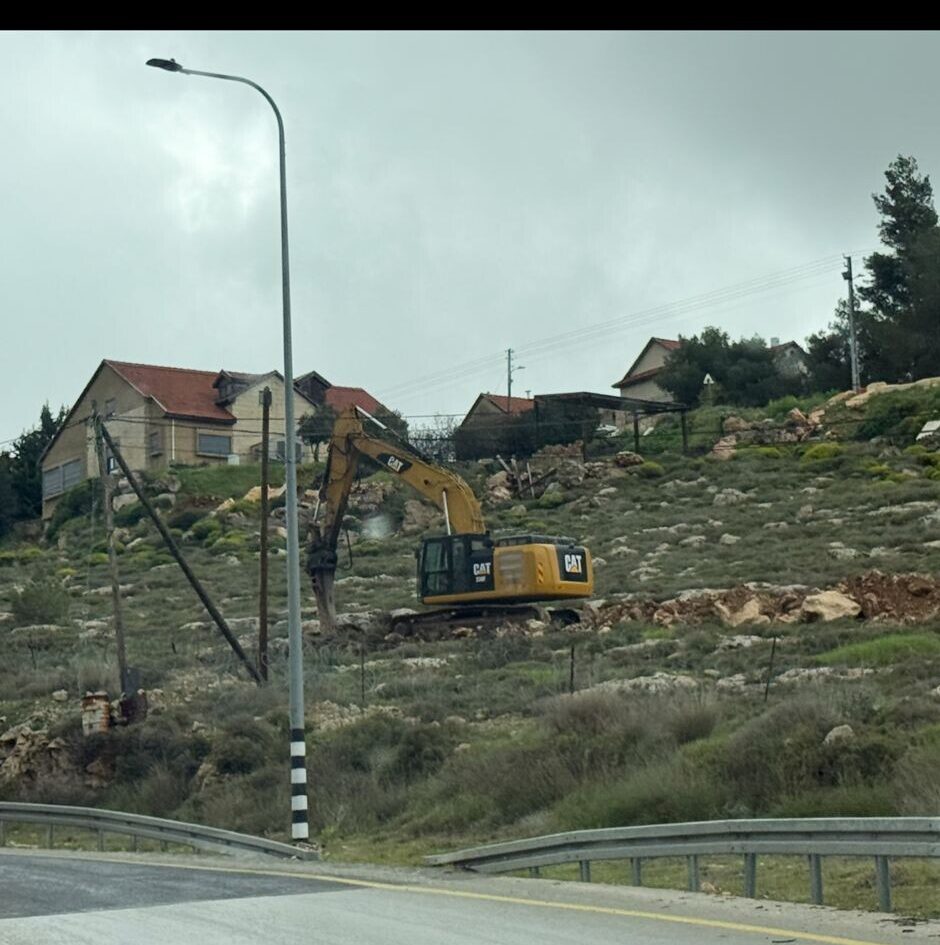 MuhammadFeb-24-2026South Hebron Hill, Beit Hagai: Paving an internal security road
-