
Hebron, Sansana, South Hebron Hills, Tuesday, 27.9.2011, Morning
Translator: Charles K.
Sansana – Meitar crossing
Packed with trucks and private cars on both sides of the checkpoint. A sign of active commerce and many workers.
The shed and the revolving gates are empty. All the laborers already went through. “Normalization.”
Route 317
Almost completely empty. Israeli flags flying defiantly, blatantly, all along the road.
At the turn to Carmel, energetic settlers paste everywhere they can posters reading: “Israeli sovereignty in Judea and Samaria next year.”
There’s “hope” in the air this Rosh HaShana. No one here has any doubts.
Route 60
Many army and other security personnel at the turn to Bani Na’im on the dirt tracks that bypass the road. Soldiers on their way in to the locality.
A Border Police soldier blocks the road. “Closed military area,” he says. A jumpy officer chases us off rudely and demands we erase photos we’ve taken. Hagit demands to see his ID and a document authorizing him to give us such orders. In response he demands her ID, calls someone and gives them her details.
The law has “muscle.” It seems to be very important to him to show who’s in charge here. They’re apparently making a great effort to find the non-Jewish stone throwers.
Jeeps and soldiers at the entrance to Kiryat Arba. The civilian guard cynically asks M., our driver, who’s a fan of Barcelona’s soccer team, and has its pennants hanging permanently in his car: “Isn’t it time to hang the tricolor flag with the triangle instead of Barce’s pennants?” But, as always, he doesn’t prevent us from coming in. “Just great!”
Hebron
There’s now a paratroop battalion in Hebron.
Next to Beit HaMeriva we ran into Osama, who lives on the Worshippers’ Route and as a result the entrance to his home was sealed about a year and a half ago. He says nothing’s changed since then even though “Yesh Din” has tried to help him. Nor does he believe there’s any chance his door will be unsealed. Our friend B., who lives right next to Beit HaMeriva, also shows up. He says the area has been quiet for a long time. A paratroop officer and soldier watch the “traitoresses,” but don’t say anything. All they’ll say to us is that they won’t get leave for the holiday, and they remember that when they were children people expressed to them the hope that when they grew up they’d no longer have to serve in the army. What’s important is that, for now, the army “lives” in this house. The adjoining Moslem cemetery is being renovated, and there are also concrete blocks and concertina wire everywhere. Two elderly women trudge through the obstacles on the road which was once much easier to walk along. They complain how hard it is to get through. And we, as always, say nothing, embarrassed.
In general, what’s most noticeable in this [mixed Arab-Jewish] ghost town [Hebron] are the pedestrians. Old men, women carrying babies and small children can only walk, ascend and descend difficult, steep paths up Shuhada Street toward Tel Rumeida, etc. All so they don’t interfere with the movement of the “lords of the land.” No detainees at any of the checkpoints. Just the usual desperation.
On our way back, near Dahariyya, we met some young people. One of them, who sells sheep, told us that yesterday, on his way to Nablus, near Ma’ale Mikhmash, settlers attacked him, threw rocks, broke windows in his vehicle and beat him. He didn’t try to call for help because, in his experience, the police do nothing when Palestinians are attacked. He simply fled. He was also attacked two months ago near “Shavei Shomron.” Now he shows us the marks on his car from the rocks. He’d already replaced the window. He agrees to notify us immediately the next time it happens so we can help him file a complaint and/or give him the names of our members who deal with that specific region so one of us can assist him. We also suggested that he carry a camera with him and take pictures if he can do so without endangering himself.
Hebron
See all reports for this place-
According to Wye Plantation Accords (1997), Hebron is divided in two: H1 is under Palestinian Authority control, H2 is under Israeli control. In Hebron there are 170,000 Palestinian citizens, 60,000 of them in H2. Between the two areas are permanent checkpoints, manned at all hours, preventing Palestinian movement between them and controlling passage of permit holders such as teachers and schoolchildren. Some 800 Jews live in Avraham Avinu Quarter and Tel Rumeida, on Givat HaAvot and in the wholesale market.
Checkpoints observed in H2:
- Bet Hameriva CP- manned with a pillbox
- Kapisha quarter CP (the northern side of Zion axis) - manned with a pillbox
- The 160 turn CP (the southern side of Zion axis) - manned with a pillbox
- Avraham Avinu quarter - watch station
- The pharmacy CP - checking inside a caravan with a magnometer
- Tarpat (1929) CP - checking inside a caravan with a magnometer
- Tel Rumeida CP - guarding station
- Beit Hadassah CP - guarding station
Three checkpoints around the Tomb of the Patriarchs
 Raya YeorDec-18-2025Hebron - Yusri Jaber and part of his family
-
Meitar checkpoint / Sansana
See all reports for this place-
Meitar Checkpoint / Sansana The checkpoint is located on the Green Line and serves as a border crossing between Israel and the West Bank. It is managed by the Border Crossing Authority of the Defense Ministry. It is comprised of sections for the transfer of goods as well as a vehicle checkpoint (intended for holders of blue identity cards, foreign nationals or diplomats and international organizations). Passing of Palestinians is prohibited, except for those with entry permits to Israel. Palestinians are permitted to cross on foot only. The crossing has a DCO / DCL / DCL / DCL (District Coordination Office), a customs unit, supervision, and a police unit. In the last year, a breach has been opened in the fence, not far from the crossing. This breach is known to all, including the army. There does not appear to be any interest in blocking it, probably as it permits needed Palestinian workers without the bureaucratic permits to get to work in Israel. Food stalls and a parking area economy have been created, but incidents of violent abuse by border police have also been recorded. Updated April 2022
-
South Hebron Hills
See all reports for this place-
South Hebron Hills
South Hebron Hills is a large area in the West Bank's southern part.
Yatta is a major city in this area: right in the border zone between the fertile region of Hebron and its surroundings and the desert of the Hebron Hills. Yatta has about 64,000 inhabitants.
The surrounding villages are called Masafer Yatta (Yatta's daughter villages). Their inhabitants subsist on livestock and agriculture. Agriculture is possible only in small plots, especially near streams. Most of the area consists of rocky terraces.Since the beginning of the 1980s, many settlements have been established on the agricultural land cultivated by the Palestinians in the South Hebron Hills region: Carmel, Maon, Susia, Masadot Yehuda, Othniel, and more. Since the settlements were established and Palestinians cultivation areas have been reduced; the residents of the South Hebron Hills have been suffering from harassment by the settlers. Attempts to evict and demolish houses have continued, along with withholding water and electricity. The military and police usually refrain from intervening in violent incidents between settlers and Palestinians do not enforce the law when it comes to the investigation of extensive violent Jewish settlers. The harassment in the South Hebron Hills includes attacking and attempting to burn residential tents, harassing dogs, harming herds, and preventing access to pastures.
There are several checkpoints in the South Hebron Hills, on Routes 317 and 60. In most of them, no military presence is apparent, but rather an array of pillboxes monitor the villages. Roadblocks are frequently set up according to the settlers and the army's needs. These are located at the Zif Junction, the Dura-al Fawwar crossing, and the Sheep Junction at the southern entrance to Hebron.
Updated April 2022
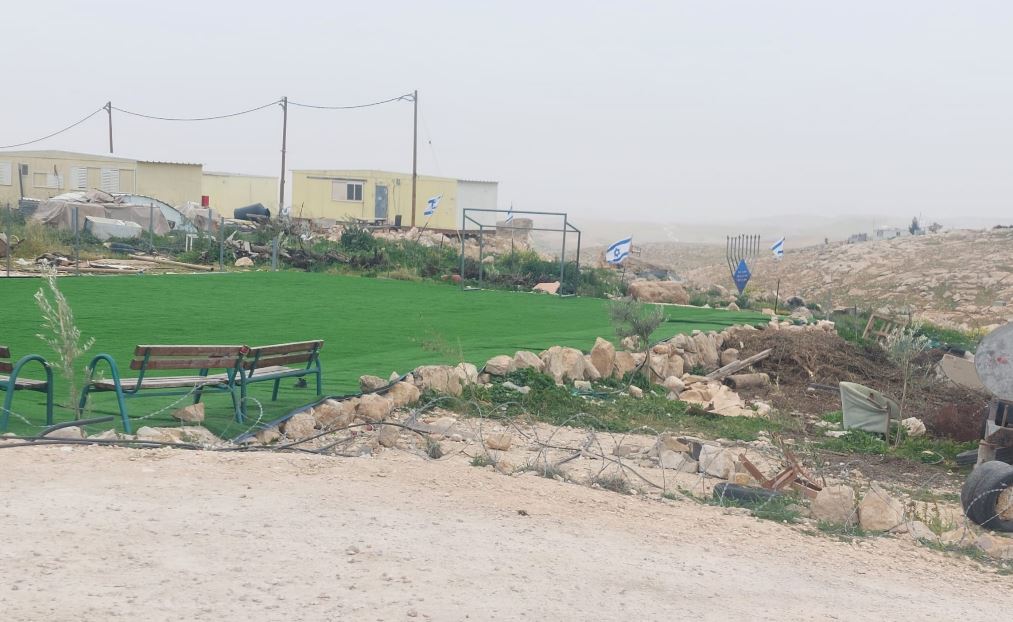 Michal TsadikFeb-17-2026Umm al-Khair: The soccer field for Palestinian children is surrounded by new trailers and lots of Israeli flags
-