
Hebron, Sansana, South Hebron Hills, Wed 10.6.09, Morning
School year is over and we can therefore leave a bit later than normal. We may have been allowed a few extra sleep hours, but there's a price to be paid, too – the streets of Hebron are crowded by settlers now and it appears to be a matter of time before there is a clash between us.
Sansana: 8:15, two Border Police stand at the CP, next to the security men of the civilian company working here, and check those entering the territories (rather than those, exiting, as may have been expected).
Road 60
Entry to Samoa': several rocks were placed here, which now make it necessary for one to zigzag the way in. As we exit, a track stands there, which apparently cannot get through. 
Despite the late hour, road 60 is entirely empty. Along the road, signposts against Obama: Barak Hussein Obama: anti-Semitic Jew-hater (photo attached).
Dahariya: entry is blocked and the residents walk over the impediment by foot, descending to the highway, Road 60, where they wait in hope of getting a lift from cars passing-by.
Dura Elfawwar: open.
Sheeps' Junction: open.
Hebron
On the synagogue on the way in, several signposts announce: "Extend! Do not demolish!" "The Iranian reactor is not in Maz. Barak, attack the right place!"
Curve 160 CP: many Border Police soldiers, seven or eight of them, stand next to the curve, chatting. A youngster wheels a cart with planks on it. He tries to walk through the CP and enter H1 territory. The CP consists of several rocks, interspaced, and a meter-high gate, positioned above some rocks: one can walk through only underneath the 1 meter high gate or, in-between those rocks. The youngster attempts to walk through, only to keep discovering that the cart, with all that's on it, is too high, thus making it impossible for him to pass underneath. He moves from one throughway to another until, at last, he's had enough and he opens the gate out-wide. One would have expected that the soldiers would come running to shut the gate closed behind him – after all, the army claims that it is extremely significant, security-wise. Instead, the soldiers merely watch the youngster and continue chatting. No one takes notice of the open gate for as long as we were there. So what is it there for, anyway???
Patriarchs' Tombs' Cave CP: TIPH vehicle.
Tel Rumeidah CP: the street is empty, no one walks through CP.
Tarpat CP: Empty.
The House of Dispute CP: three detainees, apparently waiting there for some time now. Still, as we arrive, they are released.
Ziff Junction: open.
Hebron
See all reports for this place-
According to Wye Plantation Accords (1997), Hebron is divided in two: H1 is under Palestinian Authority control, H2 is under Israeli control. In Hebron there are 170,000 Palestinian citizens, 60,000 of them in H2. Between the two areas are permanent checkpoints, manned at all hours, preventing Palestinian movement between them and controlling passage of permit holders such as teachers and schoolchildren. Some 800 Jews live in Avraham Avinu Quarter and Tel Rumeida, on Givat HaAvot and in the wholesale market.
Checkpoints observed in H2:
- Bet Hameriva CP- manned with a pillbox
- Kapisha quarter CP (the northern side of Zion axis) - manned with a pillbox
- The 160 turn CP (the southern side of Zion axis) - manned with a pillbox
- Avraham Avinu quarter - watch station
- The pharmacy CP - checking inside a caravan with a magnometer
- Tarpat (1929) CP - checking inside a caravan with a magnometer
- Tel Rumeida CP - guarding station
- Beit Hadassah CP - guarding station
Three checkpoints around the Tomb of the Patriarchs
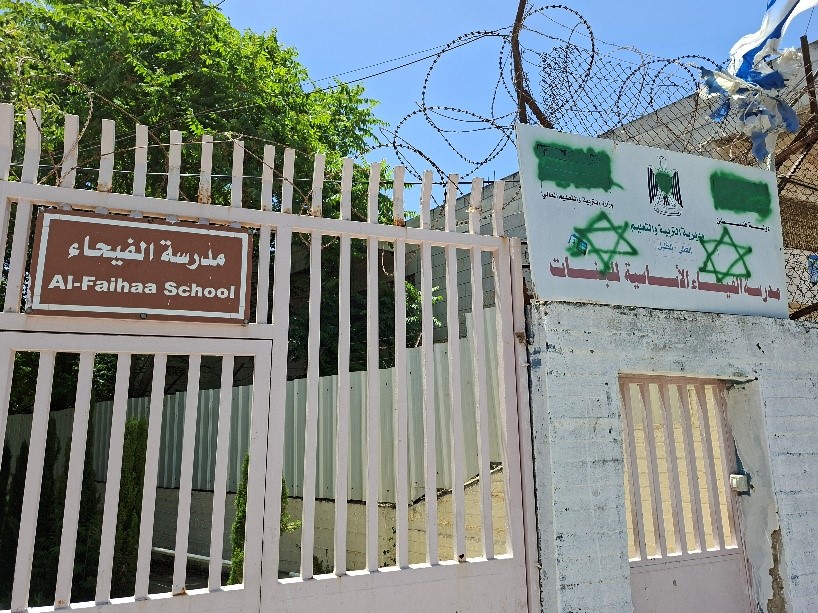 Lea ShakdielMay-27-2025Hebron, settlers vandalized the sign of the girls' school
-
Meitar checkpoint / Sansana
See all reports for this place-
Meitar Checkpoint / Sansana The checkpoint is located on the Green Line and serves as a border crossing between Israel and the West Bank. It is managed by the Border Crossing Authority of the Defense Ministry. It is comprised of sections for the transfer of goods as well as a vehicle checkpoint (intended for holders of blue identity cards, foreign nationals or diplomats and international organizations). Passing of Palestinians is prohibited, except for those with entry permits to Israel. Palestinians are permitted to cross on foot only. The crossing has a DCO / DCL / DCL / DCL (District Coordination Office), a customs unit, supervision, and a police unit. In the last year, a breach has been opened in the fence, not far from the crossing. This breach is known to all, including the army. There does not appear to be any interest in blocking it, probably as it permits needed Palestinian workers without the bureaucratic permits to get to work in Israel. Food stalls and a parking area economy have been created, but incidents of violent abuse by border police have also been recorded. Updated April 2022
-
South Hebron Hills
See all reports for this place-
South Hebron Hills
South Hebron Hills is a large area in the West Bank's southern part.
Yatta is a major city in this area: right in the border zone between the fertile region of Hebron and its surroundings and the desert of the Hebron Hills. Yatta has about 64,000 inhabitants.
The surrounding villages are called Masafer Yatta (Yatta's daughter villages). Their inhabitants subsist on livestock and agriculture. Agriculture is possible only in small plots, especially near streams. Most of the area consists of rocky terraces.Since the beginning of the 1980s, many settlements have been established on the agricultural land cultivated by the Palestinians in the South Hebron Hills region: Carmel, Maon, Susia, Masadot Yehuda, Othniel, and more. Since the settlements were established and Palestinians cultivation areas have been reduced; the residents of the South Hebron Hills have been suffering from harassment by the settlers. Attempts to evict and demolish houses have continued, along with withholding water and electricity. The military and police usually refrain from intervening in violent incidents between settlers and Palestinians do not enforce the law when it comes to the investigation of extensive violent Jewish settlers. The harassment in the South Hebron Hills includes attacking and attempting to burn residential tents, harassing dogs, harming herds, and preventing access to pastures.
There are several checkpoints in the South Hebron Hills, on Routes 317 and 60. In most of them, no military presence is apparent, but rather an array of pillboxes monitor the villages. Roadblocks are frequently set up according to the settlers and the army's needs. These are located at the Zif Junction, the Dura-al Fawwar crossing, and the Sheep Junction at the southern entrance to Hebron.
Updated April 2022
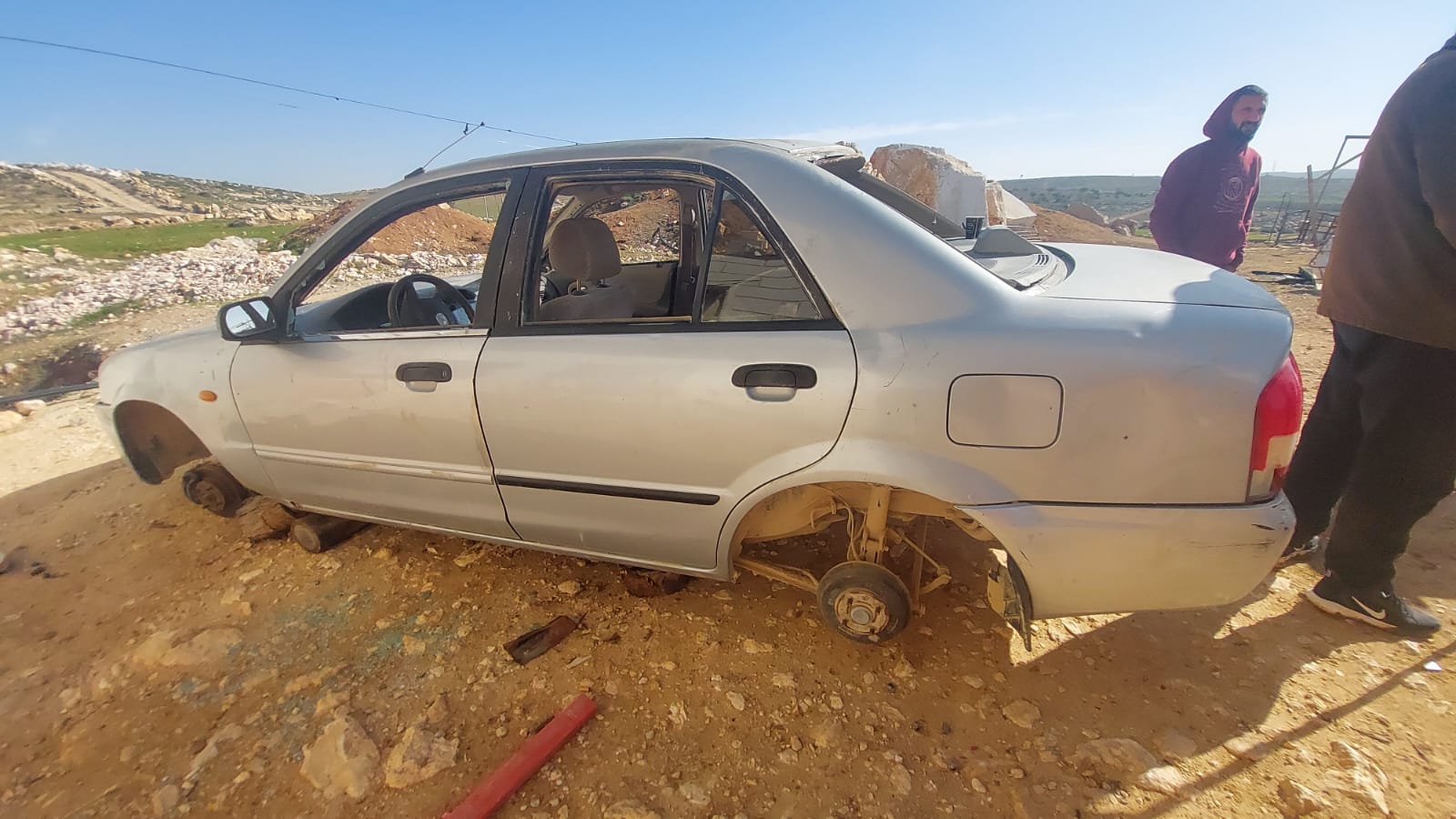 Michal TsadikDec-23-2025Wadi Shahish - The family car vandalized by settlers
-